
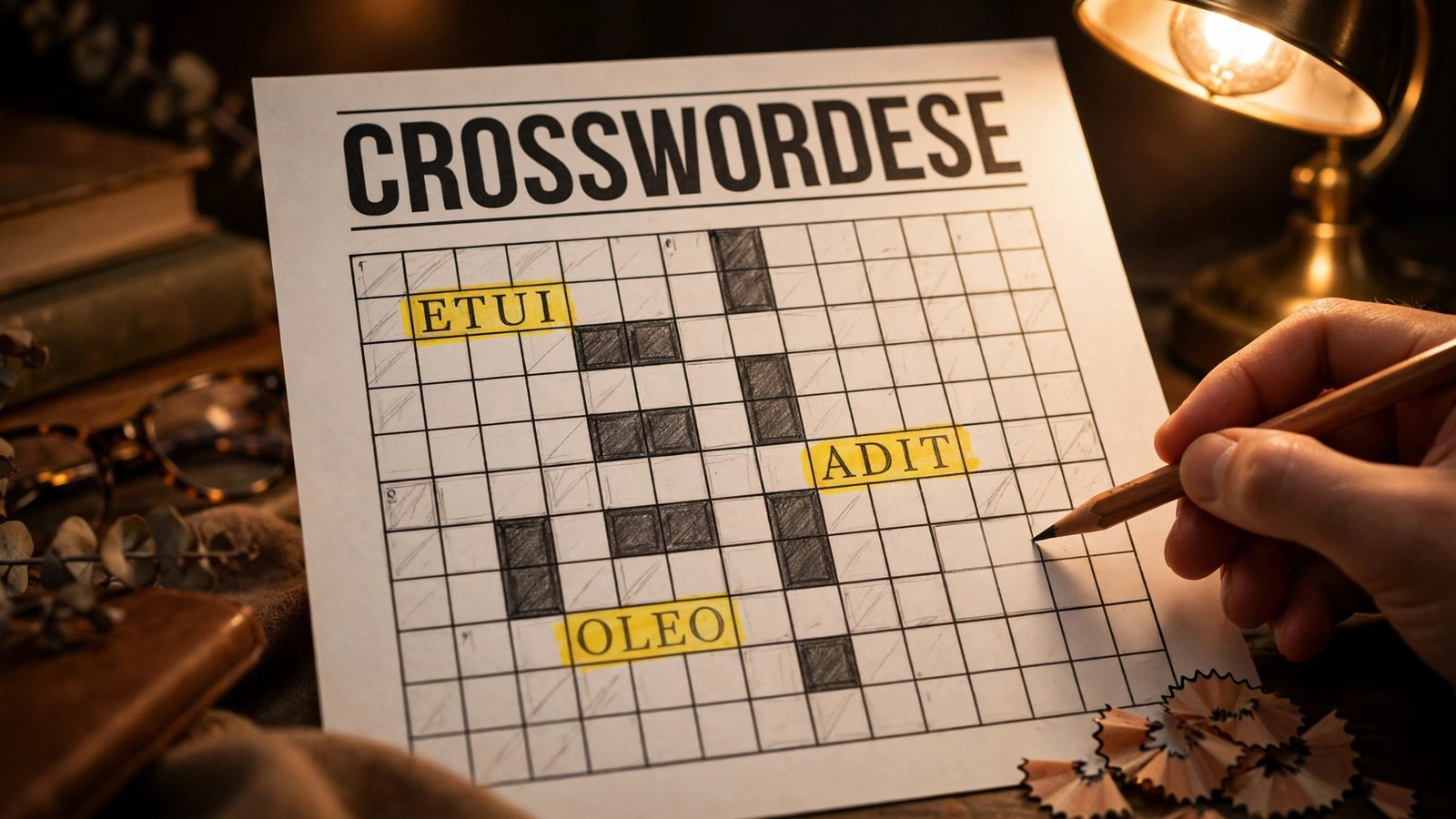

Crosswordese is the unofficial language of crossword puzzles — the strange, recurring words like ETUI, ADIT, OLEO, and ERNE that show up in grids far more often than they ever appear in real life.
Why Does Crosswordese Exist?
Crossword grids are ruthless engineering problems. Every answer must interlock with its neighbors, and short answers — three and four letters — are the glue holding the whole structure together. Constructors need short words packed with common letters (especially vowels) that can fit anywhere, and natural English simply doesn’t have enough of them. So puzzles recycle a small set of obscure-but-legal words again and again: ETUI (a small sewing case), ADIT (a mine entrance), OLEO (margarine), ERNE (a sea eagle), EPEE (a fencing sword). These words are “crosswordese” — fluent in crosswords, nearly extinct everywhere else.
The NYT has its own dialect of crosswordese, and regular solvers learn to speak it. Words like ETUI appear so often that veteran solvers fill them in without even reading the clue — “small sewing case” might as well say “free letters.” Wikipedia even maintains an article on crosswordese, which tells you how established the concept is. Far from being a flaw, crosswordese is part of the game’s charm: it’s a shared vocabulary between constructors and solvers, a secret handshake you learn by playing.
Solving Tip: Learn the Usual Suspects First
You don’t need to memorize a dictionary of crosswordese — you need about thirty words. Start with the vowel-heavy short ones that appear constantly: ETUI, ADIT, OLEO, ERNE, EPEE, ANOA, OLIO, AGORA. Every time one appears in a puzzle you solve, it gets easier, because crosswordese is designed to be recognizable — constructors reuse the same small set precisely so solvers can learn it.
When you hit an unfamiliar short answer, guess crosswordese before guessing anything exotic. If the clue is “Mine entrance” and you have A _ _ T, the answer is almost certainly ADIT, not some word you’d actually say. And pay attention to the clue phrasing — crosswordese words get clued the same way nearly every time (“Small sewing case” is always ETUI), so the clue itself becomes the giveaway.
Frequently Asked Questions
What is crosswordese?
The set of obscure words that appear in crossword puzzles far more often than in everyday language — short, vowel-rich words like ETUI, ADIT, and OLEO that constructors reuse to make grids work.
What are the most common crosswordese words in the NYT Crossword?
ETUI (small sewing case), ADIT (mine entrance), OLEO (margarine), ERNE (sea eagle), EPEE (fencing sword), ANOA (small buffalo), OLIO (mixture), and AGORA (marketplace) are the classics.
Why do crosswords use such weird words?
Grid construction demands short answers full of common letters that interlock in many positions. Ordinary English doesn’t supply enough of them, so constructors lean on a recycled set of legal-but-obscure words.
How can beginners learn crosswordese?
Solve regularly and keep a running list of unfamiliar short answers — you’ll notice the same 30 or so words cycling through. Within a few weeks of daily solving, ETUI and ADIT will feel like old friends.