
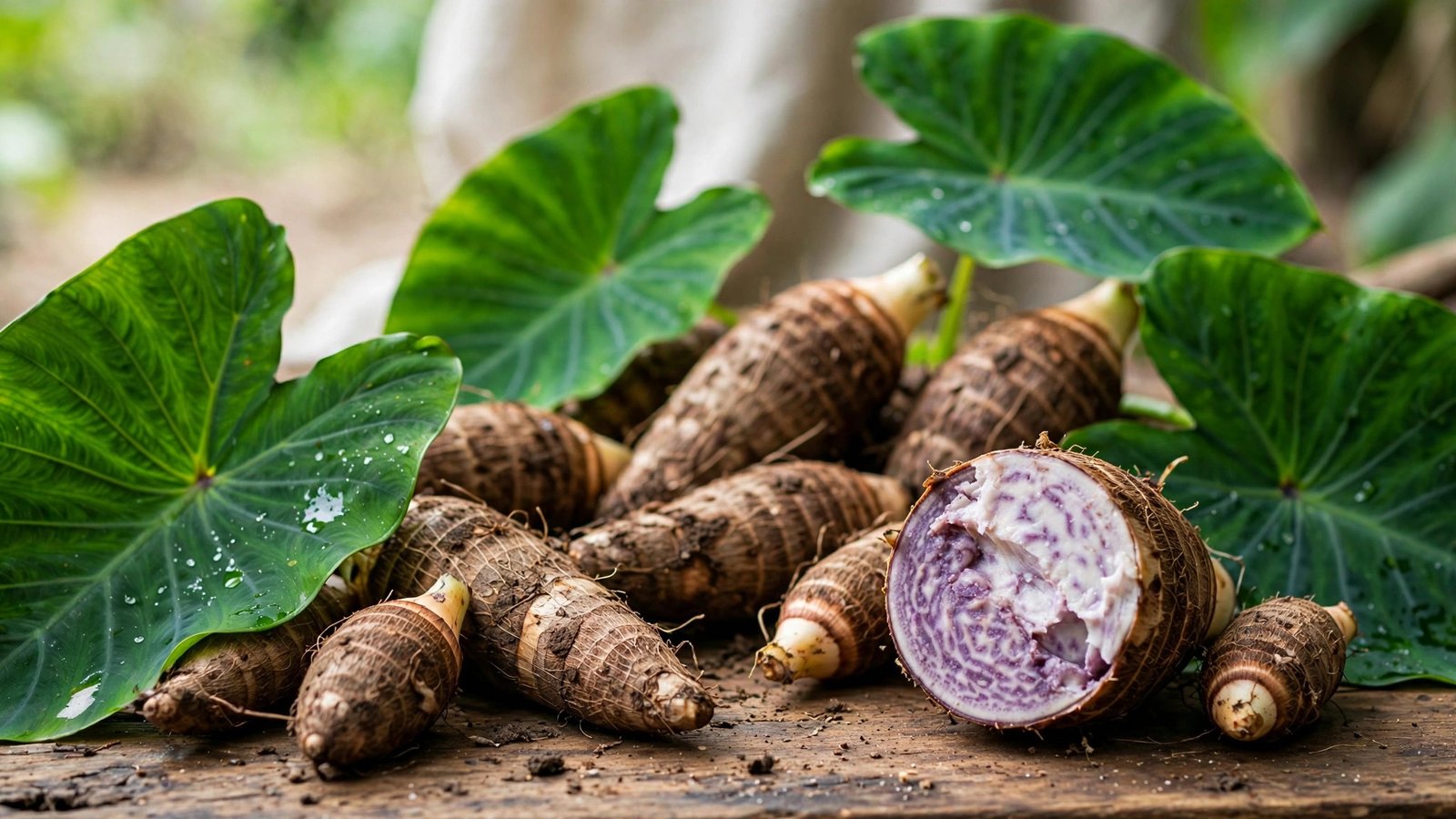

You’ve probably eaten it without knowing its name. It’s the purple-gray paste in your taro bubble tea, the crispy chip in that Hawaiian snack mix, the starchy side dish at a luau. And if your NYT crossword asks for the “Poi plant” in four letters, the answer is TARO — the tropical root behind one of the world’s oldest cultivated foods. Here’s the journey from your bowl to the crossword grid.
From Your Bowl to the Grid: Poi, Bubble Tea, and Taro Chips
Let’s start with the dish in the clue. Poi is the traditional staple of Native Hawaiian cuisine: cooked taro root, pounded with water into a smooth, slightly sticky paste. It’s an acquired taste for some — mildly sour when fermented, subtly sweet when fresh — but it has sustained Hawaiians for over a thousand years, and it remains the centerpiece of the luau table, served alongside kalua pig and lomi salmon.
But taro’s modern fame goes far beyond poi. That lavender-hued taro bubble tea (boba) lighting up café menus? Taro powder or mashed taro blended with milk and tea. Those crunchy taro chips in the snack aisle? Thin-sliced, fried taro root. In Filipino cuisine, taro (called gabi) thickens stews and fills sweet desserts like laing and ginataan. In West Africa and the Caribbean, it’s known as dasheen or cocoyam, boiled and mashed like potatoes. Across the Pacific and Asia, taro is what the potato is to Ireland or rice is to Japan: the foundational starch everything else is built on.
One safety note worth knowing: raw taro is inedible — even irritating to the skin and mouth — because of needle-like calcium oxalate crystals. Cooking destroys them completely. Every culture that eats taro figured this out millennia ago, which tells you just how ancient this food relationship is.
The Plant Behind the Plate: Taro Botany
The taro plant (Colocasia esculenta) is a showstopper even before you dig it up. It grows enormous, heart-shaped leaves — glossy, vivid green, sometimes two feet across — on long stalks rising from a central corm. Ornamental gardeners in temperate climates grow it purely for those dramatic leaves, under names like “elephant’s ear” — a phrase you’ll also see in crossword clues.
Underground is where the food is. The corm (often called the root, though botanists are picky about the distinction) is a starchy, tuberous mass, brown and hairy on the outside, white to pale purple inside. A single plant can produce a central corm plus smaller side cormels, each one a meal. Taro thrives in wet conditions — traditional Hawaiian lo’i are flooded terraces, essentially taro paddies — which is why it’s sometimes called a plant “grown in field pond” in cryptic-style clues.
Archaeologists believe taro was one of the very first plants ever domesticated, cultivated in New Guinea perhaps 7,000–10,000 years ago — older than wheat farming in some regions. Polynesian voyagers carried it across the Pacific in their canoes as a “canoe plant,” one of the essential species needed to found a new settlement. When you eat poi, you’re tasting one of humanity’s oldest agricultural partnerships.
Taro Around the World: One Root, Many Names
Part of what makes taro fascinating is how many cultures independently built cuisines around it. A quick world tour:
- Hawaii: kalo — pounded into poi; also baked as kulolo (a coconut-taro pudding)
- Philippines: gabi — in sinigang (sour soup) and laing (coconut-milk taro leaves)
- China: yu tou — braised with pork, or mashed into sweet taro balls for dessert
- West Africa & Caribbean: dasheen / cocoyam — boiled, fried, or pounded into fufu
- Egypt & Levant: qolqas — simmered in garlicky broth
- Samoa & Tonga: talo — baked in earth ovens, the center of the feast
This global footprint is exactly why the NYT loves the word: it’s a compact, internationally flavored answer with a rich clue history.
TARO’s Crossword Life: A Four-Letter Favorite
At four letters, TARO is prime grid real estate — and its A-O vowel pair plus the friendly consonants T and R make it a constructor’s friend. It shows up constantly in the NYT and across American puzzles, usually clued through its Hawaiian connection. It’s textbook crosswordese: a word most solvers meet in puzzles long before they meet it on a menu.
The clue family is remarkably stable. Once you’ve seen “Poi plant” a few times, you’ll recognize every variation instantly.
Dated Appearances: TARO in the NYT Crossword
- “Poi plant” — NYT, November 10, 2014
- “Poi plant” — NYT, March 26, 2001
- “Root used for poi” — NYT, December 22, 2008
- “Poi plants” — NYT, February 10, 2019 (answer: TAROS)
- “What poi is made from” — NYT (undated archive listing)
- “Root used in making poi” — NYT (undated archive listing)
Every Clue That Points to TARO
- “Poi plant” / “Poi source” / “Poi base” / “Poi ingredient” / “Poi root”
- “Root used for poi” / “Root used in making poi” / “What poi is made from”
- “Hawaiian tuber” / “Hawaiian root” / “Hawaiian staple” / “Hawaiian crop”
- “Tropical root” / “Tropical tuber” / “Tropical food staple” / “South Seas staple”
- “Elephant’s-ear” (the ornamental leaf name)
- “Plant with an edible root” / “Starchy tropical root”
- “Member of the arum family” (its botanical family)
- “Poi, essentially” (a cheeky definitional clue)
Watch the plurals: TAROS (“Poi plants”) adds an S, and some puzzles use EDDO or DASHEEN for related clues — but for the classic “Poi plant” wording, TARO is the answer essentially every time.
Solver Tips: Digging Up the Answer
Food clues are some of the friendliest in crosswords because they point at concrete things. If you see Hawaii, poi, luau, or “tropical root” with four letters and a T at the front, write in TARO and move on. The crossings will confirm it quickly — A and O are high-frequency letters that tend to resolve from neighboring answers.
Building a mental pantry of these food answers pays off across every puzzle you solve. For more short, high-frequency answers like this one, check our complete guide to crosswordese. Stuck mid-grid? Our free Crossword Solver takes your pattern and known letters and does the digging for you — and the Wordle Solver is there for your daily five-letter fix.
So the next time “Poi plant” stares back at you from the grid, think of flooded Hawaiian terraces, a bowl of fresh poi at a luau, and that purple bubble tea in your hand. Four letters, ten thousand years of agriculture: T-A-R-O.