
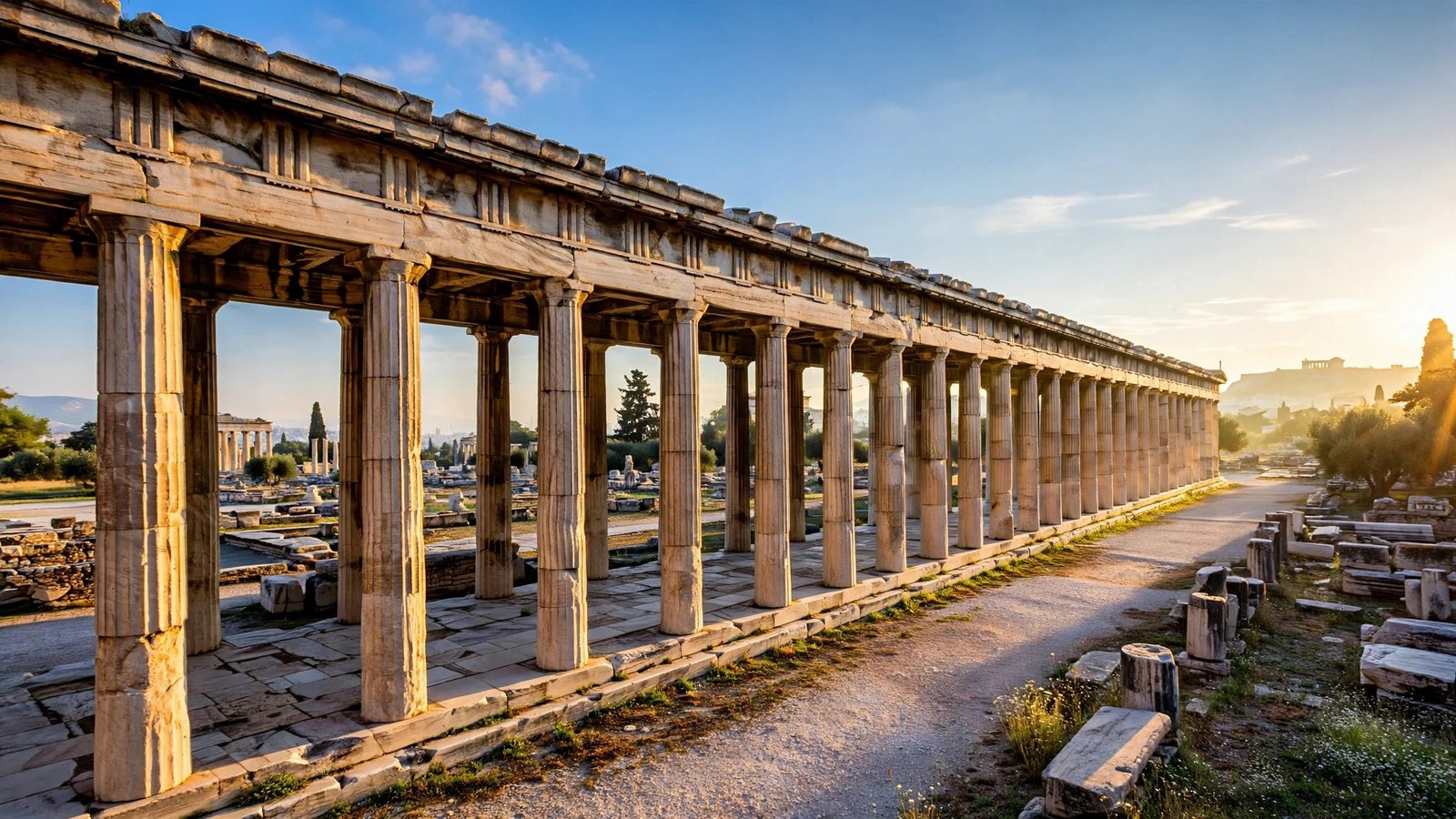

Stuck on a four-letter answer to “Greek colonnade” in your NYT crossword? The answer is STOA — and the story behind it begins not in a puzzle grid, but more than two thousand years ago on a dusty marble terrace in ancient Athens, where philosophers argued, merchants haggled, and ordinary citizens went about their daily lives under the shade of a long stone colonnade.
A Walk Through the Ancient Agora: What a Stoa Actually Was
Picture the Agora of Athens in the fifth century BCE — the bustling civic heart of the world’s first democracy. Along its edges rose long, covered walkways built from rows of stone columns. These were the stoas (the plural of stoa), and they were the shopping malls, office corridors, and town squares of the ancient Greek world, all rolled into one.
A stoa was, at its simplest, a roofed colonnade: a long, narrow building with a row of columns across its open front and a solid wall at the back. Some were single stories; the great ones rose two stories high, with an upper gallery reached by stairs at the ends. They provided shade from the fierce Mediterranean sun and shelter from sudden rain, and Athenians filled them with life. Painters displayed their work in the Stoa Poikile — the “Painted Stoa” — where panels by great artists depicted famous battles. Magistrates held court in others. In the Stoa Basileios, the king-archon administered his duties.
These buildings were so central to Greek public life that their design spread across the entire Mediterranean world wherever Greek culture reached. The word stoa (στοά) simply means a covered walkway or portico in ancient Greek, but in practice it denoted one of the most characteristic structures of Greek civic architecture — a building type as recognizable as the temple or the theater.
The Stoa of Attalos: Athens’ Greatest Colonnade, Reborn
The most famous stoa of them all is the Stoa of Attalos, which still stands — reconstructed — along the eastern edge of the Athenian Agora today. Built in the second century BCE by King Attalos II of Pergamon, it stretched an enormous 115 meters long and two stories tall, its facade a double row of Doric columns below and Ionic columns above.
When archaeologists of the American School of Classical Studies rebuilt it in the 1950s, they did so with such care that walking through it today feels like stepping into the ancient world: the cool stone, the rhythmic repetition of the columns, the play of light and shadow across the floor. It now houses the Museum of the Ancient Agora, but for nearly four hundred years in antiquity, it was exactly what the dictionary says: a Greek colonnade — shops and offices behind, the life of the city flowing past its columns.
Crossword editors love the Stoa of Attalos specifically. When a clue reads “___ of Attalos” or “Greek colonnade where Zeno taught”, the answer is still STOA — but the clue is tipping its hat to this very building.
The Painted Stoa and the Birth of Stoicism
Here’s the part of the story that makes STOA unforgettable once you know it. Around 300 BCE, a Phoenician merchant-turned-philosopher named Zeno of Citium began lecturing in the Stoa Poikile — the Painted Stoa. His followers became known as Stoics, literally “the people of the stoa,” named not for a doctrine but for the colonnade where they gathered.
Stoicism — the philosophy of accepting what you cannot change and mastering your own judgments — grew from conversations held under a colonnade. When Marcus Aurelius wrote his Meditations, when Seneca penned his letters on the shortness of life, they were heirs of the Stoa. So when you write STOA into your crossword grid, you’re inked into a word that named one of the most influential philosophies in Western history. That’s a lot of weight for four letters to carry.
From Athens to the New York Times: STOA’s Crossword Life
So why does the NYT keep coming back to this word? STOA is what crossword constructors call a workhorse — a short, vowel-rich word that fits neatly into the corners and edges of a grid where longer theme answers can’t reach. With the pattern S-T-O-A, it offers constructor-friendly letter combinations, and the four-letter length makes it endlessly useful as grid filler.
But it’s also a perfect piece of crosswordese: a word that appears in puzzles far more often than it ever appears in ordinary conversation. Nobody says “stoa” at the dinner table, yet regular NYT solvers learn it by heart, the same way they learn OLEO, ERIE, and ADIT.
Dated Appearances: STOA in the NYT Crossword
The word has deep roots in Times puzzles. Here are confirmed sightings:
- “Athenian colonnade” — NYT, April 11, 2016 (30-Down)
- “Ancient Greek colonnade” — NYT, June 16, 2018
- “Ancient Greek colonnade” — NYT, October 16, 2007 (47-Down)
- “Classical colonnade” — NYT, August 6, 1998 (45-Down)
As you can see, the editors have been using essentially the same clue for decades — “Greek colonnade,” “Athenian colonnade,” “Ancient Greek colonnade.” When you see any of these, you can fill in STOA with confidence.
Every Clue That Points to STOA
The NYT and other major puzzles recycle a familiar set of clues for this answer. Watch for:
- “Greek colonnade” / “Athenian colonnade” / “Ancient Greek colonnade” / “Classical colonnade”
- “Portico in Athens” or simply “Portico”
- “Roofed colonnade”
- “___ of Attalos” (referring to the great stoa in the Agora)
- “Site of Zeno’s teaching” or “Where Zeno of Citium lectured”
- “Birthplace of Stoicism” (a trickier, more editorial clue)
- “Painted colonnade of Athens” (the Stoa Poikile)
Note the plural forms too: five letters might mean STOAS (“Greek colonnades”), and occasionally you’ll see STOAE, the Greek-style plural. Check your crossings before committing.
Solver Tips: Never Miss STOA Again
If the clue mentions Greece, Athens, columns, a portico, or Zeno, and you have four letters starting with S and ending with A, stop thinking — it’s STOA. The crossing letters will almost always confirm it: the T and O are common letters that tend to fall into place from neighboring answers.
For more answers like this one, explore our complete guide to crosswordese, where we unpack the ancient words, abbreviations, and odd spellings that crosswords love. And if you’re ever staring at a half-filled grid, our free Crossword Solver can help you work the pattern, while the Wordle Solver keeps your five-letter game sharp.
The next time “Greek colonnade” appears in your puzzle, picture the sunlit columns of the Agora, the merchants and philosophers moving in the shade, and Zeno of Citium holding forth beneath the painted panels. Write in STOA — and enjoy the two thousand years of history packed into four little squares.