
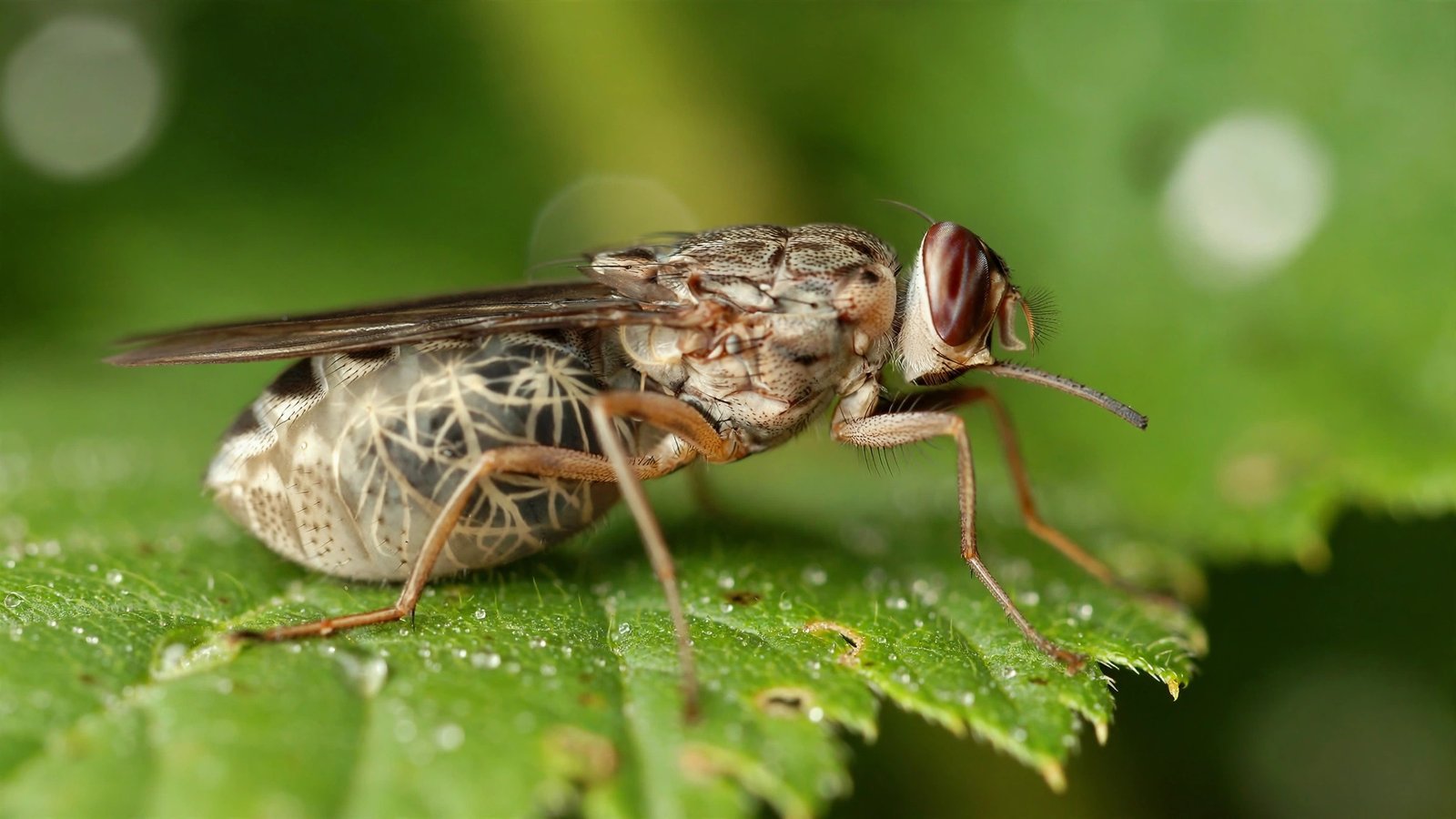

If your NYT crossword asks for the “Sleeping sickness carrier” in six letters, the answer is TSETSE. But before we get to the puzzle, let’s clear something up — because almost everything people think they know about the tsetse fly is slightly wrong. Time for some myth-busting.
Myth #1: The Tsetse Fly Gives You Sleeping Sickness by Biting You
This is the big one, and it’s almost true — which is why it sticks. The tsetse fly doesn’t manufacture sleeping sickness the way a factory makes a product. It transmits it. The actual culprit is a microscopic parasite called Trypanosoma brucei, a single-celled organism that lives in the blood. Here’s the real chain of events:
- A tsetse fly bites an infected human or animal and sucks up blood containing the parasites.
- The parasites multiply inside the fly over several weeks.
- The fly bites a new victim and injects the parasites along with its saliva.
- The parasites invade the victim’s bloodstream, then the central nervous system — causing the disrupted sleep cycles, confusion, and eventual coma that give “sleeping sickness” its name.
So the fly is the vector — the delivery vehicle — not the disease itself. That’s why crossword clues say “carrier,” “transmitter,” or “fly that causes sleeping sickness” rather than anything more direct. The distinction matters to epidemiologists, and it matters to solvers: the clue is describing a role, not an identity.
Myth #2: Tsetse Flies Are Giant, Terrifying Monsters
Thanks to nature documentaries and pulp adventure stories, the tsetse fly has a fearsome reputation. The reality is more mundane: a tsetse fly is roughly the size of a housefly — about 8 to 17 millimeters long. What makes it distinctive isn’t size but anatomy: when at rest, it folds its wings flat over its back like a closed pair of scissors (most flies hold theirs out at an angle), and it has a prominent forward-pointing proboscis it uses to pierce skin and suck blood.
Both males and females feed on blood — unusual among biting flies, where typically only the females bite. And unlike mosquitoes, tsetse flies don’t lay eggs; the female nourishes a single larva inside her body and gives birth to it live, one at a time. For an insect, that’s remarkably mammal-like parenting.
Myth #3: Sleeping Sickness Is a Historical Curiosity
Many people file sleeping sickness (African trypanosomiasis) alongside smallpox and polio — a disease of the past. Not quite. While cases have dropped dramatically thanks to screening and treatment programs — from tens of thousands per year in the 1990s to historically low numbers today — the disease still exists in rural sub-Saharan Africa, and the tsetse fly still ranges across some 10 million square kilometers of the continent.
The fly’s impact goes beyond human disease. Tsetse flies also transmit nagana, a related trypanosome disease that devastates cattle and horses — which is why you’ll sometimes see “Nagana transmitter” as a crossword clue for TSETSE. Across large parts of Africa, the presence of tsetse flies has shaped agriculture, settlement patterns, and economies for centuries. This is not a trivia insect; it’s an ecological force.
Myth #4: “Tsetse” Is Just a Silly-Sounding Made-Up Word
It sounds like a typo that escaped — TSETSE, with its stuttering double-T. But it’s a genuine loanword: it comes from Tswana, a Bantu language spoken in Botswana and South Africa, where tsetse means “fly.” The NYT has clued it exactly this way multiple times: “English word that comes from Tswana” (July 24, 2010), “English word derived from Tswana” (June 13, 2013), and “Word from Tswana” (July 10, 1997).
That etymology is a gift to solvers. When a clue mentions Tswana, Botswana, or an African language origin, and you need six letters with a doubled pattern, TSETSE should jump to mind. Few English words have the T-S-E-T-S-E letter rhythm, which makes it highly recognizable once you’ve seen it.
The Real Tsetse Fly: Facts Worth Knowing
- Scientific name: Glossina spp. — about 30 species, all in sub-Saharan Africa.
- What it spreads: African trypanosomiasis (sleeping sickness) in humans; nagana in livestock.
- How it hunts: attracted to movement, dark colors (especially blue and black), and carbon dioxide — the same cues mosquitoes use.
- Reproduction: females give birth to live larvae, one at a time — extremely unusual for flies.
- Resting pose: wings folded flat over the abdomen, like closed scissors — the field mark entomologists look for.
- Name origin: from the Tswana word for “fly.”
Why TSETSE Loves the NYT Crossword
From a constructor’s perspective, TSETSE is nearly perfect. Six letters with a repeating T-S-E pattern, three vowels, and consonants that cross cleanly — it slots into mid-grid positions where longer theme answers leave gaps. It’s also unmistakable: once a solver knows the word, the unusual letter pattern makes it instantly fillable from just one or two crossings.
And it’s durable crosswordese. The NYT has been cluing this fly for decades, and the clue vocabulary barely changes: sleeping sickness, Tswana origin, African fly, nagana. Learn the word once, and it pays dividends for years.
Dated Appearances: TSETSE in the NYT Crossword
- “Fly that causes sleeping sickness” — NYT, November 15, 2025
- “Creature whose name comes from the Tswana language” — NYT, December 19, 2020
- “English word derived from Tswana” — NYT, June 13, 2013
- “English word that comes from Tswana” — NYT, July 24, 2010
- “Fly that carries sleeping sickness” — NYT, March 24, 2003
- “Word from Tswana” — NYT, July 10, 1997
Notice the two clue families running in parallel across nearly thirty years: the disease angle and the etymology angle. The NYT alternates between them, which means you should be ready for both.
Every Clue That Points to TSETSE
- “Sleeping sickness carrier” / “Carrier of sleeping sickness” / “Fly that carries sleeping sickness”
- “Fly that causes sleeping sickness” / “Creature that transmits sleeping sickness”
- “Sub-Saharan scourge” / “Dangerous fly” / “African fly”
- “English word that comes from Tswana” / “Word from Tswana” / “Tswana for ‘fly'”
- “Creature whose name comes from the Tswana language”
- “Nagana transmitter” (the livestock disease angle)
- “Pest with a repetitive name” (a playful nod to the doubled syllables)
Solver Tips: Swatting This One Down
The doubled T-S-E rhythm is your best friend: TSETSE is one of very few six-letter English words with that internal repetition. If you have T_E_S_ or _S_T_S_ with an Africa- or disease-flavored clue, fill it in with confidence. And remember the two clue families — if the clue mentions Tswana, Botswana, or language origins instead of disease, it’s still the same fly.
For more answers that show up in puzzles far more than in real life, see our complete guide to crosswordese. When a tricky pattern has you stuck, our free Crossword Solver will work it from your known letters — and the Wordle Solver keeps your short-word instincts sharp for the daily five-letter game.
So: not a monster, not a myth — just a housefly-sized insect with an unusual name, a live-birth habit, and a microscopic passenger that changed the history of a continent. Six letters, two myths busted per syllable: T-S-E-T-S-E.