
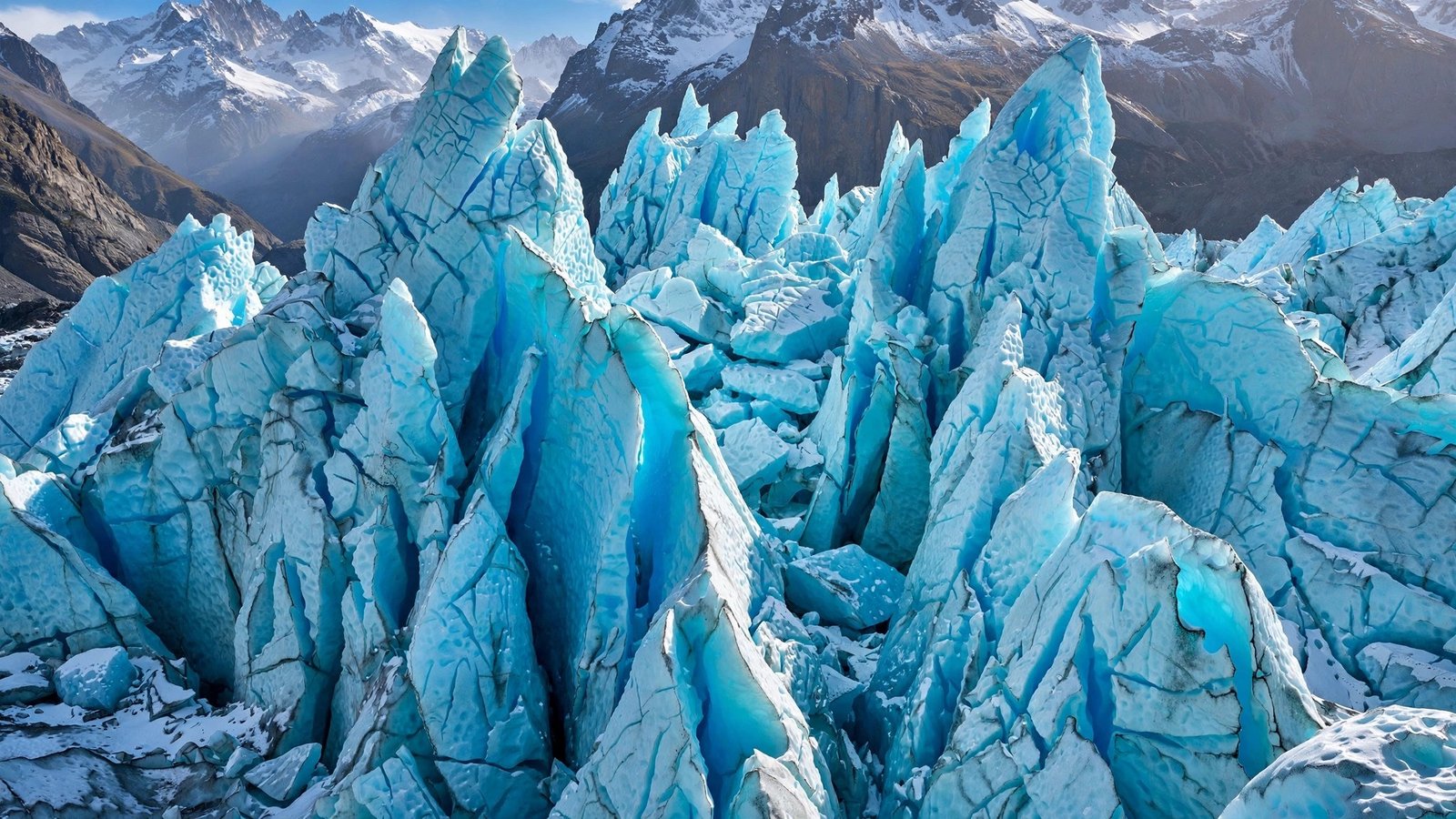

Some crossword answers arrive with fanfare. SERAC arrived with ice axes. The answer to the NYT clue “Glacial ice formation” has been cutting its way through New York Times grids since the 1990s — a five-letter tower of blue ice that constructors keep returning to, decade after decade. This article leads with the paper trail: every dated appearance we can document, then the science of the thing itself, then the tactics that make it an instant solve.
The Paper Trail: SERAC in the NYT, Dated
Here is the documented timeline of “Glacial ice formation” → SERAC in the New York Times:
- April 6, 1997 — The New York Times, Sunday puzzle by Rich Norris. 94-Across: “Glacial ice formation” = SERAC. This is the earliest dated NYT appearance on record, sitting in a Sunday grid alongside answers like FAUVISM and POOLAREA. Twenty-nine years ago, and the clue wording hasn’t changed since — a sign of how stable this answer’s identity is.
- September 10, 2006 — The New York Times. “Glacial ice formation” = SERAC again, 121-Across. Nine years after its debut, the same clue, the same answer, zero drift.
- September 2011 — Universal Crossword (twice). September 11 and September 29, 2011, both used “Glacial ice formation” for SERAC, showing the clue had become the industry-standard phrasing across publishers.
Notice what’s remarkable: nearly three decades, multiple publishers, and the clue barely varies. In crossword history, that kind of stability means the definition is airtight. Editors don’t rewrite what already works.
What Is a Serac? The Science
A serac is a block or tower of glacial ice formed where crevasses intersect. When a glacier flows over a steep drop or around a bend, the ice cracks in multiple directions at once; the chunks left standing between the cracks are seracs — jagged pinnacles that can tower dozens of meters high. The word comes from the French sérac, named for a hard Swiss cheese of the same shape: pale, angular, and crumbly-looking.
Seracs are beautiful and notoriously dangerous. The most famous serac field on Earth is the Khumbu Icefall on Mount Everest, where climbers weave between leaning ice towers that can collapse without warning. Every Everest expedition crosses it, and every account of the mountain describes the blue-white maze in near-religious terms. When the crossword says “glacial ice formation,” this is the thing it means — not a snowflake, not an iceberg, but the fractured architecture of a moving glacier.
The Cheese Connection (Yes, Really)
The etymology deserves its own moment because constructors have noticed it too. Sérac (also sold as Schabziger or Sapsago) is a hard, cone-shaped Swiss cheese made from skimmed cow’s milk and blue fenugreek. Eighteenth-century French glaciologists looked at the ice towers, looked at the cheese, and named the ice after the cheese.
This gives SERAC a second life in crosswords: food-adjacent wordplay. If you ever see a clue about Swiss cheese with five letters and a C, check whether the crosses spell S-E-R-A-C. The glacier and the cheese are the same word wearing different jackets.
Why Constructors Keep Coming Back to SERAC
SERAC is textbook crosswordese: a word most people rarely say aloud, kept alive by the grid. Its construction value is easy to see:
- Five letters, alternating consonants and vowels (S-E-R-A-C) — it crosses cleanly in both directions.
- The terminal C is rare in English and therefore precious; it lets constructors anchor difficult down answers.
- No repeated letters — maximum crossing flexibility.
- Airtight definition — “Glacial ice formation” has meant SERAC since at least 1997, so editors can reuse it without ambiguity.
The clue family around it is equally stable:
- “Glacial ice formation” — the canonical clue (NYT 1997, NYT 2006, Universal 2011)
- “Glacial pinnacle” / “Icy pinnacle” / “Crevasse pinnacle” — the shape clues
- “Glacial mass” / “Glacial ridge” / “Glacial element” — the category clues
- “Block of ice on a glacier” — the plain-English version
- “Polar irregularity” — the cryptic-flavored variant
- “Glacial pinnacle (or backward, troubles)” — the wordplay special: SERAC spelled backward is CARES, a synonym for “troubles”
That last one is a constructor showing off, and it’s worth memorizing: SERAC reversed = CARES. Reversal clues are rare for this answer, but when they appear, they’re instant solves for anyone who knows the trick.
Solver Tactics: Making SERAC Instant
- Lock the pattern. Five letters, starts with S, ends with C, glacier in the clue — there is no other common word. S?R?C with an ice clue is SERAC the way 3-letter inlet is RIA.
- Know the anagrams. SERAC anagrams to CARES and RACES. If the clue has a wordplay indicator, think reversals.
- Think cheese. A five-letter Swiss cheese clue with a C in it deserves a second look.
- Distinguish from lookalikes. “Glacial formation” (without “ice”) has pointed at ARETE (a sharp mountain ridge) in some puzzles; the word “ice” in the clue is SERAC’s fingerprint.
Pattern-matching like this is a trainable skill. Running five-letter patterns through the Wordle Solver builds the same muscle — S?R?C is a fine Wordle line of attack — and the Crossword Solver will confirm SERAC against any letter pattern in seconds.
Frequently Asked Questions
What is the NYT crossword answer for “Glacial ice formation”?
SERAC — a five-letter word for a tower of ice formed by intersecting crevasses on a glacier. The clue appeared with this answer in the New York Times on April 6, 1997 (94-Across, Rich Norris Sunday puzzle) and again on September 10, 2006.
How do you pronounce SERAC?
suh-RAK, with the stress on the second syllable — from the French sérac. The final C is pronounced, unlike in many French loanwords.
What is the difference between a serac and an iceberg?
A serac is a tower of ice still attached to (or freshly broken from) a glacier on land; an iceberg is a chunk of ice floating in open water. Seracs become icebergs only if they calve into the sea.
Is SERAC related to cheese?
Yes — the ice formation is named after sérac, a hard cone-shaped Swiss cheese. The resemblance in shape gave 18th-century glaciologists the name.
The Takeaway
SERAC has been answering “Glacial ice formation” in the New York Times since 1997 — through three decades of editors, constructors, and solving fashions — because nothing else fits the definition so exactly. Learn the timeline, learn the cheese, learn the CARES reversal, and this five-letter ice tower becomes one of the most reliable answers in your grid.
For more answers with this kind of staying power, explore our crosswordese guide, and keep the Crossword Solver handy for the next glacier that crosses your puzzle.