
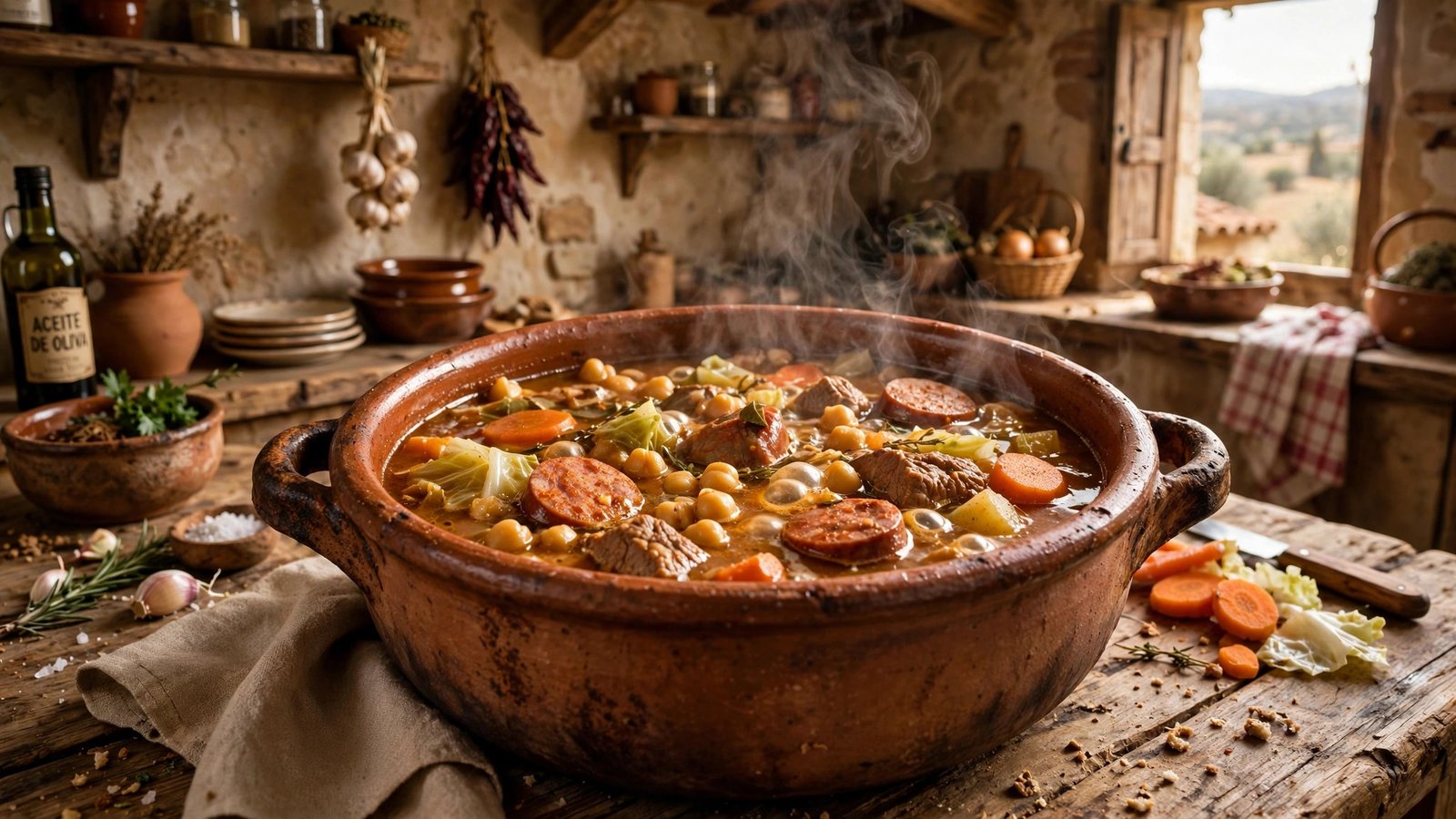

Picture a Spanish farmhouse kitchen: a wide clay pot — an olla — sits over low heat, steam curling up from a broth crowded with chickpeas, chunks of pork, slices of chorizo, cabbage, and carrots. It simmers for hours. Nothing in it matches anything else, and that is precisely the point. This is olla podrida, Spain’s great mixed stew, and its name traveled across languages and centuries to give English one of its most useful words for a jumble: OLIO.
So when the New York Times Crossword clues a four-letter answer as “Hodgepodge,” it is serving you the stew. The answer is OLIO — a word that began in a cooking pot and ended up meaning “mixture” in the dictionary.
The Answer: OLIO
Clue: “Hodgepodge”
Answer: OLIO (4 letters)
This pairing is one of the most durable in the NYT. The Times archive records OLIO again and again under mixture-flavored clues: “Mixed bag” on Tuesday, January 22, 2013; “Bunch of stuff” on Sunday, April 27, 2014; a bare 39-across OLIO on Thursday, March 11, 2010; and archive entries documenting “Conglomeration” and “Grab bag” as NYT clues for the same answer. Different decades, different constructors, same four letters. OLIO is crossword infrastructure.
From Olla to Olio: How a Stew Became a Word for “Mixture”
The journey starts with the pot. Spanish olla means “pot” — specifically the earthenware cooking pot — and olla podrida (literally “rotten pot,” a joking name for a pot left to simmer until everything is gloriously soft) is a stew defined by variety: meats, sausages, legumes, vegetables, whatever the kitchen had. English borrowed the dish’s name as olio, and then did what English always does: it stretched the word.
First it meant the stew itself. Then, by metaphor, it came to mean any mixture or medley — a “hodgepodge” in the culinary sense becoming a hodgepodge in general. By the 1600s the figurative use was established: an olio was a miscellaneous collection, whether of foods, of literary pieces, or of anything thrown together. The stew taught the language a new way to say “a bit of everything.”
From the Kitchen to the Stage: Olio’s Second Career
Here is the detail that makes OLIO more than a food word. In 19th-century theater, an olio was a variety act — a medley of songs, dances, and comic bits performed after the main play, often in front of a painted curtain called an “olio drop.” The metaphor is the same one the stew gave us: a little of this, a little of that, served up together. The word had traveled from the Spanish kitchen to the American vaudeville stage without changing its meaning at all — a mixture, an assortment, a grab bag.
This stage history is why OLIO feels so at home in crosswords. It is not an obscure dictionary fossil; it is a working word with a biography — kitchen, metaphor, theater — and every stop on the journey meant the same thing: a bit of everything.
Why “Hodgepodge” Means OLIO: The Clue Logic
This is a straight synonym clue. Let us break it down the way a solver should:
- “Hodgepodge” means a confused mixture, a jumble of disparate things — which is the dictionary definition of OLIO as “a miscellaneous collection” or “medley.”
- The stew connection confirms it: a hodgepodge is literally what an olio is in the pot.
- Four letters, O_I_ pattern — with an O and an I from crossings, OLIO is nearly automatic.
The clue contains no wordplay and no misdirection. It is a pure vocabulary test: do you know the four-letter word that means “mixture”? If you know the stew story, you will never miss it — and now you do.
OLIO vs. OLEO: Don’t Mix Them Up
Every solver eventually faces this trap. OLIO (the mixture, the stew) and OLEO (margarine, from “oleomargarine”) differ by a single letter and both are crossword regulars. Here is how to keep them straight:
- OLIO ends in IO — think “mixture,” “medley,” “hodgepodge.”
- OLEO ends in EO — think “margarine,” “butter substitute,” “spread.”
- The clue decides: food-spread clues (“Butter substitute,” “Margarine”) want OLEO; mixture clues (“Hodgepodge,” “Melange,” “Miscellany”) want OLIO.
- Memory hook: olIo has an I for “mIxture”; olEo has an E for “sprEad.”
Constructors know solvers confuse these two, which is exactly why the pair keeps appearing. Learn the distinction once and it pays off forever.
Other NYT Clues That Lead to OLIO
The Times rotates through the whole synonym family. Watch for these:
- “Hodgepodge” — the classic straight synonym.
- “Conglomeration” — documented as an NYT clue for OLIO in the Times answer archive.
- “Grab bag” — documented as an NYT clue for OLIO in the Times answer archive.
- “Mixed bag” — NYT, Tuesday, January 22, 2013.
- “Bunch of stuff” — NYT, Sunday, April 27, 2014.
- “Melange” / “Miscellany” / “Medley” — any four-letter mixture synonym is OLIO territory.
Notice how every clue circles the same idea: a collection of different things. If the clue is a noun meaning “assortment” and the slot is four letters starting with O, OLIO is the answer until proven otherwise.
Crossword Tips: Locking In OLIO Fast
OLIO is core crosswordese — vowel-rich (three vowels in four letters: O-I-O), with a rare-ish L that gives constructors useful crossing options. It is one of the words that makes grids work.
- Pattern recognition: any “mixture” synonym in a four-letter slot is OLIO first, OLEO never (OLEO is a spread, not a mixture).
- The O_I_O skeleton: O and I are among the most common crossing letters, so partial fills resolve fast.
- Think stew: if you blank on the definition, picture the clay pot — “a bit of everything” is OLIO.
- Use a solver for the stubborn ones: when the crossings will not cooperate, our Crossword Solver can work from the letters you already have.
For more on why words like OLIO, OLEO, and ELAN dominate grids, see our guide on what crosswordese actually is.
Frequently Asked Questions
What does “Hodgepodge” mean in a crossword?
It means OLIO — a four-letter word for a mixture or medley, borrowed from the Spanish mixed stew of the same name. The NYT has used this clue-and-answer pairing across decades.
Where does the word “olio” come from?
From Spanish olla (“pot”), via olla podrida, a mixed stew of meats, chickpeas, and vegetables. English first used “olio” for the stew, then figuratively for any mixture.
What is the difference between OLIO and OLEO?
OLIO means a mixture or medley (from the Spanish stew). OLEO is short for oleomargarine — margarine, a butter substitute. Mixture clues want OLIO; spread clues want OLEO.
What was an “olio” in vaudeville?
A variety medley — songs, dances, and comic bits performed after the main play, often before a painted “olio drop” curtain. The name used the same “mixture” metaphor as the stew.
The Bottom Line
The next time you see “Hodgepodge” in the New York Times Crossword, picture the clay olla on the fire — chickpeas, chorizo, cabbage, and carrots all bubbling together into something greater than its parts. That pot gave English a word for every mixture, from vaudeville bills to crossword grids. Four letters, centuries of simmering: OLIO. And if word games are your thing beyond the Sunday puzzle, our Wordle Solver is there for the five-letter daily challenge too.