
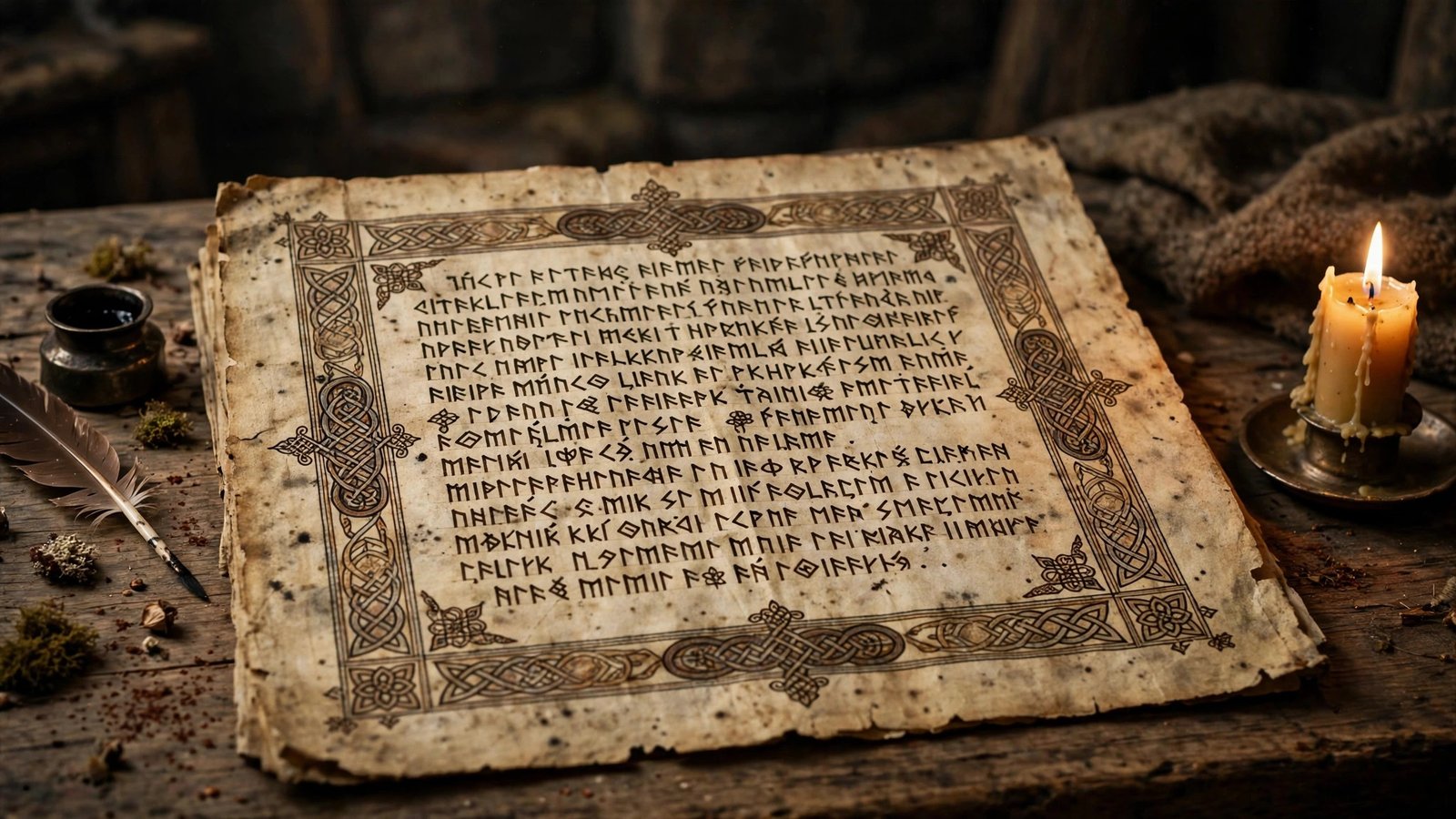

In 1643, a bishop in southern Iceland opened a medieval manuscript and found something astonishing: a collection of ancient poems about Odin, Thor, and the end of the world — poems nobody had read in centuries. The book was called the Codex Regius, and the poems inside it were given a name that still echoes through libraries, concert halls, and crossword grids eight hundred years later: the Edda.
If your clue reads “Norse epic”, the answer is EDDA — but “epic” is selling it short. EDDA is not one book. It is two.
The Answer: EDDA
Clue: “Norse epic”
Answer: EDDA (4 letters)
EDDA is the name shared by the two great medieval Icelandic works that preserve Norse mythology: the Poetic Edda and the Prose Edda. The crossword record is long and clear. Gamerjournalist.com documents “Old Icelandic work” answered as EDDA and last seen in the NYT Crossword on March 13, 2022. The anagrammer.com crossword archive goes further back, recording EDDA in the New York Times on March 8, 2006. And findwords.info’s clue database lists “Norse epic,” “Icelandic classic,” “Norse saga,” and “Inspiration for Wagner’s Ring Cycle” as standard EDDA clues. Four letters, a millennium of mythology, and one of the most dependable literary answers in the puzzle.
Two Works, One Name: Untangling the Eddas
This is the part that trips people up, so let us lay the two works side by side like specimens on a table.
The Poetic Edda (The Elder Edda)
The Poetic Edda is the older stranger of the pair — a collection of anonymous Old Norse poems about gods and heroes, composed between roughly 800 and 1200 AD but not written down until the 13th century. It is the book Bishop Brynjólfur Sveinsson rediscovered in 1643 in the Codex Regius manuscript. Inside are the great mythological poems: Völuspá (the prophecy of the seeress, describing the creation of the world and its fiery end at Ragnarök), Hávamál (the sayings of Odin), and the heroic lays of Sigurd the dragon-slayer. Nobody knows who wrote these poems. They are the closest thing we have to the Vikings’ own voice — raw, strange, and magnificent.
The Prose Edda (The Younger Edda, Snorri’s Edda)
The Prose Edda is the work of one man: Snorri Sturluson, the 13th-century Icelandic chieftain, law-speaker, and historian — arguably Iceland’s greatest literary figure. Written around 1220, it is a handbook of Norse mythology and poetic technique, and Snorri had a practical motive: young Icelandic poets were using kennings (riddle-like metaphors such as “whale-road” for the sea) that referenced myths their audiences were forgetting, so Snorri wrote down the myths to keep the poetry alive. Its centerpiece, the Gylfaginning (“the deluding of Gylfi”), retells the Norse creation story, the adventures of Thor and Loki, and the doom of Ragnarök in vivid prose. Without Snorri, most of what we know about Odin, Thor, and Valhalla would be lost.
Why One Name Covers Both
The word “Edda” itself is a mystery — scholars have linked it to the Old Norse word for “great-grandmother,” to the Latin edo (“I compose poetry”), and to the name of a farm where Snorri lived. What is certain is that when the Codex Regius poems were rediscovered in the 1600s, scholars gave them the same title as Snorri’s already-famous work because the two covered the same mythology. The name stuck, and now “Edda” always means both — which is exactly why crossword clues stay vague. “Norse epic,” “Old Icelandic work,” “Icelandic classic”: any of these could point at either book, and EDDA covers them all.
From Iceland to the Opera House: Wagner’s Ring
The Eddas did not stay in Iceland. In the 19th century, Richard Wagner mined them for his four-opera epic Der Ring des Nibelungen — the Ring Cycle. Siegfried is Sigurd of the Poetic Edda’s heroic lays; the Rhinegold, the cursed ring, the twilight of the gods — all of it flows from Eddic poetry through the German Nibelungenlied and into Wagner’s orchestra pit. That is why crossword databases list “Inspiration for Wagner’s Ring Cycle” and “Source for Wagner’s ‘The Ring of the Nibelung'” as EDDA clues. When you see Wagner in a clue, think Edda — the operas are the great-grandchildren of the poems.
The Clue Decoder: Every Way the Times Asks for EDDA
EDDA’s clue family is a study in elegant vagueness. Constructors rarely name which Edda they mean:
- “Norse epic” — the clue in our title; findwords.info lists it as a standard EDDA clue. Epic, saga, classic — all fair.
- “Old Icelandic work” — the NYT wording documented by gamerjournalist.com, last seen March 13, 2022. Note “old” and “Icelandic” doing all the work.
- “Icelandic classic” / “Old Norse work” — same idea, trimmed.
- “Norse saga” — technically sagas are a different genre, but constructors use the terms interchangeably for a four-letter slot.
- “Work attributed to Snorri Sturluson” — the Prose Edda specifically; Snorri’s name is the giveaway.
- “Icelandic poetry manual” — the Prose Edda again, via its handbook purpose.
- “Inspiration for Wagner’s Ring Cycle” — the opera-house branch of the family.
- “Literature that tells of Ragnarok” — the end-of-the-world branch; both Eddas describe Ragnarök.
The pattern: Iceland + old + literature = EDDA. If a clue contains any two of those three ingredients in four letters, you have your answer.
Crossword Tips: Never Confusing the Eddas Again
- The Iceland test: “Icelandic” in a four-letter literary clue is EDDA the way “sea” in a four-letter bird clue is ERNE. Memorize the pairing.
- Snorri = signal: any mention of Snorri Sturluson, the 13th century, or Old Norse poetry points to EDDA. No other four-letter answer lives in that neighborhood.
- Wagner = shortcut: “Ring Cycle” or “Nibelung” in a clue? The answer traces back to the Eddas. Four letters: EDDA.
- Do not overthink “epic”: solvers sometimes reach for ILIAD or ODYSSEY, but those are five and seven letters. In a four-letter slot, the Norse epic is always EDDA.
- Build the habit: our Crossword Solver cracks the stubborn literary clues, and our crosswordese guide collects the whole canon of repeat literary answers — the Eddas keep good company there.
Frequently Asked Questions
What does “Norse epic” mean in a crossword?
It means EDDA — the name of the two medieval Icelandic works, the Poetic Edda and the Prose Edda, that preserve Norse mythology. Crossword databases list “Norse epic” as a standard EDDA clue.
What is the difference between the Poetic Edda and the Prose Edda?
The Poetic Edda is an anonymous collection of Old Norse mythological and heroic poems (composed 800–1200 AD, written down in the 13th century). The Prose Edda is a 13th-century handbook of mythology and poetics written by the Icelandic chieftain Snorri Sturluson.
Who was Snorri Sturluson?
A 13th-century Icelandic chieftain, law-speaker, and historian, often called Iceland’s greatest literary figure. His Prose Edda (c. 1220) is our single most important source for Norse mythology.
Has the NYT used EDDA recently?
Yes — “Old Icelandic work” was last seen in the NYT Crossword on March 13, 2022 with the answer EDDA (documented by gamerjournalist.com), and the anagrammer.com archive records an EDDA appearance in the Times on March 8, 2006.
What is the Edda’s connection to Wagner?
Richard Wagner drew on Eddic material — via the German Nibelungenlied tradition — for his Ring Cycle operas. Siegfried, the cursed ring, and the twilight of the gods all trace back to stories preserved in the Eddas.
The Bottom Line
Two books, one name, a thousand years of gods and heroes: that is the EDDA. The next time “Norse epic” — or “Old Icelandic work,” or anything with Iceland and antiquity in it — appears in your grid, think of Bishop Brynjólfur opening the Codex Regius in 1643, of Snorri writing by candlelight in the 13th century, of Wagner’s horns in the opera house. Then write in EDDA: four letters that have carried Norse mythology across eight centuries and straight into your crossword. And for the daily five-letter myth of your own, our Wordle Solver stands ready.