
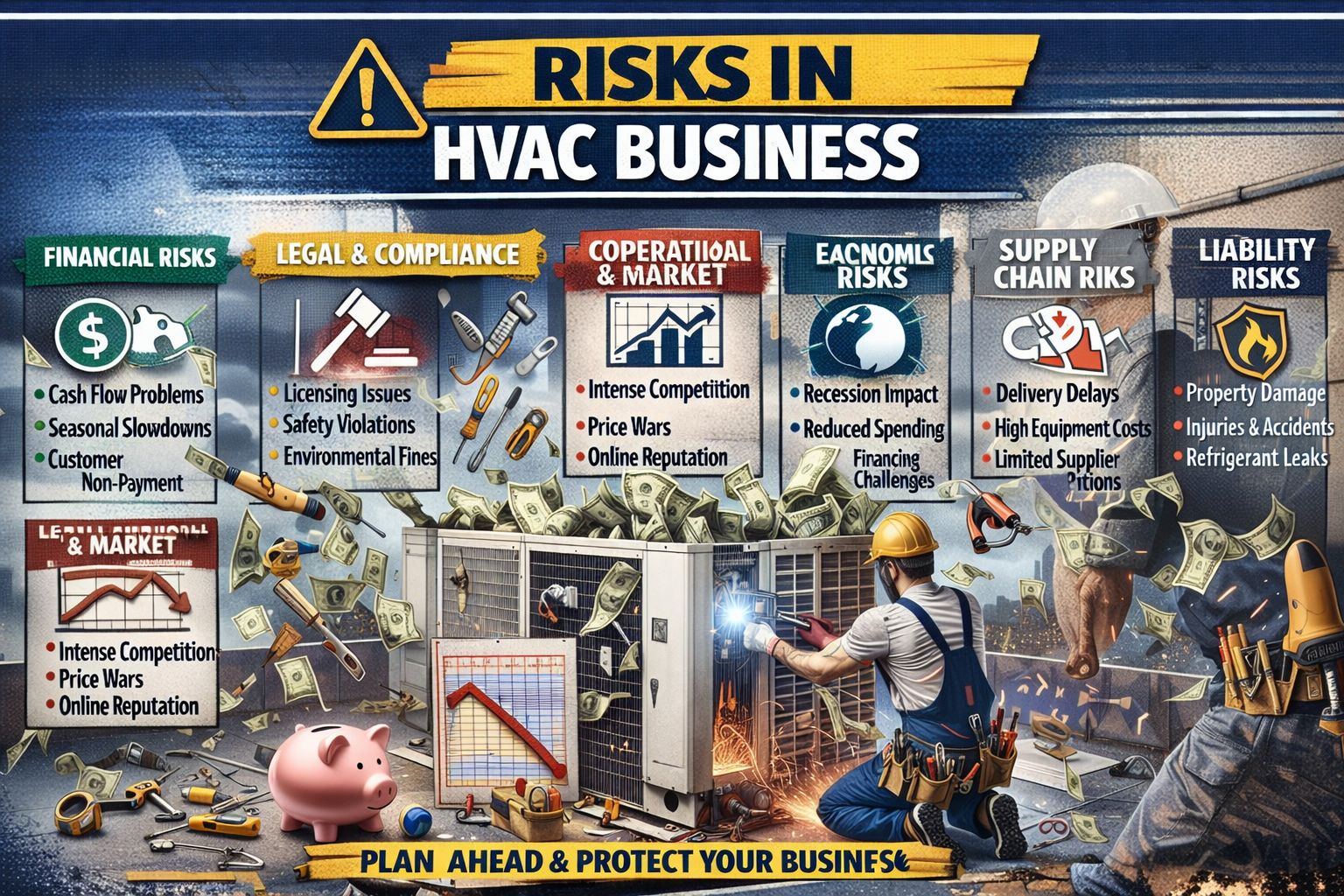

H1: Risks in HVAC Business – A Complete Guide for Owners & Contractors
The risks in HVAC business are often underestimated—especially by beginners entering what appears to be a highly profitable industry. Heating and cooling services are always in demand. After all, every home, office, hospital, and factory needs temperature control.
But behind the steady demand lies a complex web of financial, operational, legal, and safety challenges.
Whether you’re a new HVAC contractor, a growing business owner, or an established professional, understanding these risks is critical for long-term survival and profitability.
In this in-depth guide, we’ll break down:
-
What risks HVAC businesses face
-
Why they happen
-
Real-world examples
-
Financial and legal implications
-
Risk management strategies
-
How to future-proof your HVAC company
Let’s dive in.
What Is the HVAC Business?
HVAC stands for Heating, Ventilation, and Air Conditioning. The HVAC industry covers installation, repair, and maintenance of systems that regulate indoor climate and air quality.
Common systems include:
-
Air conditioners
-
Furnaces
-
Heat pumps
-
Ventilation systems
-
Commercial refrigeration
-
Ductwork systems
The global HVAC market is growing rapidly due to urbanization, climate change, and increasing comfort expectations.
But growth does not eliminate risk.
Major Risks in HVAC Business
Below are the primary risks HVAC companies face today.
1. Financial Risks in HVAC Business
1.1 High Startup Costs
Starting an HVAC business requires significant capital:
| Expense Category | Estimated Cost |
|---|---|
| Tools & Equipment | $10,000–$50,000 |
| Service Vehicles | $20,000–$60,000 |
| Licensing & Permits | Varies by state |
| Insurance | $3,000–$10,000/year |
| Inventory | $5,000–$30,000 |
For beginners, cash flow management becomes a major challenge.
Risk: Running out of working capital before achieving stable monthly revenue.
1.2 Seasonal Revenue Fluctuations
HVAC demand is highly seasonal:
-
Summer: High AC service calls
-
Winter: Heating system repairs
-
Spring/Fall: Slow seasons
If not managed properly, seasonal downturns can:
-
Impact payroll
-
Create cash flow shortages
-
Increase business debt
Mitigation Tip: Offer maintenance contracts and indoor air quality services year-round.
1.3 Customer Non-Payment
Late payments and bad debts are common in service-based businesses.
Risk increases when:
-
Contracts lack clear payment terms
-
Work is done without deposits
-
Commercial clients delay invoices
Best Practice:
-
50% upfront payment policy
-
Signed service agreements
-
Automated invoicing system
2. Legal and Compliance Risks
HVAC companies operate in a highly regulated environment.
2.1 Licensing Issues
Each state or country has different licensing requirements. Failure to comply can lead to:
-
Heavy fines
-
Business shutdown
-
Legal action
For example, contractors working with refrigerants must comply with environmental regulations similar to those governed by the Environmental Protection Agency in the United States.
2.2 Safety Violations
HVAC work involves:
-
Electrical systems
-
Gas lines
-
Heavy equipment
-
Rooftop installations
Workplace injuries can result in:
-
Workers’ compensation claims
-
Lawsuits
-
OSHA penalties
2.3 Environmental Regulations
Refrigerant handling laws are strict due to environmental concerns.
Improper disposal or leaks can:
-
Harm the ozone layer
-
Result in large penalties
-
Damage company reputation
3. Operational Risks in HVAC Business
3.1 Skilled Labor Shortage
The HVAC industry faces a skilled technician shortage globally.
Challenges include:
-
Aging workforce
-
Limited vocational training enrollment
-
High training costs
Impact:
-
Delayed projects
-
Reduced service quality
-
Customer dissatisfaction
3.2 Equipment Failure & Tool Theft
Service vehicles are loaded with expensive equipment.
Common operational risks:
-
Tool theft
-
Vehicle breakdowns
-
Equipment malfunction
One stolen van can cost tens of thousands in losses and missed jobs.
3.3 Poor Quality Installations
Improper installations can result in:
-
System failure
-
Warranty claims
-
Lawsuits
-
Online negative reviews
A single poor installation can destroy years of reputation-building.
4. Market & Competitive Risks
4.1 Intense Competition
The HVAC industry is crowded with:
-
Large franchises
-
Independent contractors
-
Low-cost competitors
Price wars reduce margins.
Many new contractors fail within 3–5 years due to:
-
Underpricing services
-
Poor marketing
-
Lack of differentiation
4.2 Online Reputation Damage
Today, one bad Google review can:
-
Reduce lead generation
-
Impact conversion rates
-
Damage trust
Digital reputation management is now essential.
5. Economic & External Risks
5.1 Economic Recession
During recessions:
-
Customers delay new installations
-
Businesses reduce capital expenses
-
Financing becomes harder
HVAC companies relying heavily on installation projects are especially vulnerable.
5.2 Supply Chain Disruptions
Recent global disruptions have shown how fragile HVAC supply chains can be.
Impacts include:
-
Delayed equipment shipments
-
Increased material costs
-
Lost contracts
6. Insurance and Liability Risks
HVAC contractors face multiple liabilities:
-
Property damage
-
Personal injury
-
Fire hazards
-
Carbon monoxide leaks
Without proper coverage:
-
General liability insurance
-
Workers’ compensation
-
Commercial auto insurance
A single incident could bankrupt a small company.
Risk Breakdown Table
| Risk Type | Severity | Probability | Mitigation |
|---|---|---|---|
| Financial Instability | High | High | Cash flow planning |
| Legal Compliance | High | Medium | Proper licensing |
| Labor Shortage | Medium | High | Training programs |
| Competition | High | High | Strong branding |
| Supply Chain | Medium | Medium | Multiple suppliers |
| Liability | Very High | Medium | Comprehensive insurance |
Advanced Risks for Growing HVAC Companies
1. Rapid Expansion Risks
Growth sounds exciting. But scaling too fast can lead to:
-
Cash flow crisis
-
Poor management
-
Service inconsistency
Many businesses collapse after aggressive expansion.
2. Technology & Cybersecurity Risks
Modern HVAC companies rely on:
-
CRM software
-
Cloud accounting
-
Online payment systems
Cyber attacks can:
-
Expose customer data
-
Freeze operations
-
Lead to legal penalties
3. Pricing Strategy Risks
Underpricing to compete may:
-
Reduce profit margins
-
Devalue services
-
Attract low-quality clients
Smart HVAC businesses price based on value, not competition.
How to Minimize Risks in HVAC Business
1. Build Strong Financial Systems
-
Maintain 3–6 months of operating cash
-
Use accounting software
-
Track job costing
-
Separate business and personal accounts
2. Invest in Training
Regular technician training reduces:
-
Mistakes
-
Accidents
-
Warranty claims
Certifications improve credibility.
3. Diversify Revenue Streams
Offer:
-
Annual maintenance contracts
-
Indoor air quality testing
-
Smart thermostat installations
-
Energy audits
This reduces seasonal dependency.
4. Implement Strong Contracts
Every job should include:
-
Scope of work
-
Payment schedule
-
Warranty terms
-
Liability limitations
5. Prioritize Customer Experience
Satisfied customers:
-
Leave positive reviews
-
Refer new clients
-
Increase lifetime value
Real-World Example
A mid-sized HVAC company expanded to three new cities within one year. Without proper financial planning, they:
-
Overhired staff
-
Purchased excess inventory
-
Took loans for vehicles
When demand slowed, cash flow collapsed.
Lesson: Growth without risk planning is dangerous.
Featured Snippet: What Are the Biggest Risks in HVAC Business?
The biggest risks in HVAC business include financial instability, seasonal revenue fluctuations, legal compliance issues, labor shortages, liability claims, and intense competition. Proper planning, insurance, and diversified services help reduce these risks.
Benefits of Understanding HVAC Business Risks
When you understand industry risks, you can:
-
Improve profitability
-
Reduce legal exposure
-
Increase operational efficiency
-
Build long-term sustainability
-
Protect brand reputation
Risk awareness creates competitive advantage.
FAQs – People Also Ask
1. What are the biggest risks in HVAC business?
The biggest risks include cash flow problems, seasonal demand shifts, legal compliance violations, technician shortages, liability claims, and intense competition.
2. Is HVAC business risky for beginners?
Yes, beginners face higher risk due to high startup costs, limited capital, and lack of industry experience. Proper planning significantly reduces risk.
3. How can HVAC companies reduce financial risk?
-
Maintain emergency funds
-
Offer maintenance contracts
-
Diversify services
-
Use clear payment policies
-
Track job costs carefully
4. What legal risks do HVAC contractors face?
They face licensing violations, safety non-compliance, environmental fines, and liability lawsuits from property damage or system failures.
5. Why do many HVAC businesses fail?
Common reasons include poor cash flow management, underpricing, lack of marketing, rapid expansion, and failure to manage operational risks.
Final Thoughts: Is HVAC Business Worth the Risk?
The risks in HVAC business are real—but manageable.
Every profitable industry carries risk. What separates successful HVAC companies from failed ones is:
-
Financial discipline
-
Legal compliance
-
Strong operations
-
Strategic growth
-
Customer-focused mindset
If you approach the HVAC industry with preparation, proper systems, and long-term vision, the rewards can outweigh the risks significantly.