
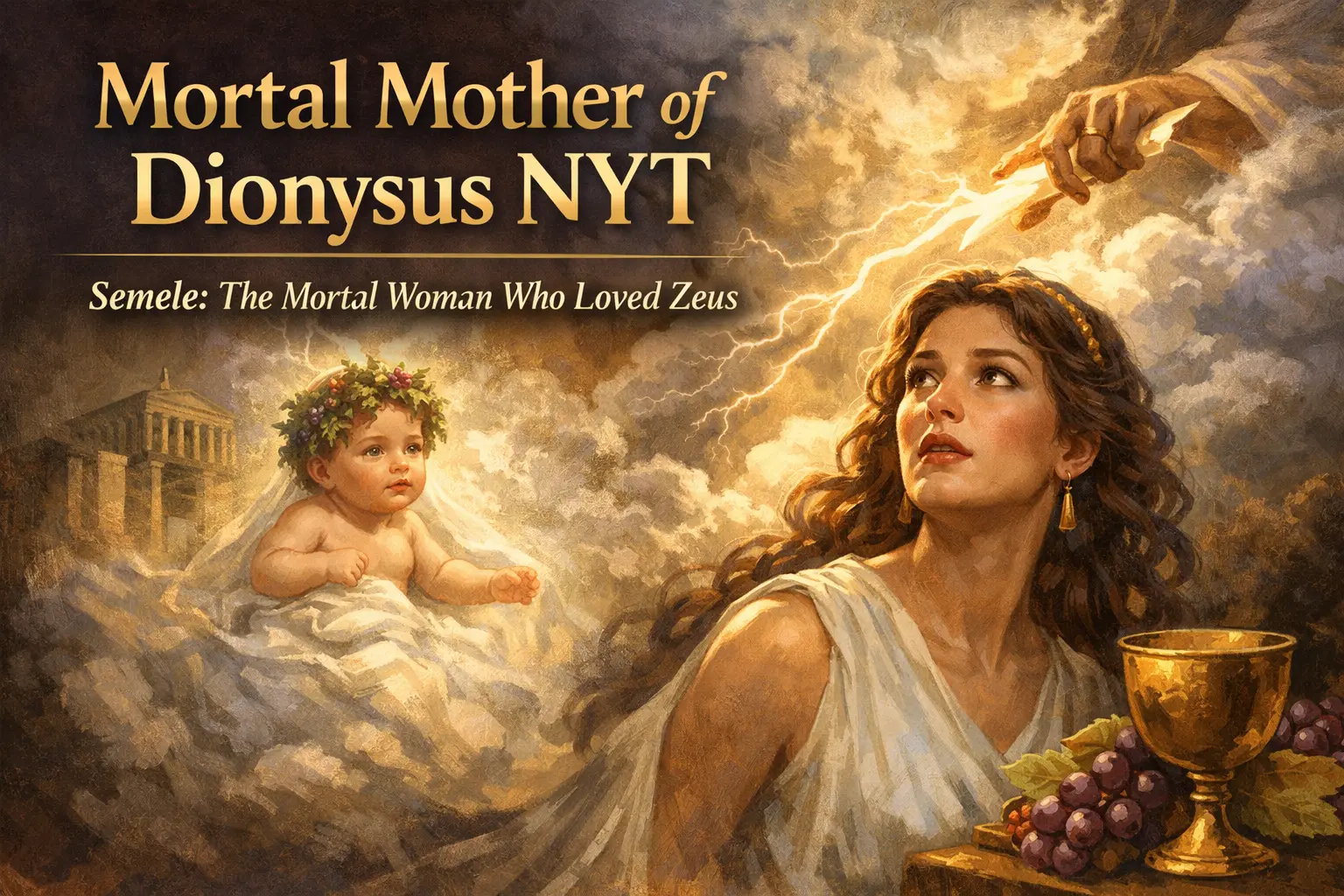

If you’ve come across the clue “mortal mother of Dionysus NYT” in the New York Times crossword, the answer is Semele.
But this simple answer opens the door to one of the most fascinating and symbolic myths in Greek mythology—one that blends mortality, divinity, tragedy, and rebirth.
In this complete guide, we’ll go far beyond the crossword clue. You’ll learn:
- Who Semele was
- Why she matters in mythology
- Her connection to Dionysus
- The deeper meaning behind the myth
- Why this clue appears frequently in puzzles
- And how to remember it forever
Quick Answer (Snippet-Friendly)
Clue: Mortal mother of Dionysus (NYT)
Answer: Semele
- A mortal woman in Greek mythology
- Lover of Zeus
- Mother of Dionysus, the god of wine, festivity, and ecstasy
Who Was Semele?
Semele was a mortal princess of Thebes and one of the many lovers of Zeus, the king of the gods.
Key Facts About Semele
| Attribute | Details |
|---|---|
| Origin | Thebes, Greece |
| Status | Mortal |
| Parents | Cadmus and Harmonia |
| Partner | Zeus |
| Child | Dionysus |
| Fate | Destroyed by Zeus’s divine form |
Unlike many mythological figures, Semele’s story is both deeply human and profoundly symbolic.
The Story of Semele and Dionysus
The Beginning – A Mortal Meets a God
Zeus, ruler of Mount Olympus, fell in love with Semele. He visited her in secret, disguising his divine nature to be with her safely.
Semele became pregnant with his child—who would later become Dionysus.
Hera’s Jealousy
Zeus’s wife, Hera, discovered the affair. Known for her jealousy, she devised a plan to destroy Semele.
Disguising herself as an old woman, Hera planted doubt in Semele’s mind:
- Was her lover really Zeus?
- Or was he deceiving her?
The Fatal Wish
Semele asked Zeus to reveal his true divine form.
Bound by an oath, Zeus had no choice.
When he appeared in his full glory—lightning, thunder, and divine power—Semele, being mortal, could not survive the sight.
She perished instantly.
The Birth of Dionysus
Zeus saved their unborn child by:
- Sewing the fetus into his thigh
- Carrying him until full term
This is why Dionysus is often called:
- “Twice-born”
- A god of dual nature (mortal + divine)
Why Is Semele Important in Greek Mythology?
Semele’s story is not just tragic—it carries deep symbolic meaning.
Themes Represented
1. Mortality vs Divinity
Semele represents the fragile human condition when confronted with divine power.
2. Curiosity and Consequences
Her desire to see Zeus’s true form leads to her downfall—echoing a common mythological theme.
3. Birth and Rebirth
Through her death, Dionysus is reborn, symbolizing transformation and renewal.
Who Is Dionysus?
Dionysus is one of the most unique Olympian gods.
Domains of Dionysus
- Wine and viticulture
- Celebration and festivity
- Theater and drama
- Ecstasy and altered states
Why His Birth Matters
Dionysus’s unusual birth gives him a special identity:
- Part mortal (through Semele)
- Part divine (through Zeus)
This dual nature makes him a god of transformation and boundary-crossing.
Why “Semele” Appears in NYT Crossword Puzzles
The New York Times crossword frequently uses mythological references because they are:
- Short and distinctive names
- Rich in cultural meaning
- Recognizable to educated solvers
Why Semele Is a Popular Clue Answer
- 6 letters (perfect crossword length)
- Unique spelling
- Strong association with Dionysus
- Frequently referenced in literature and art
How to Remember the Answer Easily
Here are simple memory tricks:
Mnemonic
“Semele = She Met Zeus”
- “Se-me-le” → She met Zeus and had his child
Association Trick
Think:
- Dionysus = wine
- Wine = celebration
- Celebration → comes from a dramatic birth → Semele
Comparison: Semele vs Other Mortal Mothers in Mythology
| Figure | Child | Father | Key Theme |
|---|---|---|---|
| Semele | Dionysus | Zeus | Death & rebirth |
| Alcmene | Heracles | Zeus | Strength & heroism |
| Leto | Apollo & Artemis | Zeus | Divine twins |
Semele stands out because:
- Her child becomes a major Olympian
- Her death is directly caused by divine revelation
- Her story explains Dionysus’s unique nature
Symbolism and Deeper Meaning
The Danger of Divine Knowledge
Semele’s fate reflects a powerful idea:
Humans are not meant to fully comprehend divine truth.
Transformation Through Suffering
Her death leads to the birth of a god associated with:
- Joy
- Madness
- Liberation
This paradox makes her myth especially rich and complex.
Use Cases – Why This Topic Matters Today
Understanding Semele isn’t just about mythology—it has modern relevance.
Crossword Solving
- Common NYT clue
- Helps improve puzzle-solving speed
Literature & Art
Semele appears in:
- Classical poetry
- Operas
- Renaissance paintings
Psychology & Symbolism
Her story is often interpreted as:
- The human desire for truth
- The cost of forbidden knowledge
Common Variations of the Clue
You might see the answer “Semele” in different forms:
- Mother of Dionysus
- Zeus’s mortal lover
- Theban princess in myth
- Woman destroyed by divine sight
Benefits of Knowing This Myth
- Improves cultural literacy
- Helps with puzzles and quizzes
- Enhances understanding of Western mythology
- Provides insight into symbolic storytelling
Risks of Misinterpretation
While learning mythology, watch out for:
- Confusing Semele with other figures
- Assuming Dionysus is purely Olympian (he’s unique)
- Overlooking symbolic meanings
FAQs (People Also Ask Style)
Who is the mortal mother of Dionysus?
The mortal mother of Dionysus is Semele, a princess of Thebes and lover of Zeus.
Why did Semele die?
Semele died because she asked Zeus to reveal his true divine form. As a mortal, she could not survive the sight of his full power.
Why is Dionysus called “twice-born”?
Dionysus is called “twice-born” because he was first conceived by Semele and later carried to term by Zeus after her death.
Is Semele a goddess?
No, Semele was originally mortal. However, in some myths, she is later deified and brought to Olympus.
Why is Semele important in crosswords?
Her name is short, distinctive, and tied to a well-known myth, making it a frequent answer in puzzles like the NYT crossword.
Expert Insights
From a mythological perspective, Semele’s story is one of the earliest explorations of:
- Human limitation
- Divine power
- The cost of curiosity
Her narrative structure also influenced later storytelling traditions, especially in tragedy and drama.
Conclusion – Key Takeaways
The answer to the NYT clue “mortal mother of Dionysus” is simple: Semele.
But behind that answer lies a powerful myth that explores:
- The fragile boundary between humans and gods
- The consequences of seeking ultimate truth
- The transformative nature of life, death, and rebirth
Actionable Takeaways
- Remember: Semele = mother of Dionysus
- Use mnemonic tricks to recall quickly in puzzles
- Explore related myths to deepen understanding
- Recognize recurring patterns in mythology and storytelling
By understanding Semele, you’re not just solving a crossword—you’re connecting with one of the most meaningful stories in Greek mythology.