

Introduction: Why This Question Matters More Than Ever
If you’ve been searching “is laundromat still a good business in 2025”, you’re not alone.
With inflation, rising utility costs, automation, and changing consumer habits, many traditional small businesses are struggling. Yet laundromats keep popping up in investor discussions, YouTube case studies, and passive income forums.
So here’s the real question:
Is a laundromat still a smart, profitable, and future-proof business in 2025—or is it an outdated idea surviving on nostalgia?
This guide answers that question honestly.
Whether you’re:
-
A beginner exploring your first business
-
An investor looking for semi-passive income
-
Or a professional entrepreneur evaluating recession-resistant models
You’ll get a clear, data-driven, real-world answer—not hype.
What Is a Laundromat Business?
A laundromat (also called a coin laundry or self-service laundry) is a retail business that provides washing and drying machines for public use.
Core Revenue Streams
-
Self-service washing & drying
-
Wash-and-fold services
-
Commercial laundry contracts
-
Vending machines (detergent, snacks)
-
Pickup & delivery laundry (modern add-on)
Why Laundromats Are Unique
-
Essential service (people always need clean clothes)
-
Cash-flow business (daily income)
-
Low staffing requirements
-
No inventory risk
That’s why laundromats are often labeled as “boring but profitable” businesses.
Is a Laundromat Still a Good Business in 2025? (Short Answer)
Yes—a laundromat is still a good business in 2025, but only if it’s done right.
The industry hasn’t died. It has evolved.
Laundromats that:
-
Use modern machines
-
Operate in the right locations
-
Control utilities efficiently
-
Offer convenience services
…are not just surviving—they’re thriving.
Poorly run, outdated laundromats? Those are quietly disappearing.
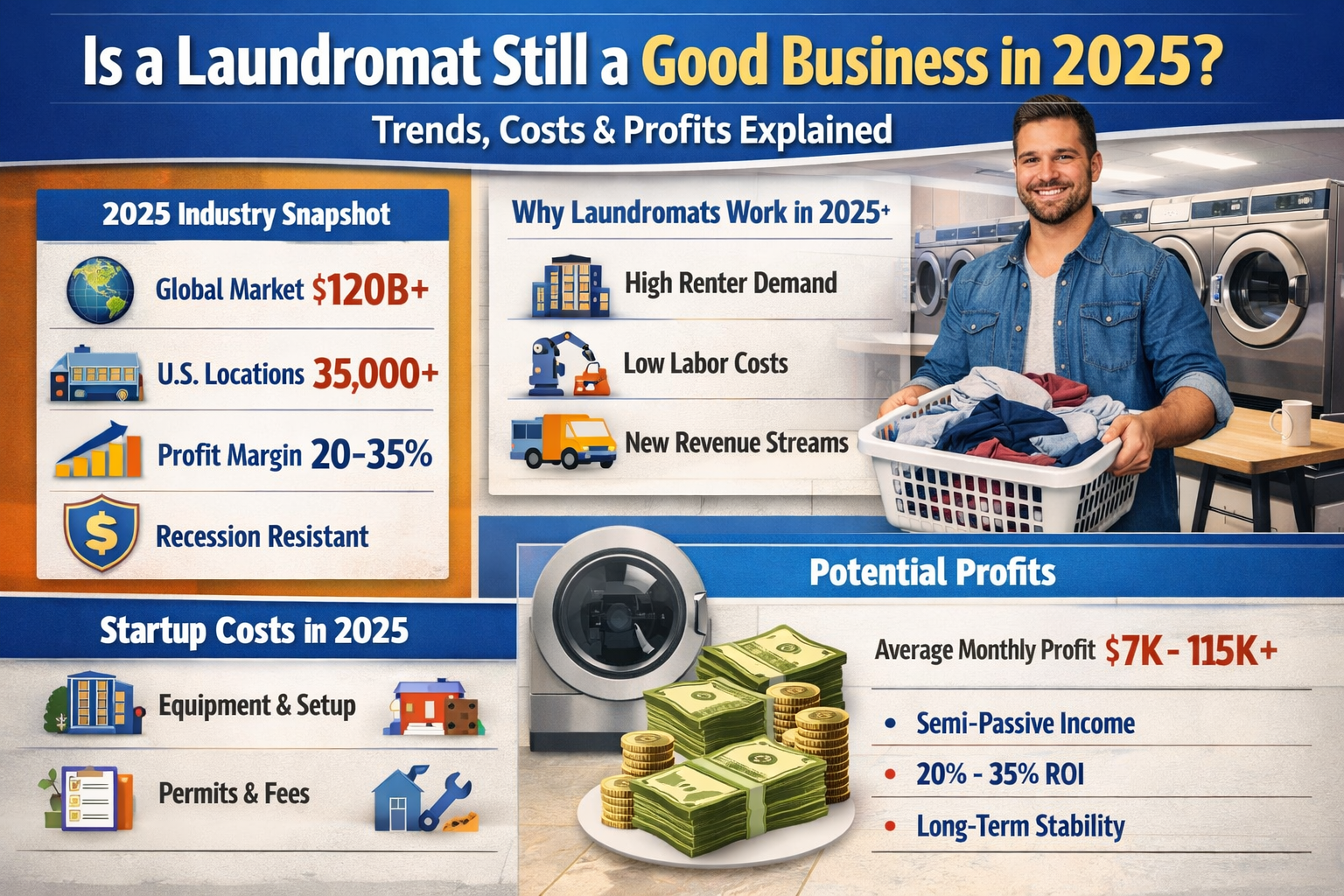
Laundromat Industry Overview (2025 Snapshot)
| Metric | 2025 Estimate |
|---|---|
| Global Laundry Market | $120+ Billion |
| U.S. Laundromats | ~35,000 locations |
| Average Profit Margin | 20–35% |
| Average Monthly Revenue | $15,000–$30,000 |
| Recession Impact | Minimal |
Key Insight:
Laundromats remain one of the most recession-resistant small businesses in 2025.
Why Laundromats Still Work in 2025
1. People Still Rent (And Can’t Install Washers)
Urbanization is increasing. So is renting.
Millions of apartments:
-
Don’t allow washers
-
Don’t have space
-
Don’t want maintenance costs
That guarantees consistent demand.
2. Recession-Proof Demand
During economic downturns:
-
People delay buying appliances
-
More people rent
-
Shared laundry becomes normal
Laundry is non-optional.
3. Automation Reduced Labor Costs
Modern laundromats use:
-
Card & mobile payment systems
-
Remote machine monitoring
-
Automated detergent dispensers
Many owners operate with zero full-time employees.
4. New Revenue Models Changed the Game
2025 laundromats don’t rely on coins alone.
Modern upgrades include:
-
Wash-and-fold subscriptions
-
App-based scheduling
-
Pickup & delivery partnerships
-
Commercial contracts (gyms, salons, Airbnb hosts)
Real Costs of Starting a Laundromat in 2025
Initial Investment Breakdown
| Expense | Estimated Cost |
|---|---|
| Lease or Property | $0–$500,000 |
| Commercial Machines | $150,000–$400,000 |
| Plumbing & Electrical | $50,000–$150,000 |
| Licenses & Permits | $5,000–$15,000 |
| Payment Systems | $10,000–$25,000 |
| Marketing & Branding | $5,000–$10,000 |
Total Investment:
💰 $250,000 to $700,000+
Pro Tip: Buying an existing laundromat can cut startup risk significantly.
Operating Expenses to Expect
-
Water & sewer (biggest cost)
-
Electricity & gas
-
Rent or mortgage
-
Maintenance & repairs
-
Insurance
-
Internet & POS software
Well-run laundromats keep operating costs below 55%.
How Much Profit Does a Laundromat Make in 2025?
Average Monthly Numbers
| Metric | Amount |
|---|---|
| Revenue | $20,000 |
| Expenses | $12,000 |
| Net Profit | $8,000 |
Annual Profit Potential
-
Small laundromat: $60k–$90k
-
Mid-size laundromat: $100k–$180k
-
High-volume urban store: $250k+
ROI typically ranges from 20% to 35% annually.
Passive or Active Business? The Truth
Laundromats are semi-passive, not fully passive.
You’ll still need to:
-
Monitor machines
-
Handle maintenance
-
Manage utilities
-
Market services
But compared to restaurants or retail, the workload is far lighter.
Best Locations for Laundromats in 2025
Location can make—or break—this business.
Ideal Locations
-
High-density apartment areas
-
Student neighborhoods
-
Low washer ownership zones
-
Urban & semi-urban regions
-
Near public transport
Locations to Avoid
-
Suburbs with large homes
-
Areas with declining population
-
Oversaturated markets
Modern Trends Shaping Laundromats in 2025
1. Cashless Payments
Mobile apps, QR codes, NFC cards.
2. Eco-Friendly Machines
Lower water and energy use = higher profit margins.
3. Subscription Laundry Services
Monthly wash plans = predictable income.
4. AI & IoT Monitoring
Remote alerts, predictive maintenance.
5. Hybrid Models
Laundry + café + co-working spaces.
Risks & Challenges You Must Know
No business is risk-free.
Key Risks
-
High upfront investment
-
Utility price increases
-
Equipment breakdowns
-
Poor location choice
-
Rising competition
How Smart Owners Mitigate Risks
-
Energy-efficient machines
-
Long-term utility contracts
-
Preventive maintenance
-
Strong branding & loyalty programs
Laundromat vs Other Small Businesses (2025)
| Business | Risk | Labor | Profit Stability |
|---|---|---|---|
| Laundromat | Low | Low | High |
| Restaurant | High | Very High | Low |
| Retail Store | Medium | Medium | Medium |
| Airbnb | Medium | Medium | Seasonal |
Laundromats consistently rank top for stability.
Who Should Start a Laundromat in 2025?
Best fit for:
-
First-time business owners
-
Investors seeking steady cash flow
-
People avoiding daily operations
-
Long-term wealth builders
Not ideal for:
-
People expecting quick flips
-
Those avoiding large upfront costs
-
Anyone unwilling to learn operations
Step-by-Step: How to Start a Laundromat in 2025
-
Market & demographic research
-
Location analysis
-
Financial modeling
-
Equipment selection
-
Permits & utilities
-
Branding & marketing
-
Launch & optimize
Featured Snippet: Is a Laundromat Worth It in 2025?
Yes, a laundromat is worth it in 2025 if it’s located in a high-demand area, uses modern equipment, and offers value-added services like wash-and-fold or delivery.
FAQs (People Also Ask)
Is a laundromat recession-proof?
Yes. Laundry is a necessity, making laundromats one of the most recession-resistant businesses.
How long does it take to break even?
Most laundromats break even in 3–5 years, faster with strong cash flow.
Do laundromats still use coins in 2025?
Many still do, but most successful ones use cashless and mobile payments.
Can I run a laundromat remotely?
Yes, with modern monitoring systems, many owners manage operations remotely.
Is competition high?
It depends on location. Underserved areas still offer excellent opportunities.
Internal Linking Suggestions
-
Guide to recession-proof businesses
-
How to evaluate local market demand
-
Passive income business models
External Authority References
-
IBISWorld – Laundry Services Industry Reports
-
Coin Laundry Association (CLA)
-
U.S. Small Business Administration (SBA)
Final Verdict: Is a Laundromat Still a Good Business in 2025?
Yes—but only for smart operators.
The laundromat business in 2025 is:
-
✔ Profitable
-
✔ Resilient
-
✔ Scalable
-
✔ Technology-driven
But success now depends on strategy, location, and modernization, not luck.
Actionable Takeaways
-
Don’t buy outdated equipment
-
Study demographics deeply
-
Focus on efficiency, not just volume
-
Add convenience services early
-
Think long-term, not fast money
If you want a business that quietly builds wealth while others chase trends—laundromats still deserve serious consideration in 2025.