
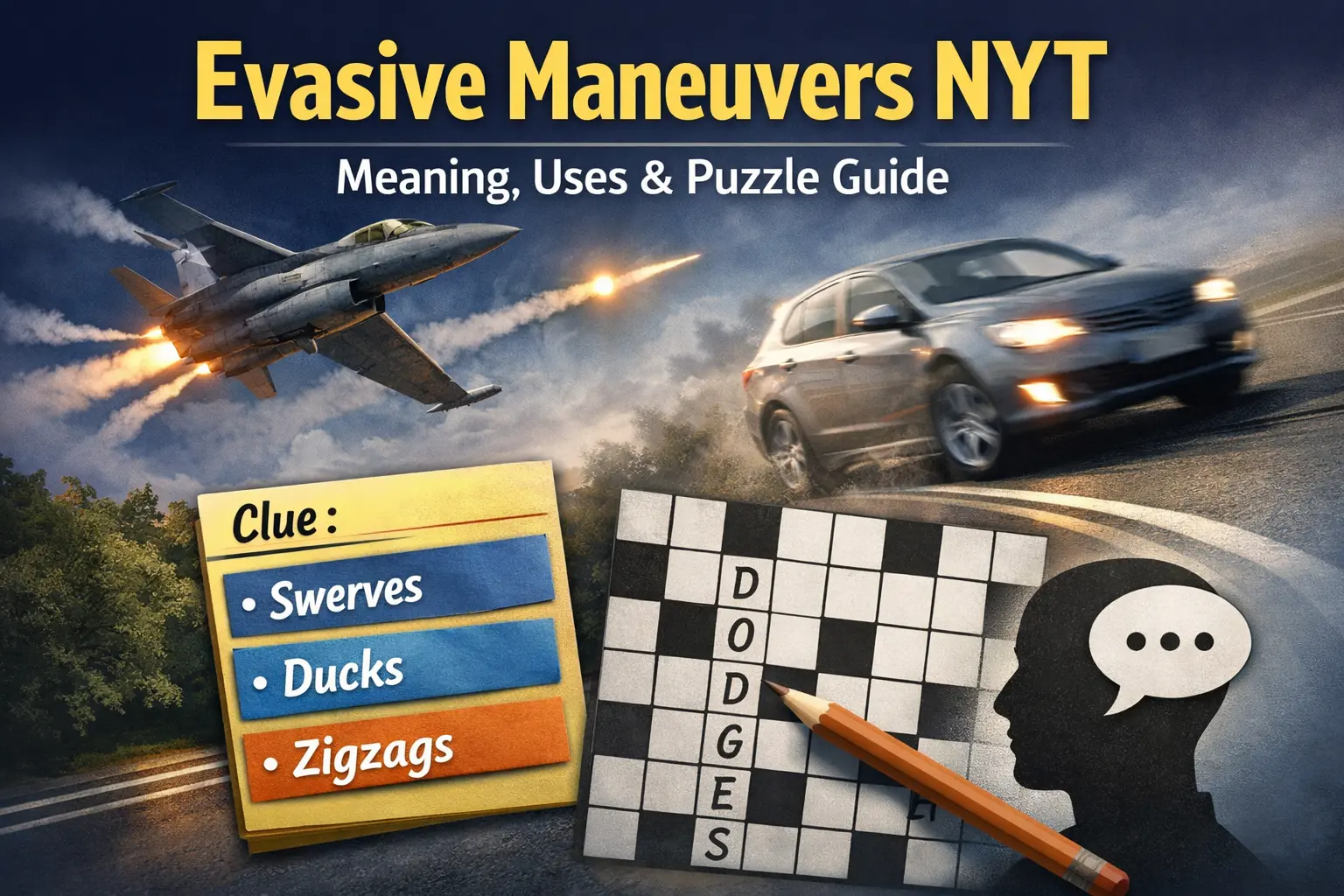

If you’ve recently searched for “evasive maneuvers NYT,” chances are you encountered it in a crossword puzzle, headline, or word clue and wanted a clear, authoritative explanation. You’re in the right place.
This comprehensive guide breaks down everything you need to know about evasive maneuvers—from its literal meaning and real-world applications to how it appears in puzzles like the New York Times crossword and how to solve it effectively.
Whether you’re a beginner trying to understand the phrase or a seasoned puzzle solver aiming to sharpen your skills, this article delivers practical insights, strategies, and expert-level tips.
What Are Evasive Maneuvers? (Quick Definition)
Evasive maneuvers refer to deliberate actions taken to avoid danger, confrontation, or detection.
Simple Explanation:
- Evasive = avoiding something
- Maneuvers = planned movements or actions
👉 Together, the phrase means:
Strategic actions taken to dodge or escape a threat.
Why “Evasive Maneuvers NYT” Is Trending
The phrase often trends because it appears in:
- Crossword puzzles (especially the NYT Crossword)
- News headlines
- Military or aviation discussions
- Pop culture references
In crossword contexts, it’s especially popular due to its flexibility—it can represent different answers depending on the clue’s structure.
Common Meanings of Evasive Maneuvers
1. Military and Aviation Context
In defense or aviation, evasive maneuvers are critical survival tactics.
Examples:
- Fighter jets dodging missiles
- Naval ships avoiding torpedoes
- Military vehicles changing routes to avoid ambush
Key Characteristics:
- Fast decision-making
- Precision movement
- High risk, high reward
2. Driving and Road Safety
In everyday life, evasive maneuvers can occur while driving.
Examples:
- Swerving to avoid a sudden obstacle
- Braking sharply to prevent collision
- Changing lanes quickly to avoid danger
Important Note:
While sometimes necessary, improper evasive driving can increase accident risk.
3. Communication and Behavior
The phrase is also used metaphorically.
Examples:
- Avoiding direct questions
- Changing topics in a conversation
- Giving vague or indirect answers
👉 In this context, it implies avoidance rather than physical movement.
Evasive Maneuvers in NYT Crossword
Now let’s get to the core of why many users search this phrase.
Why It Appears in Crosswords
The phrase “evasive maneuvers” is attractive for puzzle creators because it:
- Has multiple interpretations
- Can be broken into shorter clues
- Fits well into grid patterns
Common Crossword Answers for “Evasive Maneuvers”
Here are typical answers depending on clue style:
| Clue Type | Possible Answer | Explanation |
|---|---|---|
| Literal | SWERVES | Movement to avoid something |
| Short | DODGES | Quick avoidance |
| Slang | DUCKS | Avoiding quickly |
| Strategic | FEINTS | Deceptive movement |
| Tactical | ZIGZAGS | Irregular movement pattern |
How to Identify the Right Answer
To solve it correctly in an NYT puzzle:
Step-by-Step Strategy:
- Check clue wording
- Literal → physical movement
- Figurative → behavioral avoidance
- Count the letters
- Match with grid spaces
- Look at crossing letters
- Use intersecting answers to confirm
- Consider tense
- Present: DODGE
- Past: DODGED
- Plural: DODGES
Advanced Crossword Solving Techniques
If you want to master clues like “evasive maneuvers NYT,” you need more than vocabulary—you need strategy.
1. Recognize Puzzle Patterns
Frequent crossword themes include:
- Synonyms
- Wordplay
- Double meanings
👉 “Evasive maneuvers” often signals action-based verbs.
2. Think Beyond Literal Meaning
Crosswords love misdirection.
Example:
- Clue: “Evasive maneuvers”
- Answer: EXCUSES
👉 Not physical—but verbal avoidance.
3. Use Word Length as a Clue
A 5-letter answer is likely:
- DODGE
- SWERVE
A 7-letter answer might be:
- ZIGZAGS
- EVASION
4. Learn Common Crossword Vocabulary
Certain words appear repeatedly:
- OLEO
- ERIE
- ETUI
- AREA
Combine these with context clues for faster solving.
Real-World Applications of Evasive Maneuvers
Understanding this concept isn’t just for puzzles—it’s widely used in real life.
1. Self-Defense
Evasive movement is key in:
- Martial arts
- Personal safety
- Escape tactics
2. Sports
Athletes constantly use evasive maneuvers.
Examples:
- Football players dodging defenders
- Boxers slipping punches
- Basketball players faking moves
3. Business and Negotiation
In professional settings, evasive tactics may include:
- Deflecting tough questions
- Delaying decisions
- Redirecting conversations
4. Cybersecurity
Even digital systems use evasive strategies:
- Avoiding detection by attackers
- Redirecting malicious traffic
- Masking sensitive data
Benefits of Evasive Maneuvers
1. Risk Reduction
Helps avoid danger in critical situations.
2. Strategic Advantage
Allows you to outmaneuver competitors or threats.
3. Flexibility
Encourages quick thinking and adaptability.
4. Survival Skill
Essential in high-risk professions like aviation and military.
Risks and Downsides
While useful, evasive maneuvers can also have drawbacks.
1. Increased Complexity
Quick decisions may lead to mistakes.
2. Misinterpretation
In communication, evasiveness can appear dishonest.
3. Physical Danger
Improper execution can worsen situations.
Evasive Maneuvers vs Similar Concepts
| Concept | Difference |
|---|---|
| Avoidance | Passive, not strategic |
| Defense | Protective, not necessarily evasive |
| Escape | Leaving entirely, not maneuvering |
| Deception | May involve trickery, not movement |
Practical Examples
Example 1: Driving Scenario
A driver swerves to avoid an animal crossing the road.
👉 This is a physical evasive maneuver.
Example 2: Interview Situation
A candidate avoids answering a difficult question directly.
👉 This is a verbal evasive maneuver.
Example 3: Crossword Puzzle
Clue: “Evasive maneuvers” (6 letters)
Answer: DODGES
How to Get Better at NYT Crossword Clues
Daily Practice
Consistency improves pattern recognition.
Study Past Puzzles
Look at recurring clue-answer pairs.
Build Vocabulary
Learn synonyms and alternate meanings.
Stay Patient
Some clues are intentionally tricky.
Quick Reference: Evasive Maneuvers Cheat Sheet
Common Answers:
- DODGES
- SWERVES
- DUCKS
- FEINTS
- ZIGZAGS
Key Tips:
- Check clue tone (literal vs metaphorical)
- Count letters carefully
- Use crossing words
- Think creatively
FAQs (People Also Ask)
What does “evasive maneuvers” mean in NYT crossword?
It usually refers to actions that avoid something—physically or metaphorically. Common answers include dodges, swerves, or feints, depending on the clue.
What is the most common answer for evasive maneuvers?
“DODGES” is one of the most frequent answers because it fits many puzzle formats and meanings.
Is evasive maneuvers always literal in crosswords?
No. It can also refer to:
- Avoiding questions
- Changing topics
- Using indirect language
How do I solve tricky NYT crossword clues?
Focus on:
- Word length
- Clue tone
- Crossing letters
- Common synonyms
Why are NYT crossword clues sometimes confusing?
They use:
- Wordplay
- Double meanings
- Misdirection
This is intentional to challenge solvers.
Expert Tips for Mastery
If you want to go beyond average solving:
Think Like a Puzzle Creator
Ask:
- What’s the trick here?
- Is this literal or metaphorical?
Build a Mental Dictionary
Group words by meaning:
- Avoid → dodge, duck, evade
- Move → swerve, shift, zigzag
Practice Pattern Recognition
The more puzzles you solve, the faster you recognize clues.
Conclusion: Mastering “Evasive Maneuvers NYT”
The phrase “evasive maneuvers NYT” may seem simple at first glance, but it carries depth across multiple contexts—from real-world tactics to clever crossword clues.
By understanding:
- Its core meaning
- Its various applications
- Common crossword answers
- Strategic solving techniques
—you position yourself to solve puzzles faster, think more critically, and interpret language more effectively.
Actionable Takeaways
- Learn 5–10 common synonyms like dodges and swerves
- Always analyze clue tone (literal vs figurative)
- Use crossing letters to confirm answers
- Practice daily to improve pattern recognition
- Stay flexible—crosswords reward creative thinking