
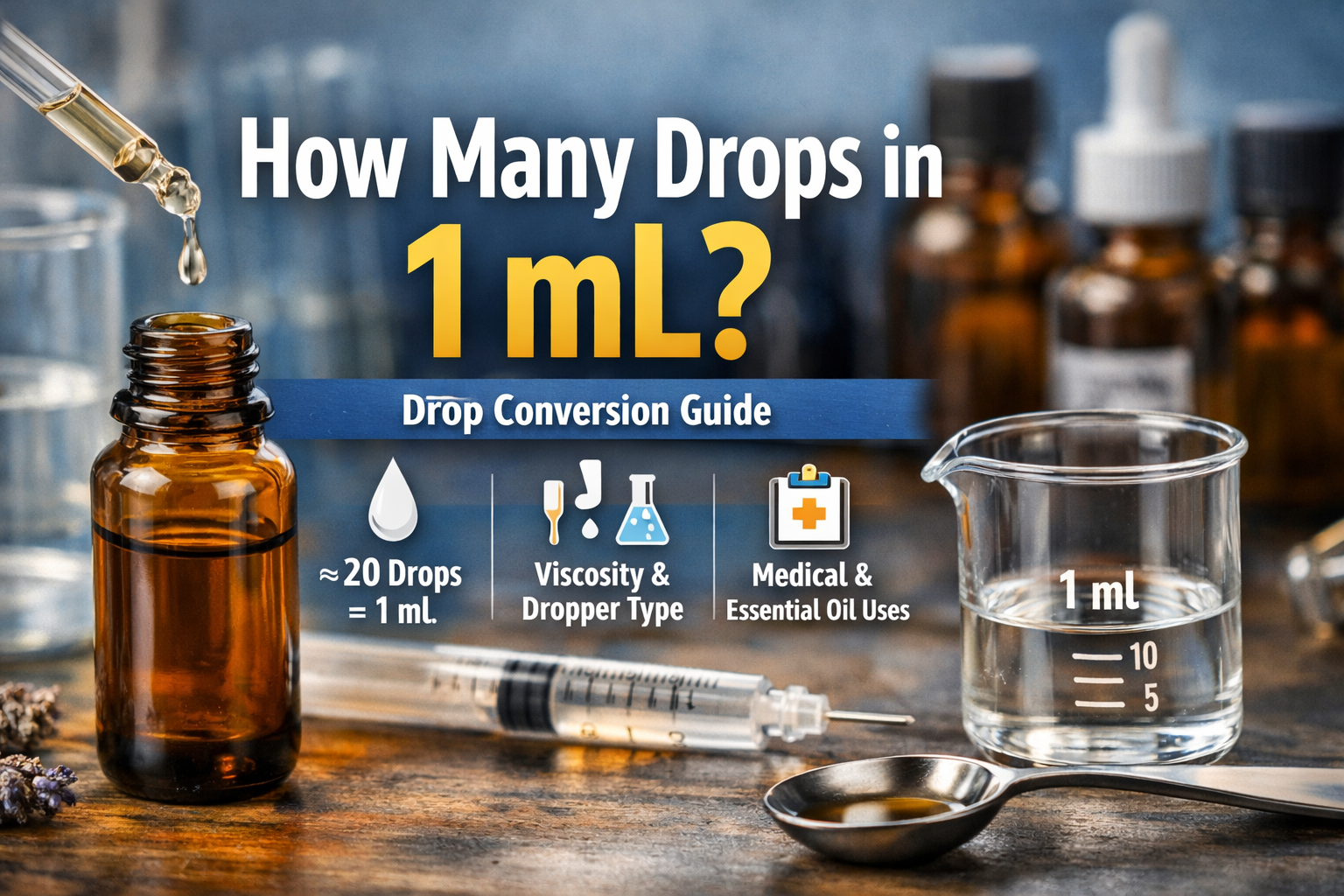

How Many Drops in 1 mL? The Complete Drop Conversion Guide
If you’ve ever measured liquid medicine, essential oils, or laboratory chemicals, you’ve probably asked a simple but surprisingly tricky question: how many drops are in 1 mL?
At first glance, it sounds like a straightforward measurement. But in reality, the number of drops in a milliliter can vary depending on several factors such as liquid viscosity, dropper design, surface tension, and temperature.
For most practical purposes, the commonly accepted answer is:
1 milliliter (mL) equals approximately 20 drops.
However, that estimate only applies to standard water-like liquids using a typical medicine dropper. In real-world situations—especially in medicine, chemistry, aromatherapy, and cooking—the number can range between 15 and 30 drops per mL.
This comprehensive guide explains everything you need to know about drop-to-milliliter conversion, including the science behind droplet formation, accurate measurements, and practical applications.
Understanding the Basics of Drops and Milliliters
Before diving deeper into conversions, it’s important to understand the fundamental units involved.
What Is a Drop?
A drop is a small quantity of liquid formed when gravity pulls liquid downward from a surface. Drops are typically measured when using:
-
Medicine droppers
-
Pipettes
-
Essential oil droppers
-
Eye droppers
-
Laboratory instruments
Unlike standardized units like grams or milliliters, a drop is not an exact scientific measurement. Instead, it’s considered an approximate volume.
Standard Drop Size
In medical and pharmaceutical contexts:
| Measurement | Approximate Value |
|---|---|
| 1 Drop | 0.05 mL |
| 20 Drops | 1 mL |
This standard is widely used in pharmacology and medicine.
What Is a Milliliter (mL)?
A milliliter is a metric unit of volume used worldwide for measuring liquids.
Key conversions:
| Unit | Equivalent |
|---|---|
| 1 mL | 0.001 liters |
| 1 mL | 1 cubic centimeter (cc) |
| 5 mL | 1 teaspoon |
| 15 mL | 1 tablespoon |
Milliliters are commonly used in:
-
Medicine dosages
-
Cooking recipes
-
Laboratory measurements
-
Cosmetics and skincare
The Standard Conversion: How Many Drops in 1 mL?
The widely accepted medical standard states:
1 mL = 20 drops
This measurement assumes:
-
Water-like liquid
-
Standard medical dropper
-
Controlled dispensing conditions
Conversion Table
| Milliliters | Drops |
|---|---|
| 0.25 mL | 5 drops |
| 0.5 mL | 10 drops |
| 1 mL | 20 drops |
| 2 mL | 40 drops |
| 5 mL | 100 drops |
| 10 mL | 200 drops |
This rule is used in many pharmaceutical guidelines when calculating doses.
Why the Number of Drops Can Vary
Despite the standard guideline, the exact number of drops in 1 mL is not always consistent.
Several scientific factors influence drop size.
1. Liquid Viscosity
Viscosity refers to how thick or thin a liquid is.
Examples:
| Liquid | Approximate Drops per mL |
|---|---|
| Water | 20 |
| Alcohol | 25 |
| Essential oils | 25–30 |
| Glycerin | 15–18 |
Thicker liquids produce larger drops, meaning fewer drops per milliliter.
2. Surface Tension
Surface tension determines how easily a liquid forms droplets.
Liquids with higher surface tension form larger drops, reducing the number of drops per mL.
Examples:
-
Water → higher tension
-
Alcohol → lower tension
Lower surface tension leads to smaller drops and more drops per mL.
3. Dropper Size and Design
Not all droppers are created equal.
The dropper tip diameter significantly affects droplet size.
Common Dropper Types
| Dropper Type | Drops per mL |
|---|---|
| Medical dropper | 20 |
| Essential oil dropper | 25–30 |
| Laboratory pipette | 20–24 |
| Eye dropper | 20–25 |
Even slight design differences can change droplet volume.
4. Temperature
Temperature influences liquid properties.
-
Higher temperatures reduce viscosity
-
Lower temperatures increase viscosity
This means drops may become smaller in warmer environments, increasing the drop count per mL.
Real-World Example
Imagine measuring 1 mL of essential oil.
If the dropper produces 25 drops per mL, then:
-
10 drops = 0.4 mL
-
20 drops = 0.8 mL
-
25 drops = 1 mL
This is why aromatherapy experts often provide dosage recommendations in drops rather than milliliters.
Drop Measurement in Medicine
Accurate drop measurement is especially important in healthcare.
Many medications are administered using drops instead of syringes.
Common Medical Examples
Eye Drops
Eye medications are usually dispensed as single drops, with each drop typically containing:
-
0.03–0.05 mL
Doctors prescribe drops instead of milliliters because it’s easier for patients.
Pediatric Medicine
For infants, droppers help deliver very small doses.
Example:
| Prescription | Drops |
|---|---|
| 0.5 mL | 10 drops |
| 1 mL | 20 drops |
However, pharmacists often recommend using oral syringes for accuracy.
IV Infusion Calculations
In hospitals, drip rates are calculated using drops per minute.
Example formula:
Common drop factors:
| Drop Factor | Meaning |
|---|---|
| 10 gtt/mL | Large drops |
| 15 gtt/mL | Standard |
| 20 gtt/mL | Micro drip |
“gtt” stands for guttae, the Latin word for drops.
Drops in Essential Oils and Aromatherapy
Essential oils are one of the most common situations where people measure liquids in drops.
Typical Essential Oil Conversion
| Measurement | Drops |
|---|---|
| 0.5 mL | 12–15 drops |
| 1 mL | 20–30 drops |
| 5 mL | 100–150 drops |
| 10 mL | 200–300 drops |
Because oils are thicker than water, they usually produce smaller drops.
Example: Aromatherapy Blend
Suppose you’re creating a 10 mL essential oil blend.
Typical dilution:
-
20 drops essential oil
-
10 mL carrier oil
This equals roughly 1% dilution.
Drops in Cooking and Food Preparation
Drops are sometimes used in cooking for highly concentrated ingredients.
Examples include:
-
Food coloring
-
Vanilla extract
-
Flavor concentrates
-
Liquid sweeteners
Because these ingredients are strong, recipes often require just a few drops.
Example Recipe Conversion
| Ingredient | Drops |
|---|---|
| Food coloring | 2–3 drops |
| Liquid stevia | 4–6 drops |
| Flavor extracts | 5–10 drops |
In cooking, drop measurement is less precise than in medicine but still useful.
Laboratory and Scientific Use of Drops
Scientists frequently measure liquids in drops when working with small quantities.
Why Drops Are Used in Labs
Benefits include:
-
Quick measurement
-
Minimal equipment needed
-
Useful for titration or testing
However, laboratories typically prefer micropipettes for precision.
How to Measure Drops Accurately
If you need precise measurements, follow these steps.
Step-by-Step Method
-
Use a calibrated dropper
-
Hold the dropper vertically
-
Dispense drops slowly
-
Count carefully
-
Avoid squeezing too hard
Consistency is key when measuring drops.
Drops vs Milliliters vs Teaspoons
Many people convert drops into kitchen measurements.
Here is a helpful comparison.
| Unit | Drops |
|---|---|
| 1 drop | 0.05 mL |
| 20 drops | 1 mL |
| 100 drops | 5 mL (1 teaspoon) |
| 300 drops | 15 mL (1 tablespoon) |
This table provides quick approximations for everyday use.
Benefits of Measuring Liquids in Drops
Using drops can be beneficial in several scenarios.
Advantages
-
Easy to measure tiny quantities
-
Requires minimal equipment
-
Ideal for concentrated liquids
-
Useful for dosing medicine
Drops are particularly helpful when precision syringes are unavailable.
Risks of Using Drop Measurements
Despite convenience, drop measurements can introduce errors.
Potential Problems
-
Dropper size variations
-
Liquid viscosity differences
-
Human counting errors
-
Inconsistent squeezing pressure
In critical applications like medication dosing, using a syringe or graduated pipette is safer.
Featured Snippet: Quick Answer
How Many Drops Are in 1 mL?
1 mL contains approximately 20 drops when using a standard medicine dropper with water-like liquids.
However, depending on the liquid and dropper size, the number can range from 15 to 30 drops per milliliter.
Practical Examples
Let’s look at real-world scenarios.
Example 1: Essential Oil Bottle
A 10 mL essential oil bottle contains roughly:
-
200–300 drops
Example 2: Eye Medication
A 5 mL eye drop bottle usually contains:
-
100–150 drops
Example 3: Flavor Extract
If a recipe needs 1 mL vanilla extract, you would add approximately:
-
20 drops
Frequently Asked Questions (FAQs)
How many drops are in 1 mL exactly?
The standard estimate is 20 drops per milliliter, but the actual number can range between 15 and 30 drops depending on the liquid and dropper.
How many drops equal 0.5 mL?
If 1 mL equals 20 drops, then:
0.5 mL = 10 drops
How many drops are in a teaspoon?
One teaspoon equals 5 mL, which is approximately:
100 drops
Are essential oil drops the same as medicine drops?
No. Essential oil droppers often produce smaller drops, meaning there may be 25–30 drops per mL instead of 20.
Can drop size affect medication dosage?
Yes. Different droppers produce different drop sizes, which can lead to incorrect dosing. For medications, it’s best to use calibrated droppers or oral syringes.
Conclusion
So, how many drops are in 1 mL?
The most widely accepted answer is:
1 mL ≈ 20 drops
But remember that drop size varies depending on:
-
Liquid viscosity
-
Surface tension
-
Dropper design
-
Temperature
In real-life applications, the number typically falls between 15 and 30 drops per milliliter.
For everyday tasks like cooking or aromatherapy, drop estimates work well. However, for medical or laboratory use, it’s always best to measure liquids using precise tools like syringes or pipettes.