
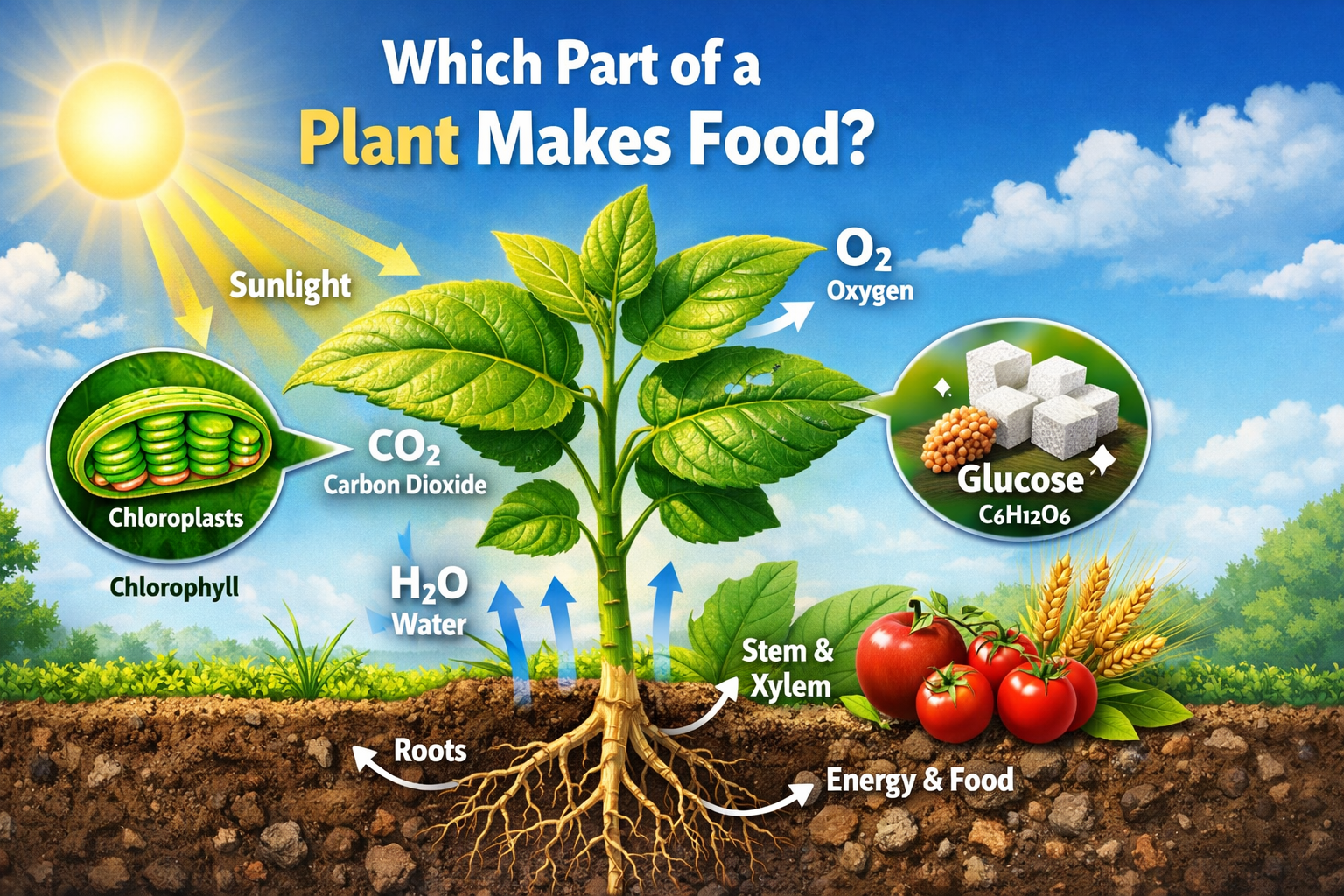

Which Part of a Plant Makes Food? (Complete Guide)
🌿 Which Part of a Plant Makes Food?
If you’ve ever wondered which part of a plant makes food, the short answer is: the leaves.
But that’s just the surface.
Leaves are the primary site where plants produce food through a process called photosynthesis. However, to fully understand how plants feed themselves—and indirectly all life on Earth—we need to explore:
-
How leaves produce food
-
Why they are uniquely designed for this job
-
What role other plant parts play
-
What happens if leaves are damaged
-
How this process affects humans and the ecosystem
By the end of this in-depth guide, you’ll understand the science from beginner to advanced level—and why leaves are among the most powerful biological factories on Earth.
🌱 Quick Answer (Featured Snippet Section)
Which part of a plant makes food?
👉 The leaves make food. They use sunlight, carbon dioxide, and water to produce glucose through a process called photosynthesis. This process occurs in tiny structures inside leaf cells called chloroplasts, which contain chlorophyll.
Understanding Plant Food Production
Before diving deeper, let’s clarify something important:
Plants don’t “eat” like humans or animals.
Instead, they make their own food. That’s why they’re called producers in the food chain.
What Is Plant Food?
Plant food is mainly:
-
Glucose (a type of sugar)
-
Stored as starch
-
Used to create:
-
Cellulose
-
Proteins
-
Fats
-
Fruits and seeds
-
Glucose is the plant’s energy source—just like carbohydrates are for us.
🌿 Why Leaves Are the Food Factories of Plants
1. Leaves Contain Chloroplasts
Inside leaf cells are organelles called chloroplasts. These structures contain chlorophyll, the green pigment that absorbs sunlight.
Chlorophyll:
-
Captures light energy
-
Powers photosynthesis
-
Gives plants their green color
No chlorophyll = no photosynthesis = no food production.
2. Leaves Are Designed to Capture Sunlight
Leaves are:
-
Broad and flat
-
Thin
-
Positioned to face sunlight
This maximizes light absorption.
Think of leaves as solar panels.
3. Leaves Have Stomata for Gas Exchange
Tiny pores called stomata allow:
-
Carbon dioxide (CO₂) in
-
Oxygen (O₂) out
Without CO₂, photosynthesis cannot occur.
🌞 What Is Photosynthesis?
Photosynthesis is the process plants use to convert:
-
Sunlight
-
Water
-
Carbon dioxide
Into:
-
Glucose (food)
-
Oxygen (by-product)
The Chemical Equation:
6CO2+6H2O+LightEnergy→C6H12O6+6O26CO₂ + 6H₂O + Light Energy → C₆H₁₂O₆ + 6O₂
In simple words:
Carbon dioxide + Water + Sunlight = Sugar + Oxygen
🔬 Step-by-Step: How Leaves Make Food
Let’s break it down clearly.
Step 1: Water Absorption
-
Roots absorb water from soil.
-
Water travels up the stem through xylem vessels.
-
It reaches the leaves.
Step 2: Carbon Dioxide Intake
-
CO₂ enters through stomata.
-
It moves into leaf cells.
Step 3: Sunlight Absorption
-
Chlorophyll absorbs sunlight.
-
Light energy powers chemical reactions.
Step 4: Glucose Production
-
Chemical reactions occur inside chloroplasts.
-
Glucose is formed.
Step 5: Food Distribution
-
Glucose moves through phloem tissue.
-
It feeds:
-
Roots
-
Stem
-
Flowers
-
Fruits
-
🌳 Do Other Plant Parts Help Make Food?
Although leaves are the main food-making part, other parts support the process.
🌿 Stem
-
Transports water and nutrients.
-
Some green stems can also photosynthesize.
🌱 Roots
-
Absorb water and minerals.
-
Store extra food.
🌸 Flowers
-
Use food for reproduction.
-
Do not produce food.
🍎 Fruits
-
Store food.
-
Protect seeds.
Comparison Table
| Plant Part | Makes Food? | Function |
|---|---|---|
| Leaves | ✅ Yes | Main site of photosynthesis |
| Stem | ⚠ Sometimes | Transport & support |
| Roots | ❌ No | Absorb water & store food |
| Flowers | ❌ No | Reproduction |
| Fruits | ❌ No | Protect seeds |
🌎 Why Plant Food Production Matters to Humans
Understanding which part of a plant makes food isn’t just biology trivia—it impacts life on Earth.
1. Oxygen Production
Plants release oxygen during photosynthesis.
Without leaves:
-
No oxygen
-
No animal life
-
No humans
2. Food Chain Foundation
Plants are primary producers.
They support:
-
Herbivores
-
Carnivores
-
Omnivores
-
Humans
3. Climate Regulation
Photosynthesis reduces CO₂ levels.
This helps fight climate change.
🌾 Real-World Example: Agriculture
Farmers depend on healthy leaves for crop production.
If leaves are damaged by:
-
Pests
-
Fungal infections
-
Drought
-
Pollution
Food production drops.
Example:
-
Wheat leaves damaged by rust fungus reduce grain yield significantly.
-
Less photosynthesis = less starch stored in seeds.
🌿 Can Stems or Roots Make Food?
Yes—but rarely.
Some plants have modified parts that perform photosynthesis.
Examples:
-
Cactus stems (leaves are reduced to spines)
-
Succulents
-
Some aquatic plants
These plants adapt to survive in harsh envi