
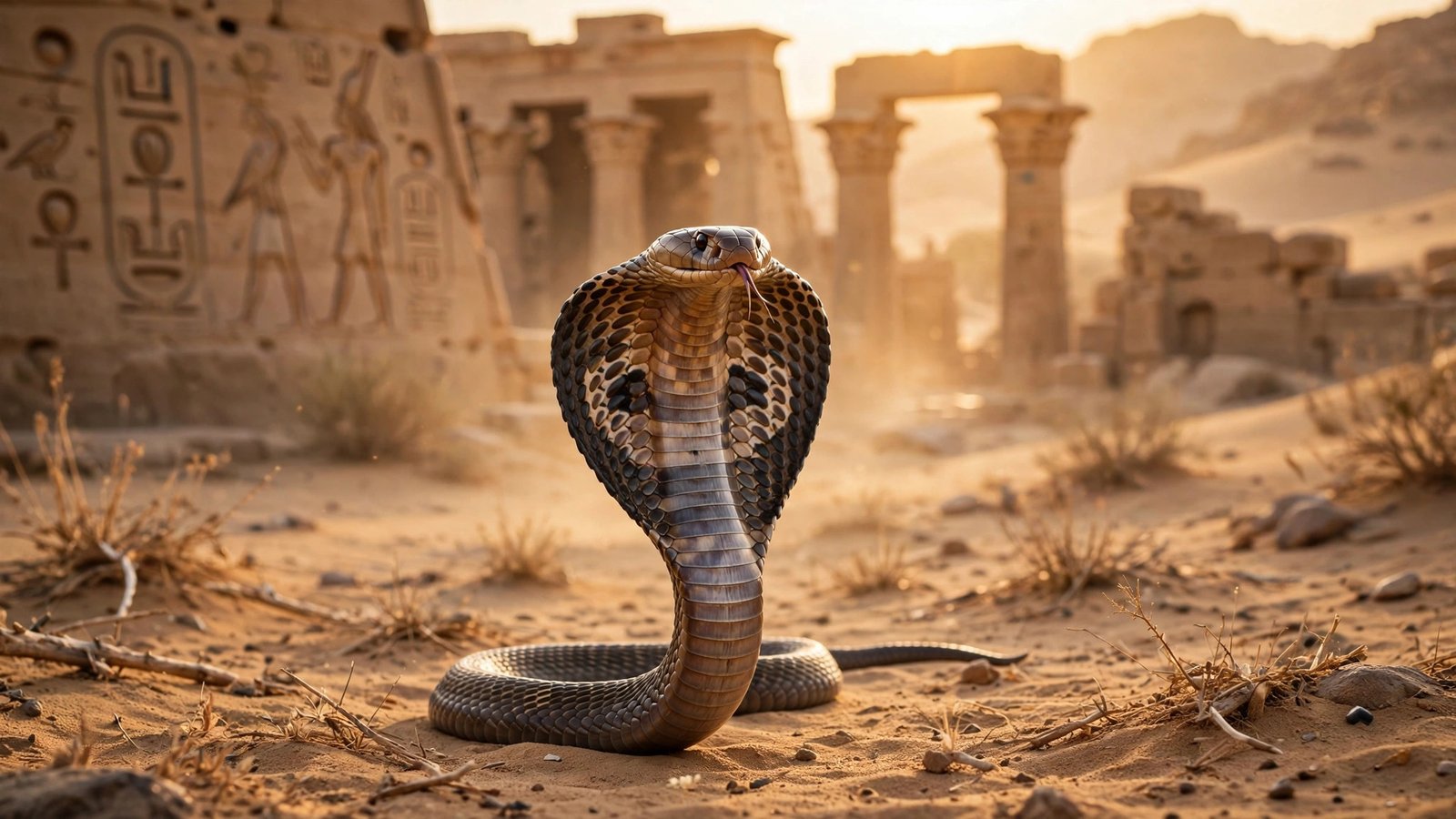

Look at any portrait of an Egyptian pharaoh and you will find it: a small rearing cobra, hood flared, fixed to the very front of the crown, staring down anyone who dares approach the king. The Egyptians called it the uraeus — the living emblem of divine power, of the goddess Wadjet, of royalty itself. And for three thousand years, the snake behind that symbol has had a name that still slithers through crossword grids today: the asp.
If your clue reads “Egyptian snake”, the answer is ASP — and its story runs from the pharaoh’s brow to Cleopatra’s legend.
The Answer: ASP
Clue: “Egyptian snake”
Answer: ASP (3 letters)
ASP is the classic crossword name for the venomous Egyptian cobra, and the evidence trail is unusually fresh. Word.tips documents “Egyptian snake” answered as ASP in the NYT Midi on October 11, 2026. Going back further, the NYXCrossword archive records the New York Times puzzle of March 22, 2022 with “7. Snake in ancient Egyptian art : ASP,” and gamerjournalist.com documents that same clue — “Snake in ancient Egyptian art” — as last seen in the NYT Crossword on March 22, 2022, answered ASP. Three dated sightings, two different puzzles, one three-letter snake. This answer is not going anywhere.
The Pharaoh’s Serpent: The Uraeus and the Symbol of Royalty
The Crown’s Guardian
The uraeus — from the Egyptian word iaret, meaning “rearing cobra” — was the stylized upright cobra worn on the pharaoh’s brow. It represented the goddess Wadjet, the ancient cobra-goddess of Lower Egypt, and it did symbolic double duty: it marked the wearer as the living embodiment of divine authority, and it promised that the goddess’s fiery venom would strike the king’s enemies. Crowns, statues, tomb paintings, amulets — the rearing cobra is everywhere in Egyptian art, which is precisely why the NYT could clue ASP as “Snake in ancient Egyptian art” and expect solvers to make the connection.
This is worth pausing on, because it explains the clue’s logic completely. The constructor is not asking about zoology. The constructor is asking about culture: what snake lives in Egyptian art? The cobra on the crown. And the crossword’s traditional three-letter name for that cobra is ASP.
What Kind of Snake Is an Asp, Really?
Here the story gets deliciously messy. “Asp” is the modern English form of aspis, the ancient Greek word for a venomous Nile-region snake — and the Greeks used it loosely for several species. Modern herpetologists believe the asp of antiquity was the Egyptian cobra, Naja haje: a large, genuinely dangerous cobra found across North Africa, capable of rearing up with its famous flared hood. So when your crossword says ASP and your field guide says Egyptian cobra, they are talking about the same animal — the crossword just kept the 2,000-year-old Greek nickname.
One caution for the precise-minded: the name “asp” has also been applied to the European asp viper (Vipera aspis), a different snake entirely. But in crossword land, ASP is always the Egyptian one — the cobra of the crown, the Nile, and the legend below.
Cleopatra and the Legend of the Bite
No telling of the asp is complete without its most famous victim — or volunteer. According to the legend reported by Plutarch and Shakespeare alike, Cleopatra VII ended her life in 30 BC by allowing an asp to bite her, choosing the snake’s venom over capture by Octavian after the fall of Alexandria. Historians debate whether it really happened — a cobra bite is a violent, uncertain way to die, and some scholars suspect poison instead — but the image proved immortal: the last pharaoh, crowned in life with the cobra symbol, dying by the cobra’s bite.
Crossword constructors adore this legend. It gives them an entire second family of ASP clues — “Cleopatra’s killer,” “Biter of Cleopatra,” “Snake in ‘Antony and Cleopatra'” — all pointing to the same three letters. When you see Cleopatra anywhere near a three-letter snake slot, the asp has already struck.
The Clue Decoder: Every Way the Puzzle Names the Snake
ASP’s clue family splits into three branches — art, Egypt, and Cleopatra:
- “Egyptian snake” — the straight definition, documented in the NYT Midi on October 11, 2026 (word.tips). The most common modern wording.
- “Snake in ancient Egyptian art” — the NYT’s March 22, 2022 wording (NYXCrossword archive; gamerjournalist.com). This one points at the uraeus on the crown.
- “Egyptian cobra” — the zoological phrasing; the NYXCrossword archive notes the Egyptian cobra (Naja haje) is also known as the asp.
- “Cleopatra’s biter” / “Cleopatra’s killer” — the legend branch. Shakespeare’s version keeps this clue alive.
- “Venomous Nile snake” — geography plus danger; the Nile is the asp’s home water.
- “Symbol of Egyptian royalty” — the uraeus branch again; the snake is the crown’s emblem.
The unifying thread: Egypt + snake + three letters = ASP. There is no other three-letter snake in Egypt as far as the crossword is concerned.
Crossword Tips: Striking Fast on ASP
- The Egypt reflex: any three-letter slot with “Egyptian” and an animal is ASP until proven otherwise. Train the reflex the way you trained ERNE-for-sea-eagle.
- Art vs. animal: “Snake in ancient Egyptian art” sounds like a museum question, but the answer is the same three letters. Do not let the fancy framing slow you down.
- Cleopatra is a flare: her name in a clue is a signal fire. “Cleopatra’s ___” in three letters is ASP; in longer slots, think ASPIS or COBRA.
- Watch the letter count: ASP (3) vs. COBRA (5) vs. VIPER (5). The clue’s box count picks the species — constructors choose the snake that fits.
- Learn the whole menagerie: ASP belongs to the classic crossword bestiary alongside ERNE the sea eagle and friends. Our guide to what crosswordese actually is catalogs these repeat creatures, and our Crossword Solver handles the ones that still bite.
Frequently Asked Questions
What does “Egyptian snake” mean in a crossword?
It means ASP — the traditional crossword name for the venomous Egyptian cobra. Word.tips documents “Egyptian snake” answered as ASP in the NYT Midi on October 11, 2026.
Is an asp the same as a cobra?
Essentially, yes — in crossword usage. “Asp” comes from the Greek aspis, an ancient name for a venomous Nile snake, and scholars identify it with the Egyptian cobra (Naja haje). The crossword uses the short ancient name; zoologists use the modern one.
What is the uraeus?
The uraeus is the stylized rearing cobra worn on the pharaoh’s crown as a symbol of sovereignty, royalty, and divine authority. It represented the cobra-goddess Wadjet, protector of Lower Egypt — which is why “Snake in ancient Egyptian art” clues ASP.
Did Cleopatra really die from an asp bite?
That is the legend, reported by ancient sources like Plutarch and immortalized by Shakespeare — but historians debate it. What is certain is that the story made the asp immortal in literature, art, and crosswords.
Has the NYT used ASP recently?
Yes. “Egyptian snake” appeared in the NYT Midi on October 11, 2026 with the answer ASP (word.tips), and “Snake in ancient Egyptian art” appeared in the NYT Crossword on March 22, 2022, also answered ASP (NYXCrossword archive and gamerjournalist.com).
The Bottom Line
From the pharaoh’s brow to Cleopatra’s legend to your Tuesday grid: the ASP has been Egypt’s signature serpent for three thousand years, and the crossword’s for nearly a century. The next time “Egyptian snake” coils into your puzzle, picture the golden uraeus rearing on the crown, hood flared, guarding the king — and write in ASP. Three letters, one goddess, and the most royal free square in the grid. And when the daily challenge shifts from snakes to five-letter words, our Wordle Solver is ready to strike.