
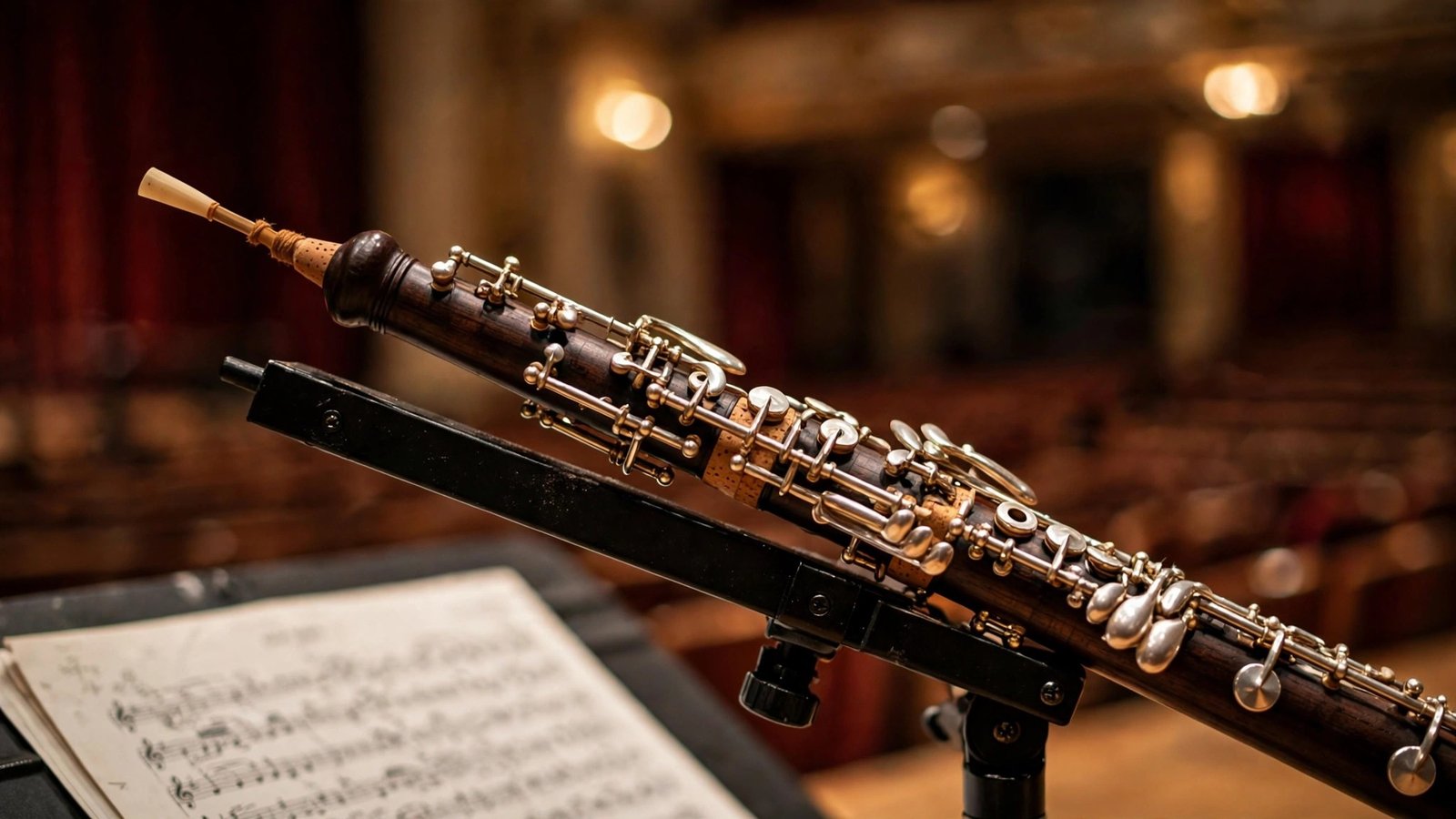

The house lights dim. A thousand conversations fade to a murmur, then to silence. From the middle of the orchestra, a single player lifts a slender black instrument, takes a breath, and plays one pure, unwavering note: A. Across the stage, a hundred musicians tune to that single pitch — and the concert begins.
That ritual, repeated in concert halls around the world every night, belongs to the oboe. And if you have ever stared at a four-letter crossword slot clued as “Double-reed woodwind,” this is the instrument the puzzle wants: OBOE.
The Answer: OBOE
Clue: “Double-reed woodwind”
Answer: OBOE (4 letters)
The clue is a straight definition with a musical twist: the oboe is the best-known double-reed woodwind in the orchestra. The pairing is a NYT regular — “Double-reed woodwind” led to OBOE in the Times on both March 17, 2025 and November 4, 2024 (nyxcrossword.com) — and the paper has also clued it as “Instrument from the French for ‘high wood'” (May 3, 2020, nyxcrossword.com). Once you understand what a double reed actually is, you will never confuse this answer with another woodwind again.
What Exactly Is a Double Reed?
All woodwinds make sound the same basic way: moving air sets something vibrating inside a tube. In a single-reed instrument like the clarinet or saxophone, one thin sliver of cane vibrates against a fixed mouthpiece. In a double-reed instrument, there is no mouthpiece at all — instead, two thin blades of cane are bound together, and the player places both between the lips and blows. The two blades vibrate against each other, like two blades of grass held between your thumbs and blown through as a kid.
That tiny buzzing pair of cane blades — hand-carved by the player from natural cane, trimmed to fractions of a millimeter — is the entire sound engine of the oboe. Change the scrape of the cane and you change the tone, which is why oboists are famously obsessive about making their own reeds, and why no two oboists sound exactly alike. The double reed produces a bright, penetrating, slightly plaintive tone that can cut through an entire orchestra — which, as we will see, is exactly why the oboe gets the most important job in the building.
Inside the Oboe: How the Instrument Works
The oboe itself is a study in elegant engineering. It is a slender tube about 65 centimeters (roughly two feet) long, usually carved from dense, dark hardwood, with a conical bore — the tube gradually widens from top to bottom, unlike the clarinet’s straight cylinder. That widening cone is a big part of the oboe’s distinctive voice: focused, bright, and a little haunting.
Running down the body is a gleaming mechanism of metal keys and rods — the modern oboe carries twenty or more keys covering its tone holes, letting the player span a range of nearly three octaves with precise intonation. At the bottom, the tube flares into a small bell that projects the sound outward. Put it all together — double reed plus conical bore plus keywork — and you get an instrument equally at home singing a mournful solo or cutting through the full roar of a symphony orchestra.
The oboe has relatives, and crosswords love the whole family. The English horn is a larger, lower-pitched cousin — the NYT once clued OBOE as “Woodwind related to the cor anglais,” the English horn’s French name — and the deep-voiced bassoon is the orchestra’s other great double reed. The Times even used the plural once: “Smaller cousins of English horns” led to OBOES on October 22, 2024.
Why the Orchestra Tunes to the Oboe
Back to that opening ritual. Why does the entire orchestra — strings, brass, everyone — tune to the oboe’s A instead of, say, the first violin’s? Two reasons, both rooted in the physics we just covered.
First, pitch stability. A double reed’s pitch barely moves with changes in temperature and humidity, while gut and steel strings drift constantly as the hall warms up. The oboe holds its A rock-steady while a hundred string players adjust to match it. Second, penetration. That bright, reedy tone slices through the ambient noise of a tuning orchestra in a way a flute or clarinet cannot — everyone on stage can actually hear the reference pitch. So before every concert, the principal oboist stands, plays a long, clear A (usually 440 or 442 vibrations per second), and the orchestra falls in line. It is the oboe’s nightly moment of quiet authority — and a lovely thing to picture the next time the clue appears.
The Name Game: From “High Wood” to OBOE
The word itself is a little piece of music history. Before about 1770, English speakers called the instrument a hautboy (pronounced “HO-boy”), borrowed from the French hautbois — a compound of haut (“high” or “loud”) and bois (“wood,” as in woodwind). The loud woodwind, essentially: the instrument that carried over outdoor ensembles and battlefield bands.
Around 1770, English adopted the Italian spelling oboè, which gives us the modern “oboe” — and gives crossword constructors one of their favorite clue angles. “Instrument from the French for ‘high wood'” (NYT, May 3, 2020) is really an etymology quiz wearing a music costume. Knowing the hautbois connection also unlocks the occasional “Hautboy” or “Shawm’s descendant” variant, since the oboe evolved from the Renaissance shawm.
Other NYT Clues That Lead to OBOE
- “Double-reed woodwind” — the classic, seen in the NYT on March 17, 2025 and November 4, 2024.
- “Instrument from the French for ‘high wood'” — NYT, May 3, 2020.
- “Woodwind related to the cor anglais” — a recent NYT appearance (the cor anglais is the English horn’s French name).
- “Smaller cousins of English horns” — NYT, October 22, 2024 (answered as OBOES).
- “Nash’s ‘ill wind that nobody blows good'” — quoting Ogden Nash’s famous wisecrack about the instrument’s difficulty.
- “Orchestra’s tuning instrument” — think of that opening A before every concert.
- “Peter and the Wolf” duck — in Prokofiev’s beloved musical tale, the duck’s waddling theme is played by the oboe.
Crossword Tips: Locking In OBOE Fast
OBOE is prime crosswordese: four letters, three of them vowels, with a friendly B in the middle. Constructors adore it for the same reason they adore OLEO and EPEE — it stitches grids together. That vowel density is your signal: if a music clue gives you O__E, fill in OBOE and check the crossings.
- Reed math: “double-reed” almost always means OBOE (high) or BASSOON (low). Four letters? OBOE. Seven? BASSOON.
- Watch the plural: the grid sometimes wants OBOES, as the NYT did on October 22, 2024.
- Etymology clues: any mention of the French “high wood” or the old word “hautboy” is OBOE.
- Stuck? Our Crossword Solver can fill the slot from the letters you already have.
New to the odd little words that rule crossword grids? Our guide to what crosswordese actually is explains the whole phenomenon.
Frequently Asked Questions
What is a double-reed instrument?
An instrument whose sound is produced by two thin blades of cane vibrating against each other, with no separate mouthpiece. The oboe, English horn, and bassoon are the main orchestral double reeds.
Why does the orchestra tune to the oboe?
Because the oboe’s pitch is exceptionally stable and its bright tone cuts through the noise of a tuning orchestra, so every player on stage can hear the reference A clearly.
What does “oboe” mean?
It comes from the Italian oboè, adopted into English around 1770, which traces back to the French hautbois — “high” (or “loud”) “wood.”
Is the oboe hard to play?
Legendarily difficult. Ogden Nash joked that the oboe is “an ill wind that nobody blows good,” and oboists spend years learning to hand-carve the reeds their sound depends on.
What is the difference between an oboe and a clarinet?
The oboe uses a double reed and has a conical bore; the clarinet uses a single reed on a mouthpiece and has a cylindrical bore. The oboe’s tone is brighter and more penetrating; the clarinet’s is warmer and mellower.
The Bottom Line
The next time you see “Double-reed woodwind” in the New York Times Crossword, hear that single tuning note ringing through a darkened hall — two blades of cane, one steady A, and a hundred musicians falling in line behind it. The instrument, and the answer, is OBOE. Four letters, three vowels, and the most authoritative voice in the orchestra. And when the daily puzzle turns to five letters, our Wordle Solver has you covered.