












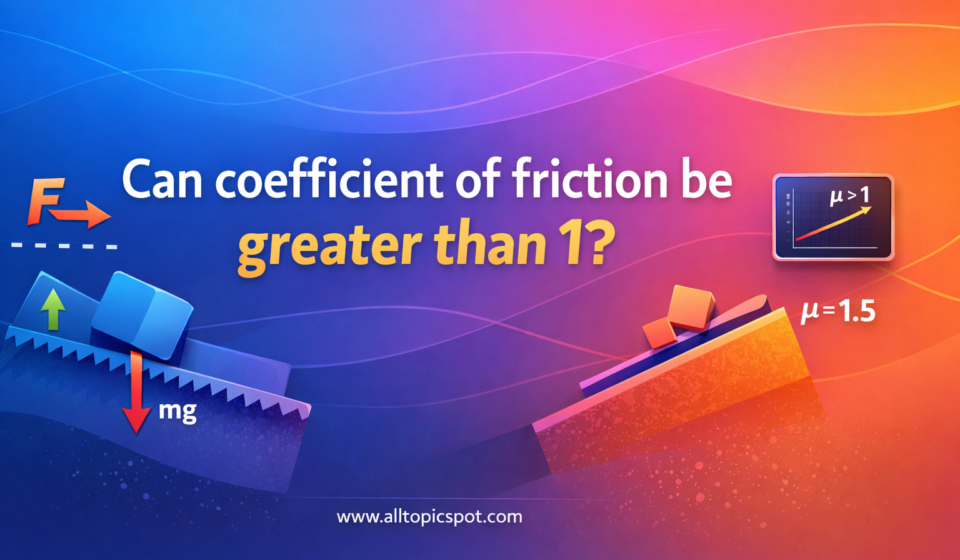

Can Coefficient of Friction Be Greater Than 1? (Complete Guide)
Can Coefficient of Friction Be Greater Than 1?
If you’ve ever studied physics, engineering, or even basic mechanics, you’ve probably wondered:
Can coefficient of friction be greater than 1?
At first glance, it feels impossible. After all, we’re taught that friction is “less than 1” in most examples. But here’s the truth:
Yes — the coefficient of friction can absolutely be greater than 1.
And in many real-world systems, it actually is.
In this comprehensive guide, we’ll break down:
-
What the coefficient of friction really means
-
Why many people assume it must be less than 1
-
When and why it becomes greater than 1
-
Real-world examples (engineering, sports, automotive, materials science)
-
The physics behind it
-
Common myths and misunderstandings
-
Advanced insights for professionals
Whether you’re a beginner learning physics or a professional engineer looking for deeper clarity, this article will give you a complete, expert-level understanding.
Quick Answer (Featured Snippet Friendly)
Yes, the coefficient of friction can be greater than 1.
It is a dimensionless ratio of frictional force to normal force. If the frictional force exceeds the normal force, the coefficient becomes greater than 1. This commonly occurs in rubber-on-rubber, climbing equipment, and high-grip materials.
Understanding the Basics of Friction
Before diving deeper into whether the coefficient of friction can be greater than 1, we must understand what friction actually is.
What Is Friction?
Friction is the resistive force that opposes relative motion between two surfaces in contact.
There are two primary types:
| Type of Friction | Description |
|---|---|
| Static Friction | Prevents motion from starting |
| Kinetic (Sliding) Friction | Opposes motion once sliding begins |
The Formula for Coefficient of Friction
The coefficient of friction (μ) is defined as:
μ=FfN\mu = \frac{F_f}{N}
Where:
-
μ = Coefficient of friction
-
Ff = Frictional force
-
N = Normal force
Important point:
The coefficient of friction is a ratio, not a percentage.
This is the key to understanding why it can be greater than 1.
Why People Think It Cannot Be Greater Than 1
There are three major reasons for this misconception.
1. Most Textbook Examples Use Values Below 1
In introductory physics courses, common examples include:
-
Wood on wood → ~0.2–0.5
-
Steel on steel → ~0.6
-
Ice on ice → ~0.03
Since these are below 1, students assume that’s a universal rule.
But it’s not.
2. Misunderstanding of “Ratio”
People assume that because friction “depends” on normal force, it must always be smaller.
That’s incorrect.
Friction can exceed the normal force if surface interactions are strong enough.
3. Confusing Friction With Percentages
The coefficient of friction is dimensionless. It is not limited between 0 and 1 like probability.
There is no physical law restricting it below 1.
So, Can Coefficient of Friction Be Greater Than 1?
The Direct Answer
Yes.
The coefficient of friction can be greater than 1 when:
-
Surfaces strongly interlock
-
Materials deform and grip
-
Adhesion between materials is high
-
Rubber interacts with rough surfaces
Let’s explore real examples.
Real-World Examples Where Coefficient of Friction > 1
1. Rubber on Dry Asphalt
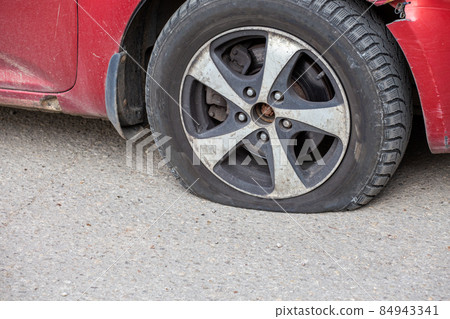

In automotive engineering:
-
High-performance tires can have static friction coefficients between 1.0 and 1.5
-
Racing slicks can exceed 1.7
This is how race cars corner at high speeds.
If the coefficient of friction could not exceed 1, Formula 1 cars wouldn’t function the way they do.
2. Rock Climbing Shoes



Climbing shoes are designed with ultra-soft rubber.
The coefficient of friction between climbing rubber and rock can exceed 1.2–1.4.
This allows climbers to:
-
Stand on tiny edges
-
Smear on vertical walls
-
Maintain grip under body weight
3. Rubber on Rubber
When two rubber surfaces interact:
-
Strong adhesion occurs
-
Deformation increases contact area
-
Friction may exceed 1
This is common in industrial rollers and conveyor systems.
4. Biological Surfaces
Certain animal footpads (like geckos) exhibit extremely high friction through microscopic adhesion mechanisms.
While this involves more than simple friction (van der Waals forces), effective friction values can exceed 1.
The Physics Behind High Friction Values
To fully understand how the coefficient of friction can be greater than 1, we must go deeper.
Classical Friction Model (Coulomb Friction)
The traditional model assumes:
Ff=μNF_f = \mu N
But this model simplifies reality.
It does not account for:
-
Surface deformation
-
Adhesion
-
Material bonding
-
Molecular attraction
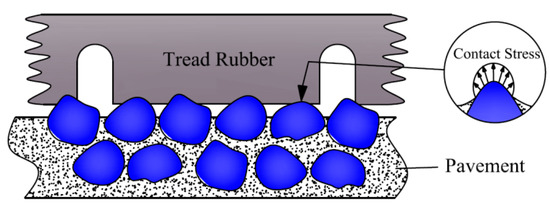
Adhesion + Deformation Theory
Real surfaces are not smooth.
Under pressure:
-
Microscopic peaks deform
-
Contact area increases
-
Molecular bonds form
-
Shearing force increases
This can produce:
Ff>NF_f > N
And therefore:
μ>1\mu > 1
Static vs Kinetic Friction Values
Static friction is usually higher.
| Type | Can It Be Greater Than 1? |
|---|---|
| Static friction | Yes (common in rubber systems) |
| Kinetic friction | Less common but possible |
Engineering Applications Where μ > 1 Is Desirable
Understanding whether the coefficient of friction can be greater than 1 is critical in engineering.
1. Automotive Braking Systems


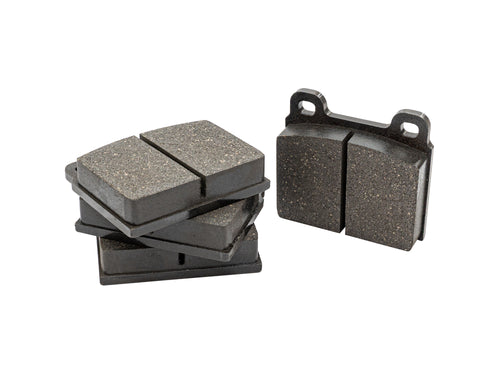
Brake pads are designed to maximize friction.
Higher friction means:
-
Shorter stopping distance
-
Better safety
-
Improved vehicle control
2. Industrial Belts and Pulleys
Conveyor systems rely on high friction to:
-
Prevent slippage
-
Maintain torque
-
Increase efficiency
3. Footwear Design
Athletic shoes are engineered for high grip.
Basketball and tennis shoes often exceed μ = 1 on appropriate surfaces.
Situations Where High Friction Is Dangerous
High friction is not always beneficial.
Risks Include:
-
Excessive wear
-
Heat generation
-
Energy loss
-
Material degradation
-
Sudden mechanical failure
In mechanical systems, designers often aim for controlled friction rather than maximum friction.
Comparison: Low vs High Friction Materials
| Material Pair | Typical μ |
|---|---|
| Ice on ice | 0.03 |
| Steel on steel | 0.6 |
| Wood on wood | 0.4 |
| Rubber on concrete | 1.0–1.5 |
| Climbing rubber on rock | >1.2 |
This clearly shows the coefficient of friction can be greater than 1.
Advanced Perspective (For Professionals)
In modern tribology (study of friction, wear, lubrication):
The classical model is considered incomplete.
Researchers analyze:
-
Contact mechanics
-
Surface roughness spectra
-
Viscoelastic behavior
-
Temperature-dependent friction
-
Time-dependent bonding
In soft materials like rubber:
Ff=Fadhesion+FdeformationF_f = F_{adhesion} + F_{deformation}
This additive mechanism explains why μ > 1 is physically realistic.
Frequently Asked Questions (People Also Ask)
1. Is it physically possible for coefficient of friction to exceed 1?
Yes. The coefficient of friction is a ratio of frictional force to normal force. If friction exceeds the normal force due to adhesion or deformation, the value becomes greater than 1.
2. Why do textbooks often show values less than 1?
Introductory physics uses rigid materials like metal and wood, which typically have friction coefficients below 1. High-friction materials like rubber are often not included in beginner examples.
3. Does μ > 1 violate Newton’s laws?
No. It does not violate any physical law. Newton’s laws govern forces and motion; they do not restrict force ratios.
4. Can kinetic friction be greater than 1?
Yes, but it is less common. Static friction is more likely to exceed 1.
5. What is the highest coefficient of friction ever measured?
Certain soft, adhesive polymers and biological systems have reported friction values exceeding 2 under controlled conditions.
External Authority References (Suggested)
For deeper reading:
-
Engineering tribology textbooks
-
SAE International automotive standards
-
Materials science journals
-
University physics research publications
(Recommended: Research from major institutions like MIT, Stanford, and mechanical engineering departments worldwide.)
Common Myths Debunked
Myth 1: Coefficient of friction must be between 0 and 1
False.
Myth 2: If μ > 1, the equation is wrong
False.
Myth 3: High friction means better performance in all systems
False. It depends on application.
Conclusion: The Definitive Answer
Yes, the coefficient of friction can be greater than 1.
It occurs in:
-
Rubber systems
-
Automotive tires
-
Climbing equipment
-
Soft polymers
-
Adhesive materials
It does not violate physics.
It does not break formulas.
It simply reflects strong surface interactions.
Actionable Takeaways
✔ The coefficient of friction is a ratio, not a capped value
✔ Static friction often exceeds kinetic friction
✔ High-grip materials frequently have μ > 1
✔ Engineers intentionally design systems with friction greater than 1
✔ Understanding real-world friction requires going beyond textbook simplifications
If you’re studying physics, designing mechanical systems, or preparing for exams, remember:
Physics doesn’t limit friction to 1 — assumptions do.