
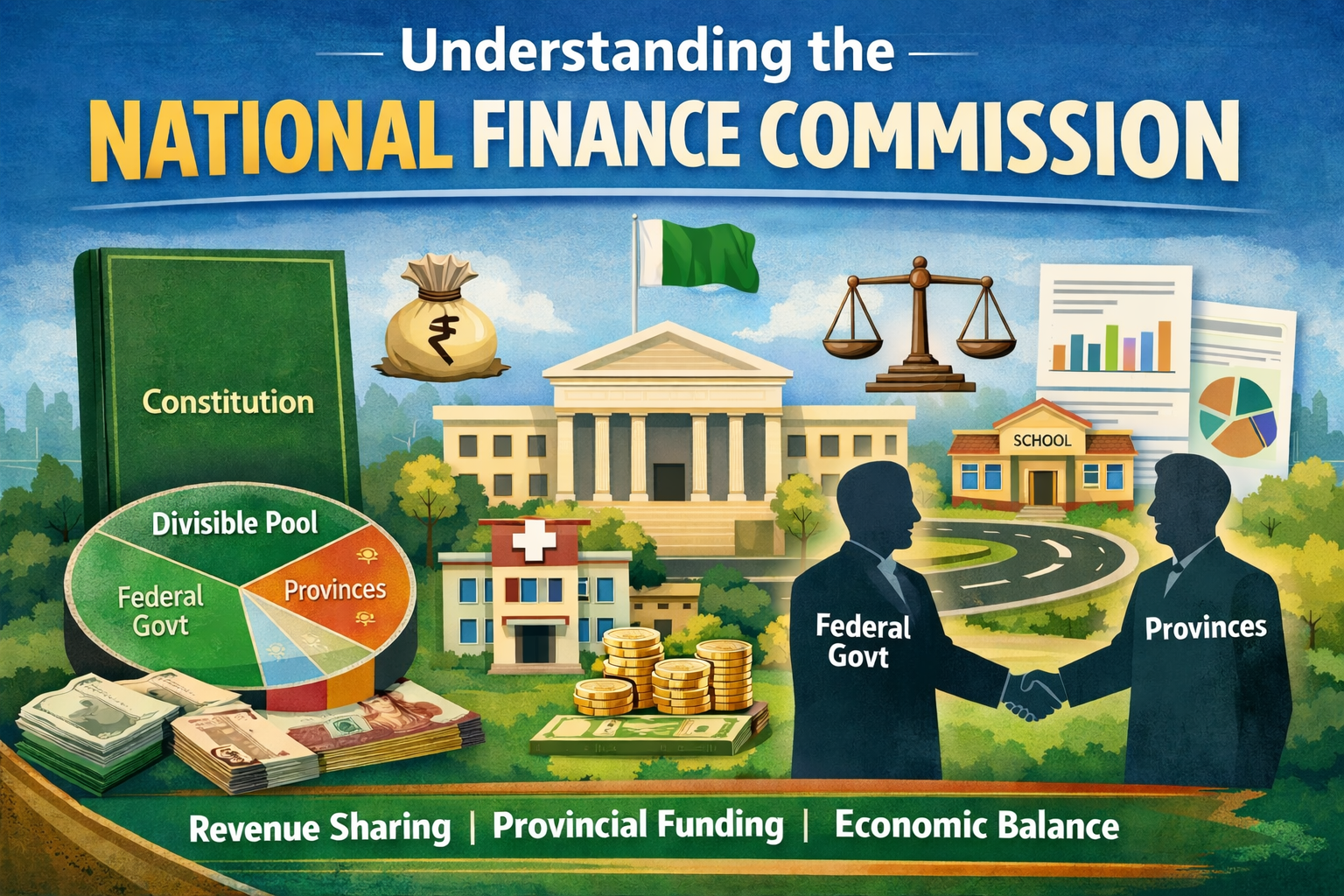

Introduction: Why the National Finance Commission Matters
If you’ve ever wondered how money is shared between the federal government and provinces, the answer lies in one powerful institution: the National Finance Commission (NFC).
From funding education, healthcare, infrastructure, and development projects to maintaining financial balance among provinces, the National Finance Commission plays a silent but decisive role in a country’s economic stability—especially in federal systems like Pakistan.
Yet, for many people, the term sounds technical, abstract, or purely political.
This guide breaks it all down—clearly, practically, and in plain language.
By the end of this article, you’ll understand:
-
What the National Finance Commission is
-
Why it exists
-
How it works
-
Who benefits from it
-
Its real-world impact
-
Criticism, challenges, and future reforms
Whether you’re a student, general reader, civil service aspirant, or policy enthusiast, this article covers everything from basics to advanced insights.
What Is the National Finance Commission?
Simple Definition
The National Finance Commission (NFC) is a constitutional body responsible for fairly distributing financial resources between the federal government and provincial governments.
In simpler words:
The National Finance Commission decides how national revenue is shared.
Technical Definition
The National Finance Commission is a constitutionally mandated commission that recommends the distribution of federal tax revenues (divisible pool) between:
-
The federal government, and
-
The provincial governments
These recommendations are issued in the form of an NFC Award.
Constitutional Basis of the National Finance Commission
The National Finance Commission derives its authority from the Constitution.
In Pakistan
-
Article 160 of the Constitution of Pakistan establishes the NFC.
-
It requires the formation of the commission every five years.
This constitutional backing gives NFC:
-
Legal authority
-
Political legitimacy
-
Financial enforcement power
Why Was the National Finance Commission Created?
Before the NFC, revenue distribution was:
-
Centralized
-
Politically biased
-
Inequitable
Core Reasons for Establishment
The National Finance Commission was created to:
-
Ensure fair resource distribution
-
Reduce inter-provincial inequality
-
Strengthen provincial autonomy
-
Promote fiscal federalism
-
Prevent financial exploitation of smaller regions
In short, NFC exists to balance power and money in a federation.
Objectives of the National Finance Commission
The main objectives of the National Finance Commission include:
-
Fair division of financial resources
-
Economic equality among provinces
-
Strengthening local governance
-
Sustainable development funding
-
Fiscal discipline and accountability
What Is an NFC Award?
An NFC Award is the official financial formula issued by the National Finance Commission.
What Does an NFC Award Decide?
It determines:
-
How much money goes to the federation
-
How much goes to provinces
-
How provincial shares are divided
Each award usually remains valid for 5 years.
Divisible Pool: The Heart of NFC
What Is the Divisible Pool?
The divisible pool is the total amount of federal tax revenue that is shared.
It includes:
-
Income tax
-
Sales tax
-
Customs duty
-
Federal excise duty
How Is the Divisible Pool Shared?
Typically:
-
A percentage goes to the federal government
-
The remaining portion is distributed among provinces
Criteria Used by the National Finance Commission
Earlier NFC awards relied only on population, but modern awards use multiple indicators.
Common Distribution Criteria
| Criterion | Purpose |
|---|---|
| Population | Basic needs |
| Poverty | Backwardness compensation |
| Revenue generation | Economic contribution |
| Inverse population density | Area disadvantage |
| Development needs | Infrastructure gap |
This multi-factor approach promotes equity over equality.
Composition of the National Finance Commission
The NFC includes:
-
Federal Finance Minister (Chairperson)
-
Provincial Finance Ministers
-
Federal economic experts
-
Provincial representatives
This ensures shared decision-making.
How the National Finance Commission Works (Step-by-Step)
-
Commission is constituted
-
Data is collected from provinces
-
Negotiations take place
-
Economic models are applied
-
Consensus or voting occurs
-
NFC Award is announced
-
Implementation begins
The 7th NFC Award: A Landmark Decision
The 7th NFC Award is widely considered historic.
Why?
-
Provinces received 57.5% share
-
Federal share reduced
-
Poverty and backwardness recognized
-
Balochistan gained special grants
This award strengthened provincial autonomy after the 18th Constitutional Amendment.
Benefits of the National Finance Commission
1. Strengthens Federalism
Encourages power-sharing between center and provinces.
2. Promotes Balanced Development
Backward areas receive more funds.
3. Improves Service Delivery
Provinces can fund education, health, and infrastructure.
4. Reduces Political Conflict
Transparent formulas reduce disputes.
Real-World Example of NFC Impact
After increased NFC shares:
-
Provinces expanded healthcare budgets
-
Education spending rose
-
Local development projects increased
-
Social safety nets improved
Challenges Faced by the National Finance Commission
Despite its importance, NFC faces challenges:
-
Political disagreements
-
Data accuracy issues
-
Federal fiscal pressure
-
Delayed awards
-
Weak implementation
Criticism of the National Finance Commission
Common criticisms include:
-
Over-reliance on population
-
Insufficient performance incentives
-
Federal government financial strain
-
Lack of transparency
National Finance Commission vs Finance Commission (India)
| Aspect | NFC (Pakistan) | Finance Commission (India) |
|---|---|---|
| Frequency | 5 years | 5 years |
| Constitution | Article 160 | Article 280 |
| Approach | Consensus-based | Expert-driven |
| Autonomy | Moderate | High |
Role of NFC in Fiscal Federalism
Fiscal federalism means:
Sharing taxing and spending powers across government levels.
NFC is the backbone of fiscal federalism.
Featured Snippet: One-Line Answer
The National Finance Commission is a constitutional body that determines how federal tax revenues are distributed between the central and provincial governments.
FAQs – People Also Ask (Schema-Ready)
What is the main function of the National Finance Commission?
The main function of the National Finance Commission is to recommend the fair distribution of federal revenues between the federal government and provinces.
How often is the NFC Award announced?
The NFC Award is constitutionally required to be announced every five years.
Why is the National Finance Commission important?
It ensures financial fairness, strengthens provincial autonomy, and promotes balanced national development.
Who chairs the National Finance Commission?
The Federal Finance Minister usually chairs the National Finance Commission.
What taxes are included in the divisible pool?
Income tax, sales tax, customs duty, and federal excise duty are included.
Conclusion: Why the National Finance Commission Shapes the Nation
The National Finance Commission is not just a financial mechanism—it’s a pillar of democracy, equity, and national unity.
By ensuring fair revenue distribution:
-
Provinces gain autonomy
-
Citizens receive better services
-
Economic disparities reduce
Key Takeaways
-
NFC ensures fair revenue sharing
-
NFC Awards define financial balance
-
It strengthens federalism
-
Continuous reform is essential
Understanding the National Finance Commission helps you understand how a country truly functions behind the scenes.