
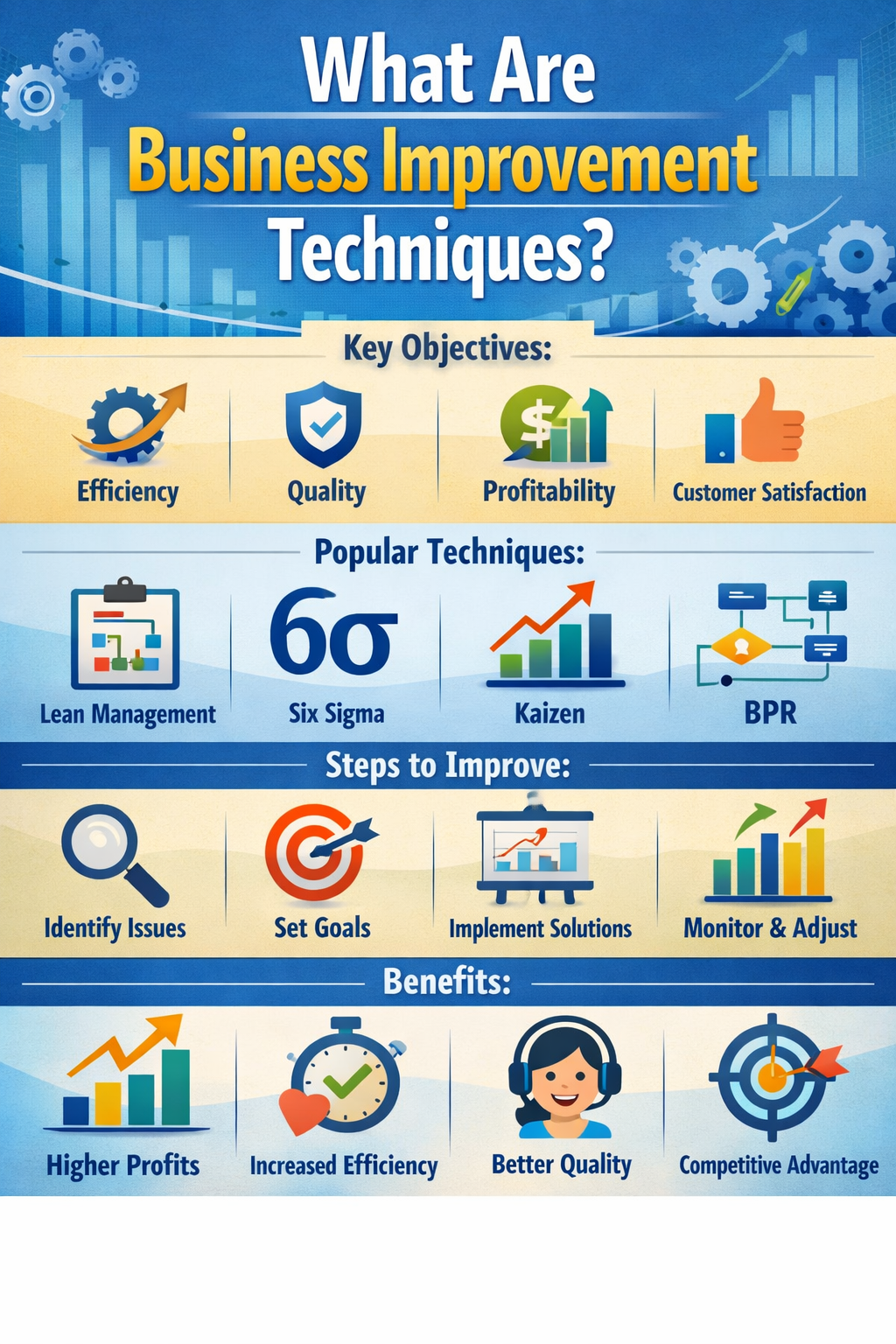

What Are Business Improvement Techniques?
Business improvement techniques are structured methods, strategies, and tools used by organizations to enhance performance, reduce inefficiencies, increase productivity, improve quality, and drive growth.
At their core, these techniques focus on:
-
Improving processes
-
Enhancing operational efficiency
-
Increasing customer satisfaction
-
Reducing costs
-
Strengthening competitive advantage
Think of them as systematic approaches to making a business better — not randomly, but intentionally and measurably.
Featured Snippet Definition
Business improvement techniques are systematic methods used by organizations to analyze, optimize, and enhance processes, performance, and overall efficiency to achieve better business outcomes.
Why Business Improvement Techniques Matter
Modern businesses operate in:
-
Highly competitive markets
-
Rapidly changing environments
-
Digital-first economies
-
Customer-driven ecosystems
Without structured improvement, companies face:
-
Wasted resources
-
Slow processes
-
Declining customer loyalty
-
Reduced profitability
According to research from McKinsey & Company, organizations that actively invest in structured improvement programs see significantly higher operational efficiency and long-term growth rates compared to those that don’t.
In short: improvement isn’t optional — it’s strategic survival.
Core Objectives of Business Improvement Techniques
| Objective | Description |
|---|---|
| Efficiency | Do more with fewer resources |
| Quality | Reduce errors and defects |
| Profitability | Increase margins and ROI |
| Customer Experience | Improve satisfaction and loyalty |
| Agility | Adapt faster to change |
| Innovation | Encourage continuous development |
Types of Business Improvement Techniques
Business improvement techniques can be categorized into several major frameworks. Below are the most widely adopted methods globally.
1. Lean Management
What Is Lean?
Lean focuses on eliminating waste while maximizing value.
Originally developed by Toyota, Lean aims to:
-
Reduce unnecessary steps
-
Eliminate defects
-
Streamline workflows
8 Types of Waste (Lean Framework)
-
Overproduction
-
Waiting
-
Transport
-
Over-processing
-
Inventory excess
-
Motion waste
-
Defects
-
Underutilized talent
Real Example
A manufacturing company reduces production time by 30% after mapping its process and eliminating redundant quality checks.
2. Six Sigma
What Is Six Sigma?
Six Sigma is a data-driven business improvement technique focused on reducing variation and defects.
It uses the DMAIC framework:
-
Define
-
Measure
-
Analyze
-
Improve
-
Control
Goal
Achieve no more than 3.4 defects per million opportunities.
Example
A telecom company uses Six Sigma to reduce customer complaint resolution time by 45%.
3. Continuous Improvement (Kaizen)
Kaizen means “continuous change for better.”
Instead of large transformations, it promotes:
-
Small incremental improvements
-
Employee involvement
-
Ongoing optimization
Why It Works
Small improvements compound over time.
4. Total Quality Management (TQM)
TQM focuses on company-wide quality control.
Key principles:
-
Customer focus
-
Employee involvement
-
Process-centered approach
-
Integrated system
-
Strategic alignment
5. Business Process Reengineering (BPR)
BPR involves radically redesigning business processes for dramatic improvement.
Unlike Lean or Kaizen, which improve incrementally, BPR can:
-
Eliminate entire departments
-
Redesign workflows from scratch
-
Implement automation at scale
Example
A bank moves from manual loan approvals to fully automated digital systems, reducing approval time from 10 days to 24 hours.
6. Agile Methodology
Agile focuses on adaptability and fast iteration.
Primarily used in software development, but now applied across industries.
Core elements:
-
Short development cycles (sprints)
-
Continuous feedback
-
Rapid testing
7. Benchmarking
Benchmarking compares your business performance against:
-
Industry leaders
-
Competitors
-
Best practices
This technique identifies gaps and improvement opportunities.
8. SWOT Analysis
A strategic planning tool used to evaluate:
-
Strengths
-
Weaknesses
-
Opportunities
-
Threats
While simple, SWOT helps guide strategic improvement decisions.
How to Implement Business Improvement Techniques (Step-by-Step)
Improvement fails when it lacks structure. Here’s a proven roadmap:
Step 1: Identify the Problem
Ask:
-
Where are inefficiencies?
-
What do customers complain about?
-
Which processes take too long?
Use data, not assumptions.
Step 2: Set Clear Goals
Make goals SMART:
-
Specific
-
Measurable
-
Achievable
-
Relevant
-
Time-bound
Example: Reduce production cost by 15% in 6 months.
Step 3: Choose the Right Technique
Not all techniques fit all problems.
| Problem Type | Best Technique |
|---|---|
| High defect rates | Six Sigma |
| Workflow inefficiency | Lean |
| Slow innovation | Agile |
| Major operational redesign | BPR |
| Ongoing optimization | Kaizen |
Step 4: Train Employees
Improvement fails without team buy-in.
Invest in:
-
Workshops
-
Certifications
-
Internal champions
Step 5: Measure and Monitor
Track KPIs:
-
Cost per unit
-
Customer satisfaction score
-
Process cycle time
-
Employee productivity
Step 6: Adjust and Scale
Continuous monitoring ensures sustainability.
Benefits of Business Improvement Techniques
Implementing business improvement techniques leads to:
1. Increased Efficiency
Less waste, faster processes.
2. Higher Profit Margins
Reduced operational costs.
3. Better Customer Experience
Improved quality and faster service.
4. Stronger Competitive Position
Ability to outperform competitors.
5. Employee Engagement
Clear systems reduce frustration.
Risks and Challenges
While powerful, business improvement techniques also come with risks:
-
Resistance to change
-
Poor implementation
-
Over-complex frameworks
-
Lack of leadership support
-
Short-term focus
Pro Tip: Start small. Scale gradually.
Real-World Case Studies
Amazon
Uses continuous improvement and data-driven optimization to reduce delivery times and enhance logistics.
Toyota
Pioneer of Lean manufacturing, achieving global leadership in production efficiency.
General Electric
Successfully implemented Six Sigma, reportedly saving billions in operational costs.
Business Improvement Techniques for Small Businesses
Small businesses don’t need complex systems.
Start with:
-
Process mapping
-
Customer feedback surveys
-
Cost tracking
-
Weekly performance reviews
-
Simple Lean principles
Even basic improvements can increase profits by 10–25%.
Advanced Strategies for Professionals
For larger organizations:
-
Digital transformation integration
-
AI-driven analytics
-
Predictive performance modeling
-
Enterprise resource planning optimization
-
Cross-functional Kaizen programs
Tools That Support Business Improvement
Popular tools include:
-
Trello / Asana (workflow tracking)
-
Tableau / Power BI (data visualization)
-
Minitab (Six Sigma analysis)
-
ERP systems
-
CRM software
Comparison of Major Business Improvement Techniques
| Technique | Focus | Speed | Best For |
|---|---|---|---|
| Lean | Waste reduction | Medium | Operations |
| Six Sigma | Quality control | Medium | Manufacturing |
| Kaizen | Continuous change | Slow but steady | All industries |
| BPR | Radical redesign | Fast | Large transformations |
| Agile | Flexibility | Fast | Tech & startups |
How to Choose the Right Business Improvement Technique
Ask:
-
What is the core issue?
-
Do we need gradual or radical change?
-
Do we have data?
-
Is leadership committed?
-
Do employees support the change?
Improvement isn’t about copying competitors — it’s about solving your specific bottlenecks.
Frequently Asked Questions (People Also Ask)
What are business improvement techniques in simple words?
Business improvement techniques are structured methods businesses use to make their processes more efficient, reduce costs, improve quality, and increase overall performance.
Why are business improvement techniques important?
They help companies stay competitive, increase profits, improve customer satisfaction, and adapt to market changes.
What is the best business improvement technique?
There is no single best method. Lean, Six Sigma, Agile, and Kaizen each serve different purposes depending on the business challenge.
Are business improvement techniques only for large companies?
No. Small businesses can benefit significantly from simple improvement strategies like process mapping and continuous feedback loops.
How long does it take to see results?
Small improvements may show results within weeks. Larger transformations can take several months to years.
Actionable Takeaways
If you remember only five things:
-
Business improvement techniques are systematic, not random.
-
Choose the method that matches your specific problem.
-
Use data to guide decisions.
-
Involve employees early.
-
Improvement is continuous, not one-time.
Final Thoughts
Understanding what business improvement techniques are is only the beginning.
The real advantage comes from applying them consistently and strategically.
Businesses that thrive in competitive markets don’t rely on luck. They rely on structured improvement, data-backed decisions, and continuous optimization.
Whether you’re running a startup, managing a department, or leading an enterprise, improvement is not a one-time initiative — it’s a mindset.
Start small. Measure everything. Improve continuously.
That’s how sustainable growth happens.