












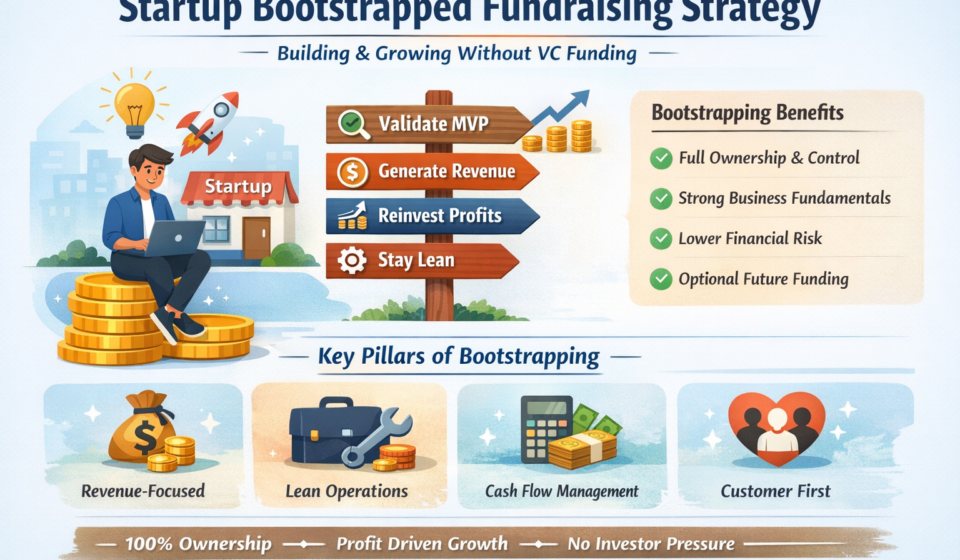

Introduction: Why Bootstrapped Fundraising Matters More Than Ever
In today’s startup ecosystem, venture capital often feels like the default path. Pitch decks, demo days, angel rounds—it’s everywhere. But quietly, and increasingly powerfully, many of the world’s most resilient startups are choosing a different route: bootstrapped fundraising.
A startup bootstrapped fundraising strategy focuses on building and scaling a company using internal resources—revenue, founder savings, and operational efficiency—rather than relying heavily on external investors.
This approach isn’t about avoiding growth. It’s about owning growth.
With tighter VC markets, higher interest rates, and increased scrutiny on profitability, bootstrapping has shifted from a “last option” to a strategic advantage.
This guide covers everything—from beginner fundamentals to advanced execution—so you can decide if bootstrapped fundraising is right for your startup and how to do it properly.
What Is a Startup Bootstrapped Fundraising Strategy?
Simple Definition
A bootstrapped fundraising strategy means funding your startup primarily through:
-
Founder’s personal savings
-
Early customer revenue
-
Reinvested profits
-
Minimal or no external investment
Instead of raising money upfront, founders focus on building a revenue-generating business early.
How It’s Different From Traditional Fundraising
| Aspect | Bootstrapped Strategy | VC-Funded Strategy |
|---|---|---|
| Capital source | Revenue & savings | Investors |
| Ownership | 100% (or near) | Diluted |
| Growth pace | Sustainable | Aggressive |
| Control | Founder-led | Investor-influenced |
| Risk | Lower burn rate | High burn pressure |
Bootstrapping doesn’t mean “small thinking.” It means disciplined thinking.
Why Startups Choose Bootstrapped Fundraising
1. Full Ownership & Control
Founders maintain decision-making authority—no board pressure, no forced pivots.
2. Stronger Business Fundamentals
Bootstrapped startups must:
-
Solve real problems
-
Monetize early
-
Retain customers
This naturally builds product-market fit.
3. Lower Financial Risk
Without massive cash burn, startups:
-
Survive market downturns better
-
Avoid sudden shutdowns
-
Scale responsibly
4. Optionality for the Future
Many bootstrapped startups raise later—on better terms.
Bootstrapping doesn’t eliminate fundraising. It delays it until you’re powerful.
Who Should Use a Bootstrapped Fundraising Strategy?
Bootstrapping works best for:
-
SaaS startups
-
Service-based startups
-
Fintech & B2B tools
-
Content-driven platforms
-
Indie founders & solopreneurs
It’s especially powerful if:
-
You can launch an MVP cheaply
-
Customers pay early
-
Growth can be organic or SEO-driven
The Core Pillars of a Bootstrapped Fundraising Strategy
1. Revenue-First Mindset
Revenue is your primary fuel.
Key focus areas:
-
Paid pilots
-
Early subscriptions
-
Pre-sales
-
Consulting-to-product transitions
2. Lean Operations
Bootstrapped startups operate with:
-
Small teams
-
Remote work
-
Open-source tools
-
Automation-first processes
3. Smart Cash Flow Management
Cash flow replaces fundraising rounds.
Best practices:
-
Monthly runway tracking
-
Conservative hiring
-
Fixed vs variable cost optimization
Step-by-Step: How to Build a Bootstrapped Fundraising Strategy
Step 1: Validate the Problem (Before Writing Code)
Ask:
-
Who has this problem?
-
How are they solving it now?
-
Will they pay immediately?
Tools:
-
Customer interviews
-
Landing pages
-
Paid waitlists
Step 2: Launch a Revenue-Generating MVP
Your MVP should:
-
Solve one painful problem
-
Be fast to build
-
Be sellable, not perfect
💡 Tip: A paying customer is better than 1,000 free users.
Step 3: Reinvest Profits Aggressively
Bootstrapped growth relies on:
-
Reinvesting revenue
-
Scaling what works
-
Killing what doesn’t
Common reinvestment areas:
-
SEO & content marketing
-
Customer success
-
Product improvements
Step 4: Use Non-Dilutive Funding (Smartly)
Bootstrapped doesn’t mean zero funding.
Options include:
-
Revenue-based financing
-
Government grants
-
Startup competitions
-
Customer prepayments
These preserve ownership while increasing runway.
Bootstrapped Fundraising vs Venture Capital: A Strategic Comparison
When Bootstrapping Wins
-
Niche markets
-
Predictable revenue
-
Founder-led vision
-
Long-term profitability goals
When VC Makes Sense
-
Capital-intensive products
-
Network-effect businesses
-
Winner-takes-all markets
Many successful startups follow a hybrid model:
Bootstrap → Prove traction → Raise selectively
Real-World Examples of Bootstrapped Success
Basecamp
-
Fully bootstrapped
-
Profitable for years
-
No VC pressure
-
Strong brand loyalty
Mailchimp
-
Bootstrapped for nearly 20 years
-
Sold for ~$12 billion
-
Founders retained control until exit
Zoho
-
No VC funding
-
Global SaaS powerhouse
-
Profitable, founder-driven growth
These companies prove that capital efficiency beats capital excess.
Common Risks of Bootstrapped Fundraising (And How to Manage Them)
Risk 1: Slower Growth
Solution:
Focus on high-ROI channels like SEO, partnerships, and referrals.
Risk 2: Founder Burnout
Solution:
Automate early, outsource non-core tasks, protect mental health.
Risk 3: Limited Market Reach
Solution:
Niche down, dominate one segment, then expand.
Advanced Bootstrapped Fundraising Tactics
SEO as a Growth Engine
Bootstrapped startups thrive on organic traffic.
Best SEO assets:
-
Long-form guides
-
Comparison articles
-
Problem-solution content
-
Programmatic SEO (when ready)
Community-Led Growth
Build:
-
Email lists
-
Slack/Discord groups
-
Founder-led communities
Trust compounds faster than ads.
Strategic Partnerships
Instead of spending money:
-
Co-market
-
Bundle offers
-
Integrate with larger platforms
Bootstrapped Metrics That Matter
Track what keeps you alive—not vanity metrics.
Key KPIs:
-
Monthly Recurring Revenue (MRR)
-
Customer Acquisition Cost (CAC)
-
Customer Lifetime Value (LTV)
-
Churn rate
-
Cash runway
Featured Snippet: Bootstrapped Fundraising Explained
What is a startup bootstrapped fundraising strategy?
A startup bootstrapped fundraising strategy is a method of growing a business using internal resources like founder savings and customer revenue instead of relying on external investors or venture capital.
FAQs: People Also Ask (Schema-Ready)
Is bootstrapped fundraising good for startups?
Yes, bootstrapped fundraising is ideal for startups that want full ownership, sustainable growth, and early profitability without investor pressure.
Can a bootstrapped startup scale big?
Absolutely. Companies like Mailchimp and Zoho scaled globally without venture capital by reinvesting profits strategically.
How long can a startup stay bootstrapped?
A startup can remain bootstrapped indefinitely as long as it maintains positive cash flow and controlled expenses.
Do bootstrapped startups ever raise funding?
Yes, many bootstrap early and raise later at higher valuations with better terms.
What industries work best for bootstrapping?
SaaS, fintech tools, content platforms, consulting, and digital services work exceptionally well.
Internal Linking Suggestions
-
Link to: Startup MVP development guide
-
Link to: SEO growth strategy for startups
-
Link to: Cash flow management for founders
External Authority References
-
Harvard Business Review (bootstrapping & capital efficiency)
-
Y Combinator founder essays
-
Stripe Atlas startup resources
-
Small Business Administration (SBA)
Final Thoughts: Bootstrapping Is a Power Move
A startup bootstrapped fundraising strategy isn’t about rejecting investors—it’s about earning leverage.
When you bootstrap:
-
You build real value
-
You understand customers deeply
-
You grow on your terms
In an era where capital is cautious and profitability matters again, bootstrapping is no longer the underdog strategy—it’s the smart founder’s advantage.
Actionable Takeaways
-
Start with revenue, not slides
-
Keep operations lean
-
Reinvest profits intentionally
-
Use SEO and partnerships for growth
-
Raise capital only when it strengthens—not controls—you
If you build a business that customers love and pay for, funding becomes optional—and that’s real freedom.