









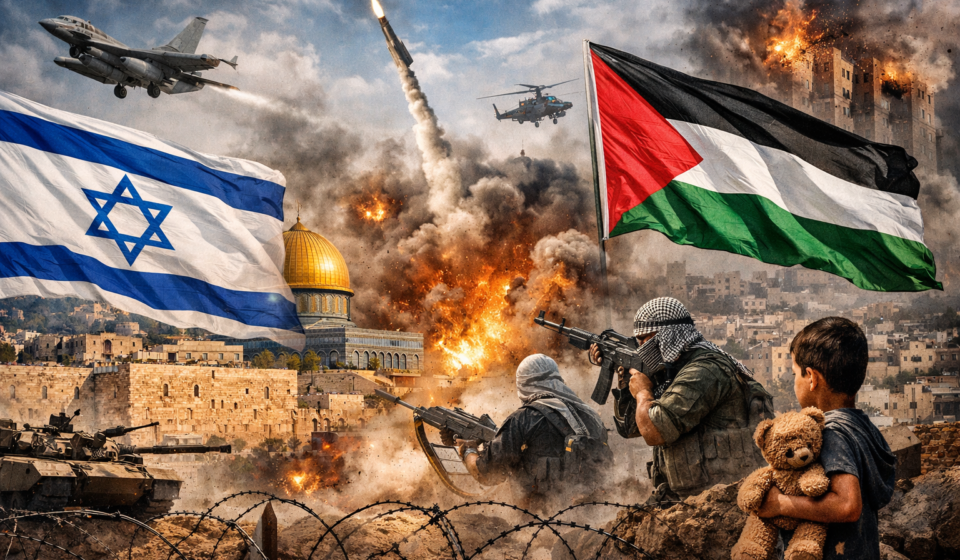

Israel-Palestine War Explained: History, Causes, Timeline & Future
The Israel-Palestine war is one of the most complex and longest-running geopolitical conflicts in modern history. For more than a century, tensions between Israelis and Palestinians have shaped politics, security, and diplomacy in the Middle East.
From historical disputes over land to modern geopolitical alliances, the conflict has evolved through wars, uprisings, peace negotiations, and humanitarian crises. Today, the issue remains central to global diplomacy and international security.
This guide explains the Israel-Palestine war in simple, clear terms, covering its origins, major events, causes, impacts, and possible future outcomes.
What Is the Israel-Palestine War?
The Israel-Palestine war, often called the Israel-Palestine conflict, refers to the ongoing political and military struggle between Israelis and Palestinians.
On one side is the State of Israel. On the other side are Palestinians, mainly represented by the Palestinian Authority and organizations such as Hamas.
At its core, the conflict revolves around several major issues:
-
Control of land and territory
-
National identity and independence
-
Religious significance of Jerusalem
-
Security concerns
-
Refugees and human rights
Both Israelis and Palestinians claim the same land as their historic homeland, making the conflict particularly difficult to resolve.
Why the Conflict Matters Globally
The Israel-Palestine war is not just a regional issue. It influences global politics, diplomacy, and security.
Key global impacts include:
| Area | Impact |
|---|---|
| Regional stability | Influences Middle East politics |
| International relations | Involves the US, Europe, Russia, and Arab countries |
| Humanitarian concerns | Millions affected by war and displacement |
| Security risks | Linked to extremism and terrorism debates |
| Global diplomacy | A major topic in international negotiations |
Because of these factors, the conflict is widely considered one of the most sensitive geopolitical issues in the world.
Historical Background of the Conflict
To understand the Israel-Palestine war, it is important to look at its historical roots.
Before the early 20th century, the region known as Palestine was part of the Ottoman Empire. The population consisted mostly of Arab Muslims and Christians, along with smaller Jewish communities.
Large-scale conflict was rare during this time, although tensions occasionally existed between communities.
The Balfour Declaration and Its Impact
In 1917, during World War I, Britain issued the Balfour Declaration. The declaration supported the establishment of a Jewish national home in Palestine.
This policy dramatically changed the political situation in the region. Jewish immigration to Palestine increased, while Arab residents feared losing political and territorial control.
The tension between these two national movements laid the foundation for future conflict.
British Rule and Rising Tensions (1920–1948)
After World War I, Britain governed Palestine under a mandate from the League of Nations.
During this period:
-
Jewish immigration grew significantly
-
Arab nationalism strengthened
-
Violent clashes occurred between communities
Britain struggled to manage the growing tensions. By the late 1940s, the situation had become unstable and increasingly violent.
Creation of Israel in 1948
In 1947, the United Nations proposed dividing Palestine into two states:
-
A Jewish state
-
An Arab state
Jerusalem was supposed to remain under international control.
Jewish leaders accepted the plan, but Arab leaders rejected it. When Israel declared independence in 1948, several Arab countries launched a military attack.
This marked the beginning of the first Arab-Israeli war.
Consequences of the 1948 War
Israel ultimately won the war and expanded its territory beyond the UN partition plan.
The war also created a major refugee crisis. Around 700,000 Palestinians fled or were forced to leave their homes.
Palestinians refer to this event as Nakba, which means catastrophe.
The refugee issue remains one of the most important unresolved aspects of the conflict today.
Major Wars That Shaped the Conflict
Several large-scale wars changed the political and territorial situation.
One of the most significant was the Six-Day War in 1967. During this conflict, Israel captured several territories including the Gaza Strip, West Bank, East Jerusalem, Sinai Peninsula, and Golan Heights.
The occupation of Palestinian territories that began in 1967 remains a central issue in negotiations today.
Another major conflict was the Yom Kippur War in 1973, when Egypt and Syria attacked Israel in an attempt to regain lost territory.
Although Israel ultimately survived the attack, the war reshaped regional politics and later helped lead to the Egypt-Israel peace agreement in 1979.
Rise of Palestinian National Movements
Over time, Palestinians organized political movements to pursue independence.
One major organization was the Palestine Liberation Organization (PLO), founded in 1964. The PLO aimed to represent Palestinians internationally and advocate for a Palestinian state.
Later, another group emerged called Hamas. Founded in 1987 during the First Intifada, Hamas combined political leadership with armed resistance.
Today Hamas governs the Gaza Strip.
The Intifadas: Palestinian Uprisings
Two major uprisings significantly intensified the conflict.
The First Intifada (1987–1993) involved widespread protests, strikes, and clashes between Palestinians and Israeli forces.
The Second Intifada (2000–2005) was much more violent. It included suicide bombings, military operations, and heavy casualties on both sides.
These uprisings deeply affected public opinion and trust between Israelis and Palestinians.
The Gaza Strip and Modern Conflicts
The Gaza Strip is one of the most densely populated areas in the world, with more than two million residents.
Since 2007, Hamas has controlled Gaza. Israel and Egypt maintain strict border controls due to security concerns.
This situation has led to repeated wars between Israel and Hamas.
Major Gaza conflicts occurred in:
| Year | Event |
|---|---|
| 2008 | Gaza War |
| 2012 | Israel-Gaza conflict |
| 2014 | Gaza war |
| 2021 | Israel-Hamas escalation |
| 2023 | Large-scale war |
Each conflict caused severe destruction and humanitarian challenges.
Main Causes of the Israel-Palestine War
Several overlapping issues continue to fuel the conflict.
Territorial disputes
Both sides claim key areas such as Jerusalem, the West Bank, and Gaza.
Religious significance
Jerusalem contains sacred sites for Jews, Muslims, and Christians, making control of the city extremely sensitive.
Security concerns
Israel emphasizes protection from attacks and rocket fire. Palestinians argue that occupation and restrictions create resistance.
Refugee crisis
Millions of Palestinian refugees still live in neighboring countries and camps.
Their right to return remains a major point of disagreement.
Humanitarian Impact of the Conflict
The Israel-Palestine war has caused enormous human suffering.
Major humanitarian effects include:
-
Thousands of civilian deaths
-
Destruction of homes and infrastructure
-
Limited access to healthcare and electricity
-
Economic hardship in Gaza and the West Bank
International aid organizations regularly provide assistance to affected populations.
Global Political Involvement
Many global powers are involved in the conflict.
The United States is Israel’s strongest ally and often plays a key role in negotiations.
Arab countries influence regional politics and sometimes support Palestinian causes.
The United Nations provides humanitarian aid and frequently proposes peace initiatives.
Peace Efforts and Diplomatic Attempts
Numerous peace initiatives have been attempted.
One of the most important was the Oslo Accords in 1993, which aimed to establish Palestinian self-governance and eventually create a Palestinian state.
Although the agreements created the Palestinian Authority, the peace process eventually stalled.
Possible Future Solutions
Several potential solutions are frequently discussed by policymakers.
The two-state solution proposes independent Israeli and Palestinian states living side by side.
The one-state solution suggests a single state where Israelis and Palestinians share equal citizenship.
Another possibility is continued conflict without a long-term settlement.
Comparison of Possible Peace Solutions
| Solution | Pros | Cons |
|---|---|---|
| Two-state solution | Recognizes both nations | Difficult border agreements |
| One-state solution | Shared governance | Political and demographic tensions |
| Confederation | Cooperative system | Complex implementation |
Example: The 2023 Escalation
In 2023, one of the most intense escalations occurred when Hamas launched large-scale attacks into Israel.
Israel responded with major military operations in Gaza.
The conflict caused thousands of casualties and massive displacement of civilians.
It quickly became a major international crisis.
Key Statistics About the Conflict
| Statistic | Estimate |
|---|---|
| Palestinian refugees | 5+ million |
| Gaza population | ~2.2 million |
| Duration of conflict | 100+ years |
| Major wars | More than 10 |
Frequently Asked Questions
What started the Israel-Palestine war?
The conflict began due to competing national claims over land in the early 20th century, particularly after the creation of Israel in 1948.
Why do Israel and Palestine fight?
The main reasons include disputes over territory, religious significance of land, national identity, and security concerns.
What is Gaza?
Gaza is a Palestinian territory governed by Hamas and frequently involved in conflicts with Israel.
What is the two-state solution?
It is a proposal to create two separate countries, Israel and Palestine, living side by side in peace.
Is peace possible?
Peace is possible but would require compromises on borders, security arrangements, refugees, and the status of Jerusalem.
Conclusion and Key Takeaways
The Israel-Palestine war is one of the most complicated geopolitical conflicts in the modern world. Its roots stretch back more than a century and involve deep historical, political, and religious dimensions.
Despite numerous wars and failed negotiations, the desire for peace remains strong among many people on both sides.
Understanding the historical background, causes, and potential solutions is essential for anyone seeking to grasp the realities of the conflict.
Key takeaways include:
-
The conflict centers on land, identity, and security
-
Historical events in the 20th century shaped modern tensions
-
Gaza and the West Bank remain central issues
-
International diplomacy plays a crucial role
-
Long-term peace requires compromise and political will
Only sustained dialogue, international cooperation, and mutual recognition can eventually bring lasting peace to the region.