




What Does “Arrange Numerically Perhaps” Mean in the NYT Crossword?
If you’ve been staring at your New York Times crossword puzzle and landed on the clue “arrange numerically, perhaps” — you’re not alone. This clue has tripped up beginners and seasoned solvers alike because it doesn’t ask for a number itself. It asks for an action that involves numbers.
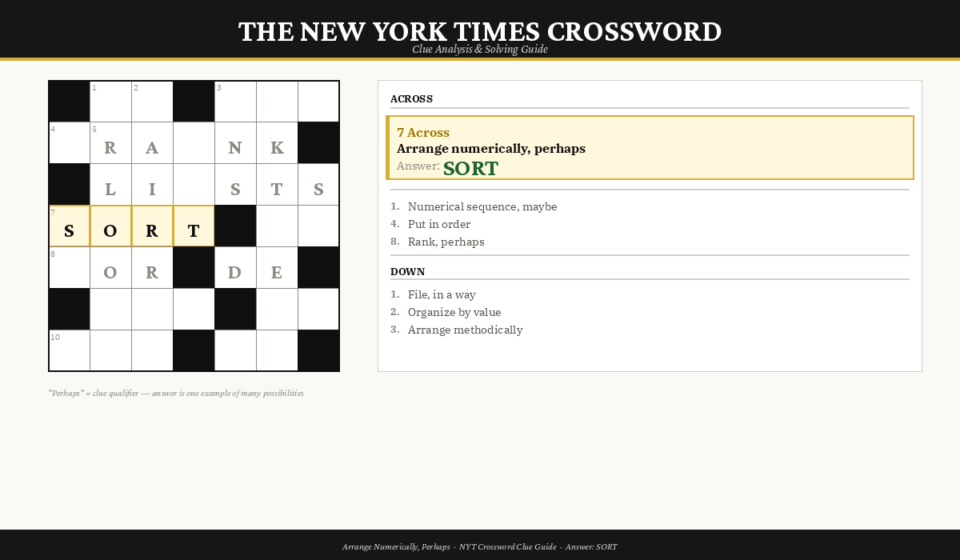
The most widely accepted answer for this clue is SORT — specifically, to sort items by number. The word “perhaps” is a softening qualifier, signaling that numerical sorting is just one possible way the action could be performed. You might also arrange things alphabetically, chronologically, or by size. Numerical order is merely one example — hence, “perhaps.”
This is classic NYT crossword wordplay. The puzzle editors, particularly under the long tenure of Will Shortz, love clues that are technically accurate but deliberately vague enough to mislead.
Let’s unpack not just the answer, but the full strategy behind solving clues like this — from total beginner to crossword enthusiast.
The Quick Answer
Clue: Arrange numerically, perhaps
Answer: SORT (4 letters) or RANK (4 letters), depending on the puzzle grid
Why: To “sort” or “rank” something can mean placing items in numerical order — but doesn’t have to. The “perhaps” makes it an example, not a definition.
Understanding NYT Crossword Clue Language
Why “Perhaps” Is a Clue Modifier You Must Notice
In NYT crossword puzzles, individual words carry enormous weight. Modifiers like perhaps, maybe, sometimes, for one, and say are not filler — they’re structural signals that change the type of answer you’re looking for.
When a clue reads “arrange numerically, perhaps,” it is telling you:
- The answer is something that can involve numbers, but doesn’t have to
- You’re not looking for a number itself
- You’re looking for a verb or concept that encompasses more than one method
This is different from a direct definitional clue like “put in order” (which would simply be SORT). The word “perhaps” opens it up to words like RANK, LIST, SORT, or even FILE — all valid depending on context and letter count.
Common NYT Qualifying Words and What They Signal
| Qualifier Word | What It Means in a Clue |
|---|---|
| Perhaps / Maybe | The answer is one example of a broader concept |
| For short | The answer is an abbreviation |
| Informally | The answer is a slang or casual term |
| In a way | Loose or metaphorical meaning |
| Say | The answer is an example of the category mentioned |
| Of a sort | Loosely fits the category |
| For one | The clue gives an example, not a definition |
Learning these qualifiers is one of the fastest ways to improve your crossword solving speed, because they fundamentally reframe what you’re searching for.
Breaking Down “Arrange Numerically, Perhaps” Step by Step
Step 1: Identify the Core Action
Strip away the qualifier. The raw clue becomes: “arrange numerically.”
Arranging numerically means placing things in numerical order — 1, 2, 3 or descending — like a ranked list, a sorted dataset, or a numbered sequence.
What’s a word that means to arrange? Common answers include:
- SORT
- RANK
- ORDER
- LIST
- FILE
- INDEX
Step 2: Apply the “Perhaps” Filter
The qualifier “perhaps” tells you the answer isn’t exclusively about numbers. SORT fits perfectly because you can sort things alphabetically, by size, by color, by date — or numerically. Sorting is the action, and numerical is just one way to do it.
RANK also fits well: you can rank things by score, by height, by importance — or by a number.
Step 3: Use the Letter Count
This is where the crossword grid becomes your best friend. If the answer is 4 letters, SORT and RANK are your primary candidates. If it’s 5 letters, consider ORDER. If it’s 6, consider LINEUP or SERIES.
The letter count narrows things down dramatically.
Step 4: Check Crossing Letters
Whatever crossing letters you’ve already filled in will confirm or eliminate candidates. If the second letter is an O, you’re almost certainly looking at SORT. If the first letter is R, consider RANK.
Why the NYT Crossword Uses This Type of Clue
The Philosophy of Misdirection
Will Shortz, the NYT crossword editor since 1993, is legendary for clues that lead solvers down one mental path while the answer lives somewhere else. “Arrange numerically, perhaps” sounds technical — almost mathematical — which makes solvers think of numerals, digits, or math operations.
But the answer is simply a common English verb: SORT or RANK.
This is intentional. The NYT crossword has four levels of difficulty (Monday through Thursday increasing, with Friday and Saturday being themeless and trickiest, and Sunday being large-grid), and clues like this one typically appear on Wednesday or Thursday, where misdirection becomes a core feature of the puzzle.
The Role of “Arrange” in Crossword Cluing
The word “arrange” is a powerhouse clue word because it has so many valid synonyms:
- Organize
- Sort
- Rank
- Order
- Set up
- Lay out
- File
- List
- Systematize
- Sequence
Crossword constructors love “arrange” because it unlocks dozens of possible short answers. Pair it with a qualifier like “numerically, perhaps” and you’ve created a clue that’s specific enough to point toward an answer, but vague enough to require real thought.
Similar NYT Crossword Clues Involving Numbers and Ordering
If you’ve seen “arrange numerically, perhaps,” you may have also encountered these related clues. Here’s a breakdown:
“Put in order”
Common Answer: SORT, RANK, ARRANGE
Why: Direct synonym for organizing. No qualifier needed.
“Numerical sequence, maybe”
Common Answer: LIST, SERIES, ORDER
Why: Similar to the original clue — “maybe” signals an example.
“Ranking system”
Common Answer: SCALE, TIER, GRADE
Why: A ranking system can be numerical or qualitative.
“Arrange by value”
Common Answer: SORT, RANK
Why: Value can be numerical or categorical.
“Sort of sort?”
Common Answer: RANK
Why: This is classic wordplay — asking for a synonym of “sort” while signaling it’s loose (“sort of”).
“Order, in a way”
Common Answer: SORT, RANK, FILE
Why: The “in a way” qualifier mirrors “perhaps” — it’s telling you the word is being used loosely.
How to Improve at Solving Clues Like This: Expert Strategies
Whether you’re picking up the NYT crossword for the first time or you’ve been solving for years and want to sharpen your game, these strategies will help you handle “arrange numerically, perhaps”-style clues with confidence.
Strategy 1: Build a Mental Library of Qualifier Words
As covered earlier, qualifier words change everything. Make a habit of noting them every time you solve:
- Perhaps / Maybe / Sometimes → The answer is an example
- In short / Briefly / For short → Abbreviation
- Var. / Var. → Variant spelling
- Hyph. → Hyphenated word
- 2 wds. → Two-word answer
- Abbr. → Abbreviated
- Slangily / Informally → Casual register
Once these become second nature, your brain starts processing clues faster.
Strategy 2: Think in Synonyms, Not Definitions
Crossword clues rarely give you a straight definition. They give you a synonym, a category, an example, or an analogy. Train yourself to immediately generate 3–5 synonyms for any key word in a clue.
For “arrange”: SORT, RANK, ORDER, FILE, LIST, PLACE, SET
For “numerically”: by number, in order, sequentially, cardinally
Cross-reference these lists and look for short, common English words.
Strategy 3: Use Letter Patterns Aggressively
Even before you have any crossing letters, the letter count tells you a lot:
- 3 letters: likely a common short word (SET, PUT, FIX)
- 4 letters: SORT, RANK, LIST, FILE, PILE
- 5 letters: ORDER, ARRAY, GRADE, PLACE
- 6 letters: LINEUP, SERIES, RANKUP
The moment you have even one crossing letter, your possibilities narrow sharply.
Strategy 4: Trust the “Aha” Moment
Experienced solvers describe the feeling of getting a tricky clue as a sudden “click” — where the answer just appears fully formed. This happens when your brain has processed enough surrounding context.
If you’re stuck on “arrange numerically, perhaps,” skip it. Come back after filling in nearby clues. Often the crossing letters will trigger that click immediately.
Strategy 5: Know Common Crossword-Friendly Words
Certain words appear in crossword puzzles far more often than their general frequency in English would suggest. This is because constructors need short words with common vowel-consonant patterns that fill grids cleanly.
High-frequency crossword words that relate to ordering/sorting:
- SORT, RANK, FILE, LIST, TIER, GRADE, SCALE, ARRAY, RANGE, ALIGN
Memorizing these as “crossword vocabulary” dramatically speeds up solving.
The Broader Concept: What Does It Actually Mean to “Arrange Numerically”?
Beyond the crossword, understanding the concept adds depth to your solving intuition. Arranging numerically is one of the most fundamental human organizing activities. Here’s what it looks like across different contexts:
In Everyday Life
- Organizing receipts by date (a form of numerical order)
- Lining up by height (a ranked order)
- Sorting songs by play count
- Ranking candidates by score on a test
In Technology and Data
When software engineers or data analysts “arrange numerically,” they use sorting algorithms — procedures that rearrange data into ascending or descending order. The most famous include:
- Bubble Sort – Repeatedly swapping adjacent items that are in the wrong order
- Quick Sort – Divides data around a pivot point for fast sorting
- Merge Sort – Splits data into halves and merges them in order
In spreadsheets, it’s as simple as clicking the “Sort A→Z” or “Sort smallest to largest” button.
In Language and Grammar
Words themselves can be arranged numerically — think of alphabetical index numbers (A=1, B=2, etc.) or numerical codes for characters in languages.
This conceptual breadth is exactly why “arrange numerically, perhaps” is such an effective crossword clue. The real-world concept is huge, but the answer is tiny.
NYT Crossword Quick Reference: SORT vs. RANK
Both SORT and RANK are extremely common NYT crossword answers. Here’s how to tell them apart from context:
| Feature | SORT | RANK |
|---|---|---|
| Letter count | 4 | 4 |
| Primary meaning | To categorize or separate by type | To place in a hierarchy or numbered list |
| Also means | A type or kind (noun) | A row or line; military grade |
| Common crossword clue types | “Put in order,” “categorize,” “organize” | “Put in order of importance,” “classify,” “rate” |
| Fits “arrange numerically, perhaps” | ✅ Yes | ✅ Yes |
When both fit letter-count-wise, check crossing letters. If the first letter is confirmed as S, go with SORT. If it’s R, go with RANK.
Frequently Asked Questions (People Also Ask)
What is the answer to “arrange numerically, perhaps” in the NYT crossword?
The most common answer is SORT (4 letters) or RANK (4 letters). The word “perhaps” indicates that numerical ordering is one possible method — the answer refers to an action that can, among other things, be performed numerically.
What does “perhaps” mean in a crossword clue?
In NYT crossword clues, “perhaps” signals that the answer is an example of the category described, not the category’s only definition. It tells solvers the answer fits loosely or is one possible interpretation, rather than an exact match.
How do you arrange things numerically?
To arrange something numerically means to place it in order by number — either ascending (1, 2, 3…) or descending (10, 9, 8…). This applies to data, ranked lists, numbered files, test scores, dates, prices, and any other measurable quantity.
What are common 4-letter NYT crossword answers meaning “put in order”?
The most frequent 4-letter answers for ordering/arranging clues include: SORT, RANK, FILE, LIST, and PILE. SORT and RANK are the most common for clues that include numerical or hierarchical language.
Is SORT or RANK more common in NYT crossword puzzles?
Both appear frequently. SORT tends to appear with clues about categorizing or separating, while RANK appears more often with clues involving hierarchy, importance, or grading. For “arrange numerically, perhaps,” either can be correct — the letter count and crossing answers determine which one fits.
Why does the NYT crossword use vague clues intentionally?
Vague or misdirecting clues are a feature, not a bug. They’re designed to test lateral thinking and vocabulary. Difficulty increases across the week, with Monday being the most straightforward and Saturday being the trickiest. Qualifier words like “perhaps” and “in a way” are tools constructors and editors use to add appropriate difficulty.
What are other clues similar to “arrange numerically, perhaps”?
Similar clues include: “put in order, say,” “rank, perhaps,” “organize by number, for instance,” “sort of order?” and “systematize, in a way.” All of these use qualifier language to signal that the answer fits loosely or is an example.
Advanced Insights: How Crossword Constructors Think About Clues Like This
For those who want to go beyond solving and understand the craft of puzzle construction, this section pulls back the curtain.
The Two-Step Clue Formula
Many NYT crossword clues follow an implicit formula:
- Define the word loosely or by example
- Add a qualifier to signal the looseness
“Arrange numerically, perhaps” = [verb meaning “put in numerical order”] + [qualifier signaling this is just one way]
This formula produces clues that are technically fair (you can verify the answer is correct) but cognitively challenging (it doesn’t feel like a definition at first).
Why Editors Love “Perhaps” and “Maybe”
These qualifiers do double duty. First, they make the clue accurate — a constructor could be sued for a factually incorrect clue, so qualifiers protect accuracy. Second, they add difficulty without changing the answer, which is the constructors’ goal on harder puzzle days.
The “Crossword Approved” Word List
Not every English word works in a crossword. Words must fit grid patterns, have common vowel placement, and be recognizable to a broad solving audience. SORT scores perfectly on all counts: it’s four letters, starts with a common consonant, has a central vowel, and ends with a common consonant. It fills cleanly into almost any grid configuration.
Tips for Beginners: Your First Week Solving NYT Crosswords
If “arrange numerically, perhaps” is the kind of clue that made you feel lost, here’s a week-one roadmap to build your skills rapidly.
Day 1–2: Start with Monday puzzles only. Monday NYT crosswords have the most direct clues. Build confidence before tackling harder days.
Day 3–4: Learn the qualifier words. Make a list of every qualifier word you encounter and note what type of answer it preceded. This builds intuitive pattern recognition fast.
Day 5–6: Solve in pencil. Erasing and revising is how you learn. Don’t be precious about wrong answers — each correction teaches you something.
Day 7: Review your wrong answers. Look up the clues you missed. Understanding why an answer was correct trains your brain faster than moving on without reflection.
Conclusion: The Bigger Lesson Behind This Single Clue
“Arrange numerically, perhaps” is a beautifully constructed crossword clue precisely because it isn’t about math. It’s about language — specifically, about how a single qualifier word (“perhaps”) transforms a specific technical-sounding clue into something intentionally broad.
The answer — SORT or RANK — is simple, common, and only four letters. But getting there requires you to recognize the qualifier, think in synonyms, leverage the letter count, and trust crossing answers.
That’s the whole game of crossword solving in miniature.
Actionable Takeaways:
- The answer to “arrange numerically, perhaps” is most commonly SORT or RANK — check your letter count and crossings to confirm
- Always note qualifier words like “perhaps,” “maybe,” “in a way,” and “say” — they change how you interpret a clue
- Build a mental vocabulary of common 4-letter crossword answers for ordering/arranging concepts
- Practice by starting with Monday NYT puzzles and working toward harder days progressively
- When stuck, skip a clue and return after filling in nearby answers — crossing letters often solve the problem for you
The NYT crossword rewards patience, vocabulary, and a willingness to think sideways. Once you crack clues like “arrange numerically, perhaps,” you’ll start seeing the puzzle’s logic everywhere — and solving will feel less like guessing and more like conversation with a very clever constructor.