













1. Introduction to Quant Finance
Financial markets today move at lightning speed. Millions of trades happen every second, driven not by human intuition alone, but by mathematical models, algorithms, and data.
This is where quant finance comes in.
If you’ve ever wondered:
-
How hedge funds predict market movements
-
Why trading algorithms beat humans
-
How risk is calculated for billions of dollars
-
Or how math and coding shape modern finance
Then this guide is for you.
Whether you’re a beginner, a finance student, or a working professional, this article explains what is quant finance, how it works, and why it dominates today’s financial world.
2. What Is Quant Finance? (Simple Explanation)
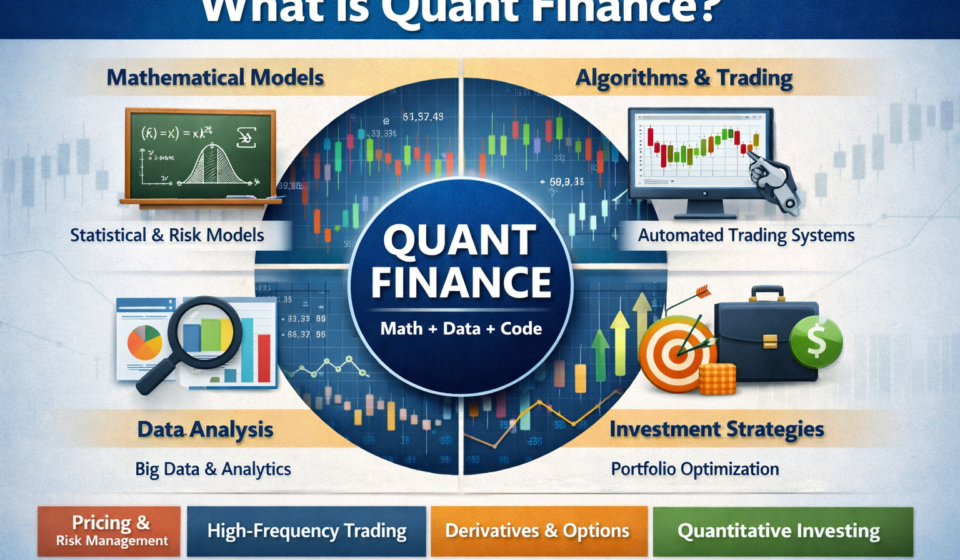
Quant finance, short for quantitative finance, is the use of mathematics, statistics, programming, and data analysis to solve financial problems.
In simple terms:
Quant finance uses numbers, models, and algorithms to make financial decisions.
Instead of relying on gut feelings or basic financial ratios, quants:
-
Build mathematical models
-
Analyze massive datasets
-
Automate trading and risk management
-
Predict probabilities instead of guessing outcomes
One-Line Definition
Quant finance applies mathematical and computational techniques to financial markets, pricing, risk management, and investment strategies.
3. Why Quant Finance Matters in Modern Markets
Quant finance is no longer optional — it’s essential.
Reasons It Matters:
-
Speed: Algorithms trade faster than humans
-
Accuracy: Models reduce emotional bias
-
Scale: Handles billions of data points
-
Risk Control: Predicts downside probabilities
-
Competitive Advantage: Used by hedge funds, banks, and fintech firms
Today, over 70% of US equity trading is driven by algorithms — a direct result of quantitative finance.
4. History and Evolution of Quantitative Finance
Quant finance didn’t appear overnight.
Key Milestones:
| Year | Development |
|---|---|
| 1900 | Louis Bachelier introduces stochastic finance |
| 1952 | Harry Markowitz develops Modern Portfolio Theory |
| 1973 | Black-Scholes option pricing model |
| 1990s | Rise of algorithmic trading |
| 2000s | High-frequency trading (HFT) |
| 2010s | Big data & machine learning |
| 2020s | AI-driven quantitative strategies |
Each step pushed finance further from intuition toward data-driven decision making.
5. How Quant Finance Works
To truly understand what is quant finance, you must know how it works step-by-step.
The Quant Workflow:
-
Identify a financial problem
-
Collect and clean data
-
Build mathematical models
-
Backtest strategies
-
Optimize parameters
-
Deploy in real markets
-
Monitor and refine
Everything revolves around probabilities, not predictions.
6. Core Components of Quant Finance
Quant finance is interdisciplinary.
Main Pillars:
-
Mathematics
-
Statistics
-
Computer Science
-
Finance Theory
-
Data Science
No single skill is enough — mastery comes from combining all five.
7. Key Mathematical Concepts Used in Quant Finance
Essential Math Topics:
-
Linear Algebra
-
Probability Theory
-
Stochastic Calculus
-
Differential Equations
-
Optimization Methods
-
Time Series Analysis
Example:
The Black-Scholes model uses partial differential equations to price options.
8. Programming Languages Used by Quants
Coding is non-negotiable in quant finance.
Most Popular Languages:
| Language | Use Case |
|---|---|
| Python | Data analysis, ML, prototyping |
| C++ | High-frequency trading |
| R | Statistical modeling |
| MATLAB | Financial modeling |
| SQL | Data management |
| Java | Enterprise trading systems |
Python dominates because of libraries like NumPy, Pandas, SciPy, TensorFlow.
9. Types of Quant Finance Roles
Quant finance isn’t one job — it’s many.
Common Quant Roles:
-
Quant Trader
-
Quant Researcher
-
Quant Developer
-
Risk Quant
-
Model Validation Quant
-
Machine Learning Quant
Each role blends finance, math, and coding differently.
10. Quant Finance vs Traditional Finance
| Aspect | Quant Finance | Traditional Finance |
|---|---|---|
| Decision Making | Data-driven | Intuition-driven |
| Tools | Algorithms, models | Spreadsheets |
| Speed | Automated | Manual |
| Risk | Quantified | Estimated |
| Bias | Low | High |
Traditional finance asks “What do I think?”
Quant finance asks “What does the data say?”
11. Real-World Examples of Quant Finance
Example 1: Algorithmic Trading
Hedge funds use models that execute thousands of trades per second.
Example 2: Option Pricing
Banks price derivatives using stochastic models.
Example 3: Risk Management
VaR (Value at Risk) models estimate worst-case losses.
Example 4: Portfolio Optimization
AI selects optimal asset weights for maximum return per risk unit.
12. Applications of Quant Finance
Quant finance is everywhere.
Major Applications:
-
Algorithmic trading
-
High-frequency trading
-
Portfolio optimization
-
Risk management
-
Derivative pricing
-
Credit scoring
-
Fraud detection
-
Robo-advisors
-
Cryptocurrency trading
13. Benefits of Quant Finance
Key Advantages:
-
Removes emotional bias
-
Handles massive data
-
Improves consistency
-
Enhances risk control
-
Scales globally
-
Enables automation
For institutions managing billions, these benefits are priceless.
14. Risks and Limitations
Quant finance is powerful — but not perfect.
Major Risks:
-
Model overfitting
-
Black swan events
-
Data quality issues
-
Over-automation
-
Systemic risk (e.g., 2008 crisis)
Models fail when reality breaks assumptions.
15. Quant Finance Career Path
Typical Path:
-
Strong math & coding foundation
-
Degree in finance, math, CS, or physics
-
Internships or research roles
-
Entry-level quant analyst
-
Senior quant / portfolio manager
16. Skills Required to Work in Quant Finance
Must-Have Skills:
-
Advanced mathematics
-
Python or C++
-
Statistics & probability
-
Financial instruments knowledge
-
Data analysis
-
Problem-solving mindset
Soft skills matter too: communication and teamwork.
17. Education & Certifications
Common Degrees:
-
Mathematics
-
Physics
-
Engineering
-
Computer Science
-
Financial Engineering
Certifications:
-
CFA (Chartered Financial Analyst)
-
CQF (Certificate in Quantitative Finance)
-
FRM (Financial Risk Manager)
18. Quant Finance Salaries (Global Overview)
Quant finance is among the highest-paying careers.
| Role | Average Salary |
|---|---|
| Entry-level Quant | $100k – $150k |
| Mid-level Quant | $200k – $350k |
| Senior Quant | $500k+ |
| Hedge Fund Partner | $1M+ |
Bonuses often exceed base salary.
19. Future of Quant Finance
The future is AI-driven.
Trends Shaping Quant Finance:
-
Machine learning models
-
Deep learning in trading
-
Alternative data (satellite, social media)
-
Quantum computing
-
Crypto & DeFi analytics
Quant finance will continue replacing manual finance roles.
20. FAQs (People Also Ask)
What is quant finance in simple words?
Quant finance uses math, statistics, and coding to make financial decisions based on data instead of emotions.
Is quant finance hard?
Yes, it’s challenging due to advanced math and programming, but highly rewarding.
Do quants need coding?
Absolutely. Coding is essential in quant finance.
Is quant finance a good career?
Yes. It offers high pay, intellectual challenge, and strong demand.
Can beginners learn quant finance?
Yes. Start with math basics, Python, and finance fundamentals.
21. Conclusion & Actionable Takeaways
Quant finance is the backbone of modern financial markets.
Key Takeaways:
-
Quant finance blends math, coding, and finance
-
It powers trading, risk management, and investment strategies
-
High demand and high salaries make it a top career
-
Beginners can start with Python and statistics
-
The future belongs to data-driven finance
Action Steps:
-
Learn Python and statistics
-
Study financial markets
-
Practice with real datasets
-
Build small trading models
-
Consider CQF or CFA
If you want a career where numbers shape decisions, quant finance is the path.