
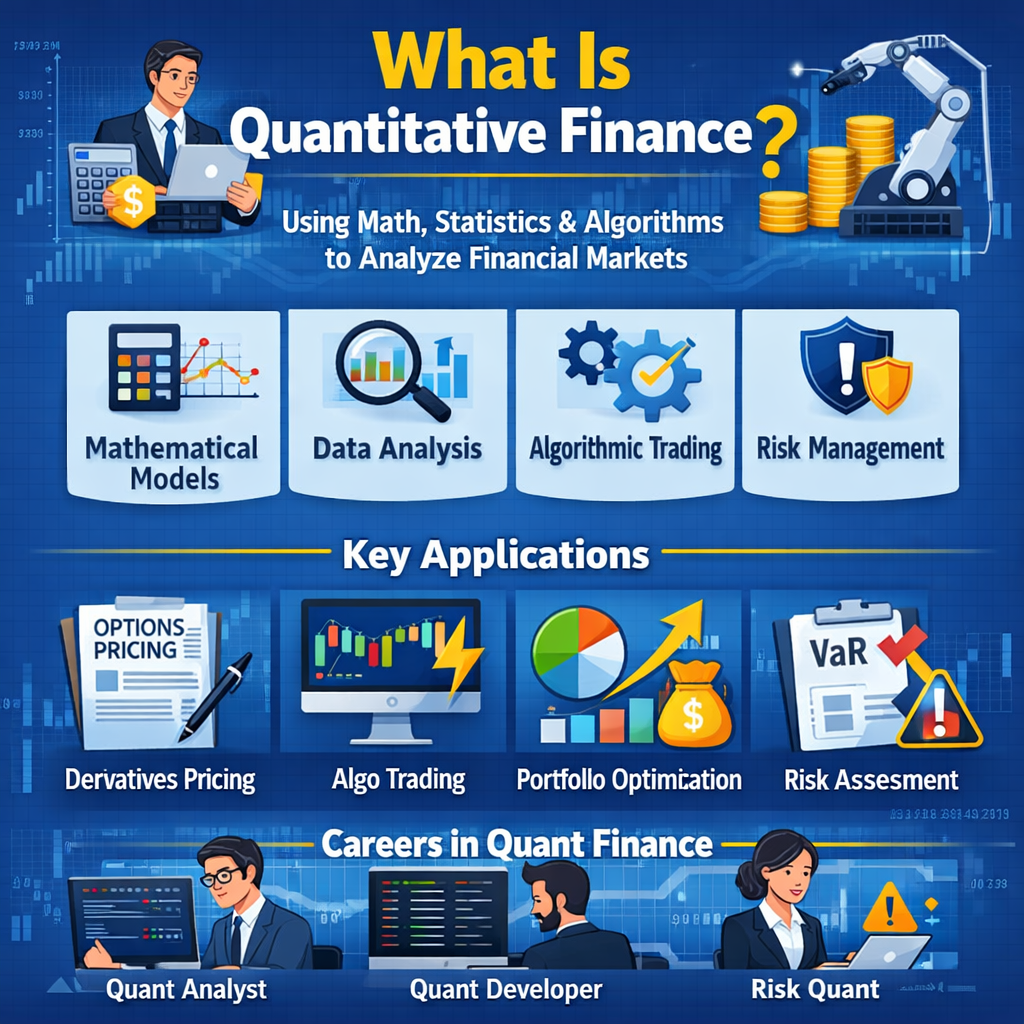

What Is Quantitative Finance?
Quantitative finance is the application of mathematics, statistics, programming, and data analysis to financial markets. It focuses on building models that help price assets, manage risk, optimize portfolios, and develop trading strategies.
In simple terms:
Quantitative finance uses numbers, algorithms, and data to make financial decisions.
Instead of relying on intuition or fundamental analysis alone, quantitative finance relies on measurable variables, probabilities, and mathematical modeling.
It is the backbone of modern:
-
Algorithmic trading
-
Risk management systems
-
Derivatives pricing
-
Portfolio optimization
-
High-frequency trading
-
Financial forecasting
Today, most major financial institutions, hedge funds, and fintech firms rely heavily on quantitative methods.
Quick Featured Snippet Answer
What is quantitative finance in one sentence?
Quantitative finance is a field that uses mathematical models, statistical analysis, and computer algorithms to analyze financial markets, price assets, and manage risk.
Why Quantitative Finance Matters Today
Financial markets are no longer driven solely by human traders shouting on exchange floors.
Instead:
-
Over 70% of U.S. equity trading volume is algorithm-driven.
-
Large hedge funds rely on data science and machine learning.
-
Risk modeling is mandatory for regulatory compliance.
Institutions like:
-
Goldman Sachs
-
JPMorgan Chase
-
Renaissance Technologies
employ teams of quantitative analysts (quants) to gain competitive advantages.
Without quantitative finance, modern derivatives markets and algorithmic trading systems simply wouldn’t exist.
The Core Components of Quantitative Finance
To truly understand what quantitative finance is, we need to break it into its building blocks.
1. Mathematics
Quantitative finance relies heavily on:
-
Calculus (especially stochastic calculus)
-
Linear algebra
-
Probability theory
-
Differential equations
-
Optimization methods
For example, option pricing models use partial differential equations.
2. Statistics & Probability
Financial markets are uncertain.
Quantitative finance models:
-
Volatility
-
Correlations
-
Risk distributions
-
Tail events
Concepts like:
-
Normal distribution
-
Monte Carlo simulations
-
Time-series analysis
are foundational.
3. Programming & Technology
Modern quants use:
-
Python
-
R
-
C++
-
MATLAB
-
SQL
Machine learning frameworks are increasingly used for predictive modeling.
Without computing power, quantitative finance would remain theoretical.
4. Financial Theory
Quantitative finance stands on the shoulders of major financial models, including:
-
Black-Scholes model
-
Capital Asset Pricing Model
-
Modern Portfolio Theory
These frameworks define how assets are priced and risk is managed.
A Brief History of Quantitative Finance
Quantitative methods in finance gained serious traction in the 1970s.
A major breakthrough came with the development of the:
-
Black-Scholes model
This model revolutionized options pricing and earned its creators a Nobel Prize in Economics.
Later developments included:
-
Portfolio optimization
-
Statistical arbitrage
-
High-frequency trading
-
Machine learning in finance
Today, quantitative finance integrates AI and big data into decision-making.
What Do Quantitative Analysts (Quants) Actually Do?
A quantitative analyst (quant) is a professional who builds mathematical models to solve financial problems.
Types of Quants
| Type | What They Do |
|---|---|
| Front Office Quant | Build trading models |
| Risk Quant | Model financial risk |
| Model Validation Quant | Test model reliability |
| Quant Developer | Implement models in production |
| Research Quant | Develop new strategies |
Daily Responsibilities
-
Building pricing models
-
Backtesting trading strategies
-
Risk simulations
-
Data cleaning and preprocessing
-
Algorithm optimization
-
Statistical research
Key Applications of Quantitative Finance
Let’s explore where quantitative finance is actually used.
1. Derivatives Pricing
Options, futures, swaps — these instruments are priced using mathematical models.
For example:
-
The Black-Scholes model calculates theoretical option prices.
Without quantitative finance, derivatives markets would collapse.
2. Algorithmic Trading
Algorithmic trading uses computer programs to execute trades automatically based on predefined criteria.
Strategies include:
-
Mean reversion
-
Momentum trading
-
Statistical arbitrage
-
Market making
Large quantitative hedge funds like Renaissance Technologies use highly sophisticated models.
3. Portfolio Optimization
Quantitative finance helps investors:
-
Minimize risk
-
Maximize returns
-
Diversify effectively
Based on Modern Portfolio Theory, investors can mathematically construct optimal portfolios.
4. Risk Management
Banks and financial institutions must measure:
-
Market risk
-
Credit risk
-
Liquidity risk
Metrics include:
-
Value at Risk (VaR)
-
Expected Shortfall
-
Stress Testing
5. High-Frequency Trading (HFT)
HFT firms use:
-
Microsecond execution speeds
-
Complex statistical models
-
Market microstructure analysis
This is pure quantitative finance in action.
Quantitative Finance vs Traditional Finance
| Feature | Quantitative Finance | Traditional Finance |
|---|---|---|
| Approach | Data-driven | Experience-based |
| Tools | Math, coding, models | Financial statements |
| Speed | Algorithmic | Human decision |
| Complexity | High | Moderate |
| Emotional Bias | Low | Higher |
Quantitative finance removes emotion and replaces it with probability.
Benefits of Quantitative Finance
1. Data-Driven Decisions
Reduces emotional bias.
2. Scalability
Algorithms can process millions of data points instantly.
3. Risk Control
Improves portfolio stability.
4. Competitive Edge
Institutional advantage in markets.
Risks & Limitations of Quantitative Finance
Despite its power, quantitative finance has risks.
1. Model Risk
Models can fail during extreme events.
Example: The 2008 financial crisis exposed flaws in risk models.
2. Overfitting
A strategy that works on historical data may fail live.
3. Black Swan Events
Rare, unpredictable events break assumptions.
4. Technology Risk
System failures can cause massive losses.
Real-World Example of Quantitative Finance
Imagine a hedge fund builds a momentum strategy:
-
It analyzes 20 years of stock data.
-
Identifies trends.
-
Uses statistical thresholds.
-
Automates buy/sell signals.
Backtesting shows a 15% annual return.
The model is deployed and trades autonomously.
That’s quantitative finance in action.
How to Get Started in Quantitative Finance
For Beginners:
Step 1: Learn Math Foundations
-
Probability
-
Linear algebra
-
Calculus
Step 2: Learn Programming
Start with Python.
Step 3: Study Financial Markets
Understand:
-
Stocks
-
Bonds
-
Derivatives
-
Risk metrics
Step 4: Build Projects
-
Backtest strategies
-
Simulate portfolios
-
Analyze datasets
Quantitative Finance Career Path
Education
Most quants hold degrees in:
-
Mathematics
-
Physics
-
Engineering
-
Computer Science
-
Financial Engineering
Many pursue a Master’s or PhD.
Salary Expectations
-
Entry-level quant: $90,000–$130,000
-
Mid-level: $150,000–$250,000
-
Senior/Hedge fund quant: $300,000+
Compensation often includes performance bonuses.
Quantitative Finance
Machine learning is transforming quantitative finance.
Applications include:
-
Fraud detection
-
Sentiment analysis
-
Predictive analytics
-
Alternative data modeling
Neural networks are now used alongside classical statistical methods.
Tools Used in Quantitative Finance
| Category | Tools |
|---|---|
| Programming | Python, C++, R |
| Data | Bloomberg, Refinitiv |
| Libraries | NumPy, Pandas, SciPy |
| ML | TensorFlow, PyTorch |
| Risk Systems | MATLAB |
Frequently Asked Questions (People Also Ask)
What is quantitative finance in simple words?
Quantitative finance is the use of math, statistics, and computer models to analyze financial markets and make investment decisions.
Is quantitative finance hard?
Yes. It requires strong skills in mathematics, statistics, and programming. However, beginners can start gradually.
Is quantitative finance the same as data science?
No. While both use data and statistics, quantitative finance focuses specifically on financial markets and risk modeling.
Do you need a PhD to become a quant?
Not always. Many front-office quants have advanced degrees, but strong skills and real projects can open doors.
External Authority References (Suggested)
-
Nobel Prize archives on option pricing
-
CFA Institute research papers
-
BIS (Bank for International Settlements) risk reports
-
Academic journals like the Journal of Finance
Final Thoughts: Should You Learn Quantitative Finance?
Quantitative finance is not just a niche specialty anymore.
It is:
-
The engine of modern financial markets
-
The foundation of algorithmic trading
Deeper Dive: History Timeline, Quant Workflow & Certifications
History Milestones of Quantitative Finance
- 1900 — Louis Bachelier introduces stochastic finance
- 1952 — Harry Markowitz develops Modern Portfolio Theory
- 1973 — Black-Scholes option pricing model
- 1990s — Rise of algorithmic trading
- 2000s — High-frequency trading (HFT)
- 2010s — Big data & machine learning
- 2020s — AI-driven quantitative strategies
The Quant Workflow: From Idea to Live Trading
Everything in quant finance revolves around probabilities, not predictions. The standard workflow:
- Identify a financial problem
- Collect and clean data
- Build mathematical models
- Backtest strategies on historical data
- Optimize parameters
- Deploy in real markets
- Monitor and refine continuously
Programming Languages: What Each Is For
- Python — data analysis, machine learning, prototyping (dominates via NumPy, Pandas, SciPy, TensorFlow)
- C++ — high-frequency trading where microseconds matter
- R — statistical modeling
- MATLAB — financial modeling
- SQL — data management
- Java — enterprise trading systems
More Applications: Beyond Trading
- Credit scoring — statistical models assess borrower risk
- Fraud detection — anomaly detection flags suspicious activity
- Robo-advisors — automated portfolio management for retail investors
- Cryptocurrency trading — quant strategies applied to digital assets and DeFi analytics
Certifications That Boost a Quant Career
- CFA (Chartered Financial Analyst) — broad finance credibility
- CQF (Certificate in Quantitative Finance) — specialized quant credential
- FRM (Financial Risk Manager) — risk-focused certification
-
A high-income, high-impact career path
-
A powerful tool for serious investors
But it requires:
-
Mathematical rigor
-
Coding discipline
-
Intellectual curiosity
-
Continuous learning
If you enjoy solving complex problems with data and logic, quantitative finance might be one of the most rewarding fields you can enter.
Going Deeper: Quantitative Finance Mastered
You do not need a PhD to start thinking like a quant. A practical first path is learning Python, basic statistics, and then backtesting a simple strategy on free historical data. Even a moving-average crossover backtest teaches the core quant loop: hypothesize, code, test, and measure. That loop matters more than any single credential.
Quantitative thinking also travels far beyond trading desks. The same models price insurance risk, detect credit-card fraud, optimize supply chains, and even guide sports analytics. Learning quant methods is therefore a portable skill: the math you use to model stock volatility today can model hospital admissions or ad clicks tomorrow.
Frequently Asked Questions
Do I need a PhD to work in quant finance?
Not always. Top research roles often want one, but quant developer, data analyst, and risk roles regularly hire strong bachelor’s and master’s graduates with solid math and coding skills.
What programming language should I learn first?
Python. Its libraries for data analysis and its huge finance community make it the default first language for aspiring quants, with C++ coming later for speed-critical roles.
Is quantitative finance only about trading?
No. Quants work in risk management, derivatives pricing, portfolio construction, fraud detection, and fintech product design. Trading is just the most visible application.
How much math is really required?
Comfort with probability, statistics, and linear algebra covers most roles. Calculus and stochastic processes matter for derivatives pricing, which you can learn on the job or through the CQF.
Related Guides
- How to Get Into Quant Finance – A step-by-step roadmap from student to first quant role.
- What Jobs Can You Get With a Finance Degree? – Where quant and traditional finance careers overlap.
- What Is TTM in Finance? – The rolling-window metrics that feed many quant datasets.
[…] What Is Quantitative Finance? – How quants use TTM-style rolling data in trading models and backtests. […]