
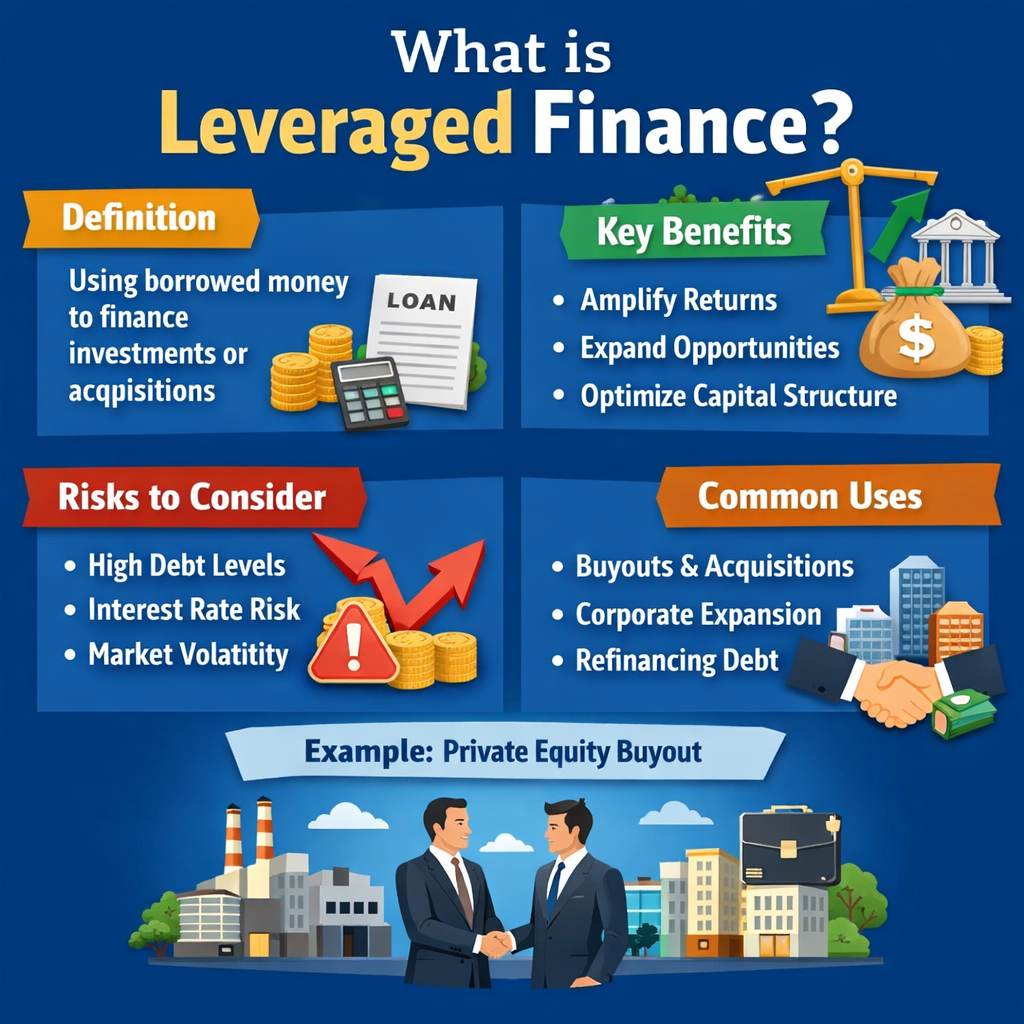

What Is Leveraged Finance? A Complete Guide for Beginners and Professionals
SEO Title: What Is Leveraged Finance? Explained for Beginners & Pros
Meta Description: Discover leveraged finance: meaning, benefits, risks, examples, and strategies from beginner to advanced level.
Suggested URL Slug: what-is-leveraged-finance
Introduction
Leveraged finance is a critical concept in corporate finance, investment banking, and private equity. It involves companies or investors using significant amounts of borrowed capital to increase the potential return on investment. This type of financing is widely used for acquisitions, buyouts, and restructuring deals.
Whether you are a beginner trying to understand corporate finance or a professional seeking deeper insights, this guide will cover leveraged finance comprehensively, including its definitions, uses, benefits, risks, and real-world examples.
Table of Contents
- Definition of Leveraged Finance
- Key Features of Leveraged Finance
- Types of Leveraged Finance
- Why Companies Use Leveraged Finance
- How Leveraged Finance Works
- Benefits of Leveraged Finance
- Risks and Challenges
- Real-World Examples
- Leveraged Finance vs Traditional Financing
- Careers in Leveraged Finance
- FAQs
- Conclusion & Key Takeaways
Definition of Leveraged Finance
Leveraged finance is the practice of funding business operations or acquisitions using debt that is significantly higher than the company’s equity. The main objective is to amplify returns on investment.
Focus Keyword: leveraged finance
Related Keywords: high-yield debt, mezzanine financing, LBO financing, corporate debt, acquisition finance
Simple Definition for Beginners
At its core, leveraged finance is borrowing money to invest in opportunities where the potential return exceeds the cost of debt. Think of it as a financial magnifying glass: it can make profits bigger, but it can also magnify losses.
Advanced Definition
In professional terms, leveraged finance typically refers to debt instruments such as high-yield bonds or leveraged loans issued to companies with higher leverage ratios, often with below-investment-grade credit ratings. These instruments carry higher interest rates due to the increased risk for lenders.
Key Features of Leveraged Finance
Understanding leveraged finance requires grasping its key characteristics:
- High Debt-to-Equity Ratio: Companies often use a debt-to-equity ratio exceeding industry norms.
- Substantial Interest Obligations: Interest rates are higher than standard corporate financing due to credit risk.
- Purpose-Driven Borrowing: Typically used for mergers, acquisitions, or refinancing.
- Risk-Return Tradeoff: Potential for high returns comes with higher financial risk.
| Feature | Description |
|---|---|
| Debt Intensity | High proportion of debt relative to equity |
| Cost of Capital | Higher than conventional debt due to risk |
| Use Cases | M&A, buyouts, recapitalizations |
| Credit Ratings | Often below investment grade |
Types of Leveraged Finance
Leveraged finance can take multiple forms, depending on the risk, structure, and borrower needs.
1. Leveraged Loans
These are loans provided to companies with significant debt. They are usually senior secured loans, meaning lenders have claims over the company’s assets.
2. High-Yield Bonds
Also called junk bonds, these are debt securities issued by companies with lower credit ratings. Investors demand higher returns due to increased risk.
3. Mezzanine Financing
A hybrid of debt and equity, mezzanine financing offers higher returns with subordinate claims. It is often used to fill the gap between senior debt and equity.
4. Bridge Loans
Short-term loans designed to provide temporary financing until permanent funding is arranged.
Why Companies Use Leveraged Finance
Companies often turn to leveraged finance to achieve strategic objectives:
- Fund Acquisitions or Buyouts: Allows companies to acquire competitors or complementary businesses.
- Capital Restructuring: Optimize the capital structure for tax benefits and improved cash flow.
- Expand Operations: Financing large-scale projects without diluting ownership.
- Enhance Returns: Using leverage can magnify returns for equity holders.
How Leveraged Finance Works
Leveraged finance works by combining debt and equity to fund transactions:
- Identify Target or Project: For instance, a company planning an acquisition.
- Determine Debt Capacity: Analyze cash flows and leverage ratios.
- Structure Financing: Decide mix of high-yield bonds, leveraged loans, and mezzanine financing.
- Execute Transaction: Debt is raised, acquisition or project is financed.
- Manage Repayment: Interest and principal repayment according to the structured terms.
Example: If a company wants to buy a $100M business and has $20M equity, it may raise $80M in leveraged finance. If the acquisition generates $15M in profit, leverage magnifies the return on the $20M equity.
Benefits of Leveraged Finance
Leveraged finance can provide significant advantages when used wisely:
- Amplified Returns: Maximizes equity returns.
- Access to Capital: Enables large transactions that equity alone cannot fund.
- Tax Benefits: Interest payments are tax-deductible in many jurisdictions.
- Flexibility: Various instruments (loans, bonds, mezzanine) provide financing options.
Risks and Challenges
With high rewards come high risks:
- Financial Risk: High debt can strain cash flow, leading to default.
- Market Risk: Economic downturns affect the ability to service debt.
- Covenant Restrictions: Borrowers must comply with restrictive terms imposed by lenders.
- Reputation Risk: Failed leveraged deals can damage credibility with investors and banks.
| Risk Type | Description |
| Default Risk | Inability to meet interest/principal obligations |
| Market Risk | Economic downturn impacts returns |
| Liquidity Risk | Difficulty in refinancing or selling debt |
| Covenant Breach | Violating terms may trigger penalties |
Real-World Examples
1. Leveraged Buyouts (LBOs)
Private equity firms often use leveraged finance to acquire companies, such as KKR’s acquisition of RJR Nabisco in the 1980s, a classic LBO example.
2. Corporate Acquisitions
Companies like Dell Technologies have used leveraged finance for strategic acquisitions to enhance growth and competitive advantage.
3. Project Financing
Infrastructure and energy projects often use leveraged loans and bonds to fund large-scale initiatives.
Leveraged Finance vs Traditional Financing
| Feature | Leveraged Finance | Traditional Financing |
| Debt Ratio | High | Low to moderate |
| Interest Rates | High | Low to moderate |
| Risk Level | High | Moderate to low |
| Typical Use | M&A, buyouts, recapitalizations | General operations, capital expenditure |
| Investor Profile | High-risk tolerance | Conservative investors |
Careers in Leveraged Finance
Leveraged finance offers lucrative career opportunities, especially in investment banking and private equity:
- Investment Banking Analyst/Associate – Structuring leveraged loans and bonds.
- Private Equity Professional – Using leverage to acquire and improve portfolio companies.
- Credit Analyst – Assessing risk of high-yield debt.
- Risk Manager – Mitigating financial exposure in leveraged transactions.
FAQs
Q1: What is the main purpose of leveraged finance?
A1: Leveraged finance is primarily used to fund acquisitions, buyouts, or large projects by using significant debt to enhance potential returns.
Q2: Is leveraged finance risky?
A2: Yes. High debt levels can strain cash flows and increase default risk, but careful structuring can mitigate risks.
Q3: Who typically uses leveraged finance?
A3: Corporations, private equity firms, and high-growth companies use leveraged finance for acquisitions, expansion, and restructuring.
Q4: What is the difference between leveraged loans and high-yield bonds?
A4: Leveraged loans are often senior secured with lower risk for lenders, while high-yield bonds are unsecured and carry higher interest rates due to greater risk.
Q5: Can beginners invest in leveraged finance products?
A5: While direct investment is usually reserved for institutions or accredited investors, ETFs and mutual funds targeting high-yield debt offer indirect exposure.
Conclusion & Key Takeaways
Leveraged finance is a powerful financial tool that enables companies and investors to achieve growth, fund acquisitions, and maximize returns. It offers high rewards but comes with equally significant risks. Understanding the mechanics, types, benefits, and challenges is essential for anyone working in finance or investing in corporate debt.
Actionable Takeaways:
- Always assess debt capacity and cash flow before using leverage.
- Diversify instruments to balance risk (loans, bonds, mezzanine).
- Keep track of market conditions, interest rates, and covenants.
- Use leveraged finance strategically, not excessively, to amplify returns.
Internal Linking Suggestions:
External References for Authority:
This comprehensive guide covers leveraged finance from beginner to advanced levels, providing both foundational understanding and professional insights suitable for Google ranking and satisfying user intent.